Category: Private Equity Technology

Altvia Connects Private Markets Data to the AI Tools Firms Already Use

FOR IMMEDIATE RELEASE

Altvia Connects Private Markets Data to the AI Tools Firms Already Use

Altvia Integration Platform Adds MCP Support Across Fundraising, Investor Relations, and Deal Sourcing Workflows

DENVER, Colorado, May, 14, 2026–Altvia, the engagement platform for alternative investment firms, today announced MCP support in the Altvia Integration Platform, connecting private markets data to the AI tools GP teams already use.

MCP is the open standard introduced by Anthropic in November 2024 and subsequently adopted by OpenAI, Google DeepMind, and Microsoft. It enables firms to use whichever AI tool their team already trusts and have it work directly against their live Altvia data. Support is now native across Claude, ChatGPT, Microsoft Copilot, Gemini, and other major AI platforms.

“The private markets are rapidly evolving their business models to successfully navigate the alternatives industry transformation,” said Ryan Keough, CEO, Altvia. “Our support for MCP gives teams governed access to their capital raise, investor relations, and deal sourcing data to surface trends, identify opportunities, and make faster, better-informed decisions without leaving their preferred AI tool. This launch is the first of several AI announcements we’ll be making this year as we continue to deepen the intelligence layer Altvia provides for alternative investment firms.”

Designed for Private Markets Workflows

This new addition to the Altvia Integration Platform makes the platform’s core workflows available as standardized MCP capabilities across three domains central to alternative investment operations:

Fund and Portfolio Data: Retrieve fund-level and portfolio-level information in the context of broader AI workflows.

Fundraising and Investor Relations: Query LP contact history, track commitment activity, surface relationship context, and prepare for investor meetings without leaving your  preferred AI tool.

Deal Sourcing: Access pipeline data, deal stage history, and sourcing activity through natural language, enabling faster origination research and deal review.

About Altvia

Altvia is the engagement platform for alternative investment firms. Founded in 2006, Altvia provides General Partner teams with workflow solutions for fundraising, investor relations, deal sourcing, and reporting. Trusted by hundreds of private equity, venture capital, private credit, and real assets firms, Altvia helps teams deepen relationships, move faster, and operate with clarity across the fund lifecycle. Learn more at visit altvia.com.

Media Contact
Annie Eissler
CMO
annie@altvia.com

The Secondary Market Has Come of Age

Private equity has always rewarded patient capital. What it couldn’t always offer was a credible path to liquidity before a fund wound down. That’s changed with GP-led secondaries, continuation vehicles, and structured liquidity solutions which have matured from tactical workarounds into a strategic layer of the alternatives market.

Secondaries make the asset class more functional, more accessible, and more attractive to a broader range of investors. The GPs who understand how to use them will carry a distinct advantage into every fundraise they run.

What Changed, and Why It Matters Now

Secondary market activity has grown into one of the most dynamic segments of private capital, driven by two forces that reinforce each other. 

  1. LP expectations around liquidity have shifted: institutional investors who receive real-time marks and daily attribution across their public portfolios are now making explicit comparisons to the ten-year lockup in a closed-end fund, and directing capital toward GPs who close the gap. 
  2. At the same time, GPs have recognized that offering a credible liquidity path is a fundraising argument in its own right. LPs evaluating a new commitment increasingly factor in anticipated secondary market access alongside track record and investment thesis.

The Two Structures Worth Understanding

Not all secondary market activity looks the same, and the distinctions carry real operational implications.

  • LP-led secondaries are the oldest structure: an existing LP sells their fund interest to a secondary buyer. For GPs, this is largely a passive event, but one that requires operational readiness. Current data rooms, accurate NAV information, and an IR team capable of supporting buyer diligence without disrupting fund operations are table stakes. Firms whose data infrastructure isn’t organized for this kind of scrutiny find out quickly.
  • GP-led secondaries are where most of the structural innovation is happening. These transactions move assets from a fund approaching end-of-life into a new continuation vehicle, giving existing LPs the choice to exit at a fair price or roll their interest forward. Done well, this preserves value and extends the GP’s relationship with high-performing assets. Governance and pricing transparency are non-negotiable here. Conflict of interest concerns are real, and how a GP handles them shapes LP trust well beyond the transaction itself.

The Operational Implication GPs Are Underestimating

Every secondary transaction, regardless of structure, requires a GP to respond to institutional-grade diligence. Buyers want current portfolio data, detailed LP economics, side letter summaries, and clean documentation across the fund’s history. GPs whose records are fragmented across spreadsheets, shared drives, and institutional memory face a painful scramble every time a transaction surfaces.

But the operational burden starts well before a transaction closes. Managing a pipeline of secondary activity introduces its own layer of complexity that most mid-market GPs aren’t systematically tracking: monitoring asset-level exposures and buyer interest across multiple potential transactions simultaneously, managing bid processes with discipline, and maintaining a clear view of how underlying portfolio company exposures shift as secondary transactions progress. Without infrastructure built for this, GPs end up managing high-stakes processes through email threads and disconnected spreadsheets, which creates both operational risk and a credibility problem with sophisticated counterparties who can tell the difference.

This is the operational constraint that catches mid-market GPs off guard. The secondary market’s growth doesn’t just create opportunity, it raises the floor for what organized looks like. LPs who observe a disorganized GP response to a secondary process file that observation away. It shapes how they think about re-up decisions and how they describe the GP to their peers.

The firms building the infrastructure to manage this proactively with centralized LP data, current documentation, clear co-invest records, pipeline tracking with asset-level visibility, and real-time reporting capability are building the operational foundation that makes every LP interaction more credible.

Where This Is Heading

The parallels to public equity market development are instructive here. When block trading and alternative liquidity mechanisms entered institutional equity portfolio management, they didn’t replace the primary market. They made the asset class more functional for institutional capital at scale. Liquidity options reduced the friction of large allocations and opened the door to broader institutional participation.

The same dynamic is playing out in alternatives. Secondary market depth makes the asset class more accessible to a broader set of LPs, including the wealth channel now entering at scale. As vehicle structures and secondary market depth make alternatives more accessible, wealth channel capital is increasingly in play. RIAs, broker-dealers, and wealth platforms serving HNW individuals are actively building allocation infrastructure, per McKinsey’s 2025 asset management research, and liquidity optionality is part of what makes the commitment decision easier. Evergreen structures and interval funds already exploit this. Secondary market liquidity does the same work for closed-end vehicles.

Investment track records will always matter. But the GPs who define the next decade of private capital will be those who build an operational track record to match, one that demonstrates the capacity to serve a broader, more demanding investor base across the full fund lifecycle, including when those investors need a path to liquidity.


This post draws on themes developed in Alvia’s 2026 whitepaper, Massive Alternative Market Shift: Déjà Vu? which examines how the structural transformation of public equity markets previews where alternative investments are heading next. 

What LPs Actually Want From Your Investor Portal (And Why Most Firms Fall Short)

There is a version of an investor portal that most private equity IR teams are familiar with: a password-protected folder where quarterly PDFs live until an LP asks where they are, then you email them directly. It is functional in the same way a fax machine is functional. It works.

LP expectations have shifted structurally, not cyclically. The bar for what constitutes an acceptable investor experience in private markets has been reset, and the firms that understand this are using their portal as a competitive advantage. The firms that do not are quietly losing ground on re-ups and relationship quality without always knowing why.

Here is what the data shows, what LPs say they want, and where most GP portals fall short.

The gap between what GPs deliver and what LPs expect is widening

A Preqin survey found that 73% of LPs cite inconsistent reporting from managers as a significant challenge when investing in alternative assets. That number alone should give IR teams pause. Nearly three out of four limited partners have a meaningful frustration with how their GPs communicate with them and reporting is the primary channel through which that relationship is maintained. 

For more on the importance of reporting see our recent blog on reporting bottlenecks here.

The frustration is not simply about formatting. Sophisticated institutional LPs and increasingly savvy high-net-worth investors now expect continuous reporting and instant access to information. The quarterly PDF delivered 45 days after quarter-end is no longer the standard. It is the floor and for many LPs, it is already below the floor.

According to CSC’s Limited Partners Guide to Fund Operations, 68% of LPs now prioritize operational transparency over even performance track record. That is a remarkable inversion. LPs are telling the market that how you run the relationship matters as much as what you return.

What LPs actually want in a Portal

When you strip away the survey language and talk to IR teams who interact with LPs daily, three things come up consistently.

1. Self-service access to their own data

LPs do not want to email IR to find out their current NAV or distribution history. Many LPs now expect on-demand access to essential data, not just quarterly reports on unrealized value. A portal that requires a support request to answer a basic balance question is not a portal. It is a bottleneck with a login screen.

The self-service expectation extends beyond documents. LPs want to be able to filter by fund, by year, by entity, and see their capital account in real time (or close to it!). A modern investor portal should provide LPs with direct access to real-time or quarter-end fund and portfolio data, historical performance, capital activity, and supporting documentation, all in one place.

2. Dashboard-style reporting, not static documents

LP expectations now highlight a preference for secure digital portals with 24/7 access to information and dashboard-style reporting rather than static documents. This does not mean GPs need to build a Bloomberg terminal. It means LPs want to see their key metrics (IRR, TVPI, DPI, capital called, distributions) in a format they can actually interact with rather than a table buried in a PDF.

LPs want to understand the underlying drivers of performance, assess risk exposures in real time, and gain a deeper understanding of the operational aspects of portfolio companies. A static quarterly report answers none of those questions. A dynamic portal with drill-down capability does.

3. Proactive communication, not reactive delivery

The worst version of an LP portal is one that only activates when the GP remembers to upload something. That’s a document dump with a login screen. What LPs value is always-on access to current information they can pull themselves, on their own schedule, without having to request it from IR.

That shift — from GP-pushed documents to LP-driven self-service — is exactly what a modern portal makes possible. When live fund data, capital account history, and performance metrics are available on demand through a single login, the LP doesn’t need to wait for a quarterly email or chase down a statement. The information is there when they need it. That frees IR teams from fielding basic data requests and lets them focus on the relationship conversations that actually matter.

The fundraising implications are real

LPs are requesting bespoke reporting to meet regulatory or internal requirements, and GPs’ willingness to accommodate these requests varies depending on the operational burden. The firms with a modern portal infrastructure can accommodate these requests more broadly, while the firms without one will be deciding, one LP request at a time, whether the relationship is worth the manual effort.

This is not just an IR operations issue. Your reporting stack is now part of the due diligence process. Prospective investors are looking at how you communicate. They are assessing your operational sophistication. And they are comparing your platform against others they have used.

LP experience during the fund lifecycle directly affects fundraising outcomes on the next raise. A committed LP who feels well-served, well-informed, and genuinely cared for is more likely a re-up than a committed LP who spent two years chasing documents and never felt like a priority.

Diving deeper into the CSC report, not only do 68% of LPs surveyed stated they are focusing on operational transparency, but many LPs believe technology is a major differentiator when looking at competitor GPs. They expect technology that offers real-time data access, integrated systems, automated reporting, and strong cybersecurity.

Technology is now part of the GP selection criteria. Not as a box-checking exercise, but as a genuine signal of whether a firm will be easy or difficult for investors to back.

What separates a portal that works from one that just exists

What’s the difference between an investor portal that strengthens LP relationships and one that simply checks a compliance box? It comes down to three things: the data, the platform and the experience.

  • The data foundation. A portal is only as good as what goes into it. If fund admin data is not connected directly to the portal or if someone is manually uploading an Excel file every quarter then your portal is a document delivery tool, not an investor experience platform. A portal that pulls live data from fund accounting and administration systems ensures what LPs see is always current, but that’s only the beginning of the platform question.
  • The platform play. A portal disconnected from your CRM, VDR, and IR communication tools doesn’t just create extra work; it creates a fragmented experience for both the firm and its LPs. Your team is maintaining the same data in multiple places, and your LPs are logging into multiple systems. When something needs to be updated, it has to be updated everywhere, manually, by someone. A connected platform eliminates that.

    Read more about the advantages of one platform for private capital firms. 

When the CRM, the portal, the VDR, and IR communications run on a single system, data flows where it needs to go without anyone manually moving it. The LP sees a consistent, current picture of their relationship with your firm. Your IR team sees a complete record of every interaction, document, and communication in one place. That is not a technology preference. That is the operational foundation that makes a genuine LP experience possible at scale.

  • The experience. LPs are sophisticated consumers of technology in every other part of their professional and personal lives. A clunky login experience, confusing navigation, or documents organized in a way that makes no intuitive sense will not be tolerated with the same patience it once was. The bar for design and usability has been set by the platforms LPs use everywhere else.

How to know if it’s working.

The clearest measure of a portal’s effectiveness is what happens to inbound LP communication after it goes live. If IR teams are still fielding the same volume of “can you send me my K-1” emails six months after implementation, the portal is not working. A well-designed portal should materially reduce ad hoc requests by making the answer self-evident.

The bottom line

LP expectations around the investor portal are not aspirational. They are current. The firms that invest in building a genuine digital experience for their limited partners, one that gives them real-time access, self-service capability, and proactive communication, are using that investment as a fundraising differentiator. The firms that treat the portal as a document archive are handing their competitors an advantage every quarter.

The question for IR teams is not whether to upgrade the LP experience. It is how much runway you have left before that decision gets made for you.


Altvia’s IR Operations workflow provides a connected LP portal and CRM built directly into the Altvia platform, giving IR teams a single system to manage documents, data access, and investor communications across the full fund lifecycle. To see how it works, request a demo.
From Headaches to High Performance: What IR Leaders Learned at the PEI IR Member Meeting

At the recent PEI IR Member Meeting, investor relations professionals came together to compare notes on what’s working—and what’s not—as they navigate another year of evolving LP expectations, data complexity, and pressure to fundraise faster.

Across three sessions, a clear theme emerged: the future of IR is digital, data-driven, and deeply human. Teams are learning how to modernize their systems and workflows without losing the trust and relationships at the heart of private capital.

Here are the biggest takeaways and how leading firms are turning common challenges into opportunities for efficiency, insight, and stronger LP relationships.


1. Turning Data Chaos into Clarity

Many IR leaders shared familiar frustrations: messy CRM data, disconnected systems, and difficulty getting a true picture of LP activity. Some teams have even switched CRMs in search of better usability, while others are investing heavily in cleanup projects between fundraises.

The lesson was simple: data quality is everything. A CRM is only as valuable as the information inside it—and without connected systems, firms can’t act quickly or confidently.

Modern IR teams are focusing on unifying data across platforms and automating the flow between CRM, accounting, and investor portals. The goal isn’t just clean data; it’s usable data that fuels better decisions, faster fundraising cycles, and more meaningful LP communication.

That’s where integrated platforms prove their worth—offering one connected source of truth and automation that eliminates manual errors and guesswork, while providing clarity for the entire firm.


2. Technology Should Strengthen Relationships, Not Replace Them

As AI and automation take center stage, IR professionals were quick to emphasize one truth: technology can make you faster, but relationships are still the currency of private capital.

The best-performing firms are using automation to enhance personalization, not diminish it. Tools like AI note summarization, contact mapping, and engagement tracking are helping teams anticipate LP needs and deliver more relevant updates.

For smaller teams, this shift is especially powerful—replacing hours of manual reporting with intelligent workflows that surface insights instantly. The freed-up time allows professionals to focus on what matters most: building and maintaining trust through consistent, transparent communication.

The roundtable discussions made it clear: digital infrastructure isn’t about replacing the human touch; it’s about scaling it.


3. Building the Infrastructure for Confident Growth

With so many new tools entering the market, firms are balancing innovation with caution. Security, compliance, and scalability are top of mind — especially as AI becomes embedded in CRM and investor communication workflows.

Participants stressed the importance of data stewardship and responsible automation. A well-governed system — one that can grow alongside the firm without sacrificing accuracy or oversight — has become a competitive differentiator.

The most forward-thinking IR teams are implementing flexible, secure systems that can handle multi-fund operations, new communication channels, and increasingly complex LP requirements. Their systems aren’t just functional; they’re future-ready, providing confidence that as the firm expands, its data and relationships remain protected.


Bridging the Digital and the Human

The takeaway from the PEI IR Roundtable wasn’t about adopting more technology—it was about adopting the right technology. The firms gaining ground are the ones connecting data, automating intelligently, and empowering their people to focus on relationships rather than administration.

When digital systems, automation, and human expertise work in harmony, IR becomes more than a back-office function—it becomes a strategic driver of growth, trust, and investor confidence.

That’s the new benchmark for investor relations—and it’s where the future of private capital is headed.


Learn how Altvia helps private capital firms unify data, strengthen LP trust, and scale growth.
👉 Request a Demo

Altvia Taps Industry Veteran Ryan Keough as CEO

FOR IMMEDIATE RELEASE

Altvia Taps Industry Veteran Ryan Keough as CEO

BROOMFIELD, COLORADO–July 21, 2025 Altvia, a leading private capital platform purpose-built for the full fund lifecycle, today announced the appointment of Ryan Keough as Chief Executive Officer. A seasoned fintech executive with over 20 years of experience driving global SaaS growth and operational leadership, Ryan will guide Altvia into its next phase of expansion and product innovation.

Keough brings a rich history of delivering exceptional client value and driving product innovation in the alternative investment community. Prior to joining Altvia, he held senior leadership roles at Allvue Systems, Finastra, and Misys, where he was instrumental in accelerating growth, enhancing product delivery, and strengthening customer success across global markets.

“I’m honored to lead Altvia at such a transformative moment for the industry,” said Keough. “Private capital firms are demanding smarter, faster, and more connected ways of working. Altvia’s technology is well positioned to meet that need. I’m excited to partner with our clients to drive innovation, expand our reach, and deliver exceptional value.”

“We’re thrilled to welcome Ryan as Altvia’s CEO,” said Nathan Pingelton of Marlin Equity Partners. “Ryan’s extensive leadership history and industry expertise align perfectly with Altvia’s mission to be the leader in equipping alternative investment firms with cutting-edge products and insights.”

About Altvia

Altvia, a leading platform powering private capital from raise to results, unifies fundraising, deal, and investor workflows into one intelligent operating system. Built on enterprise-grade technology and proprietary AI, Altvia helps top-tier firms move faster, engage smarter, and scale without limits. Trusted by hundreds of private equity, venture capital, and other alternative investment firms, Altvia pairs relentless innovation with deep industry expertise to make operational excellence feel effortless. For more information on Altvia, visit altvia.com.

Media Contact
Annie Eissler
CMO
annie@altvia.com

New Client Spotlight: Forest Investment Associates

We are thrilled to Welcome Forest Investment Associates to the Altvia Community.

Forest Investment Associates (FIA)—a global investment manager focused on sustainable forestry and natural capital—has selected Altvia as their enterprise platform for CRM, fundraising, investor communications, and Virtual Data Room.

Following a rigorous and competitive evaluation, FIA chose Altvia for our ability to:

  • Streamline global fundraising and investor engagement
  • Modernize their technology infrastructure and connect their whole firm
  • Deliver powerful reporting, dashboards, and data visibility
  • Support growth with flexibility, scalability, and ease of use

With a fully integrated solution, FIA is positioned to scale its impact–expanding access to sustainable investment strategies, enhancing transparency, and building deeper relationships with long-term partners.

In the words of MaryKate Bullen, Managing Director, Head of Business Development and Sustainability:

“Altvia stood out for its alignment with our investor-first mindset and ability to grow with us. As we expand our investment platform, technology like this helps us deliver on our promise of integrity, client service, and long-term value.”

We’re honored to support FIA’s mission and proud to power the people behind purpose-driven capital.

Welcome aboard, FIA!

Schedule a Demo ➔

You’ll be amazed at what Altvia can do for you and your team. Let’s talk and see how we can help. 


AI Without the BS: Purpose-Built for Private Capital Teams

We’re tired of the companies that cry AI. We’ve all heard the promises: AI is going to revolutionize everything, it’ll replace entire teams, pick a tool—or risk being left behind. There’s no shortage of the hype. But for private capital professionals, most of it falls flat.

At the root, too many people are pitching AI as a firm strategy. Replace firm-wide systems with low-lift AI solutions and you’ll unlock the operational edge your firm has been chasing.

The reality? Too many firms jump into AI for the optics—hoping for transformation without a clear use case or understanding of the outcomes they want. What they get instead is more fragmentation, frustration, and one more disconnected tool. 

The real AI success stories? They start with something much simpler: a specific problem, a clear objective, and a deep understanding of how AI can be deployed to make your team faster, sharper, and more efficient.

That’s where AIMe comes in.

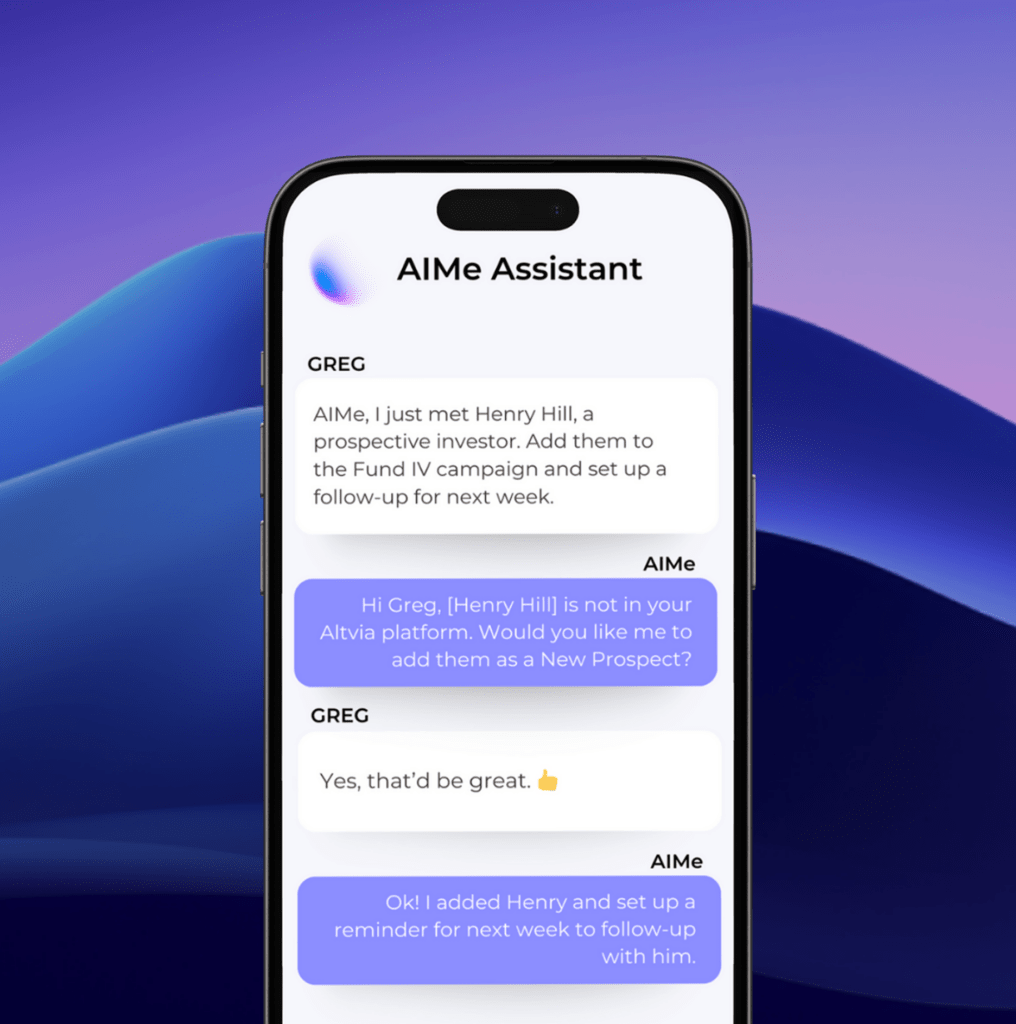
AIMe is Altvia’s new AI-powered assistant—designed specifically for how private capital teams work. It’s not another point solution to add to your tech stack. AIMe is a practical, integrated, and intelligent assistant that lives where your work happens—across desktop and mobile, inside your CRM and systems—and brings the context, insight, and speed your team needs to move confidently.

Why Most AI Misses the Mark

Before we dive into AIMe, it’s worth addressing a few common AI misconceptions we’ve seen in the private capital space:

Misconception #1: 
“We need perfect data.”

Sure, it helps, but it’s not required. Rather than spotless data, you need accessible data. Modern AI can handle messy inputs and often helps surface inconsistencies. It’s not about fixing errors; it’s about finding meaning in the mess.

Misconception #2: 
“AI will replace people.”

Also wrong. AI doesn’t replace your judgment, instincts, or experience. It removes the friction. Clears your plate so you can focus on relationships, decisions, and results.

Misconception #3: 
“Let’s Just Try A Tool.”

AI that only sees part of the picture is just guessing. Without full context—your firm’s context—AI is as useful as an intern on day one. Real value comes when AI is grounded in your data, your workflows, and your goals.

Meet AIMe: AI + Me

AIMe is Altvia’s new AI assistant—purpose-built for private capital. The name reflects our belief that AI is only valuable when it works with you. Not as a bolt-on. Not as a novelty. But as a force multiplier that enhances how your team works every day.

And while AIMe might look like another simple AI chat interface, what makes it powerful is what lies underneath:

  • It’s deeply integrated across your CRM, data room, portals, and systems.
  • It understands the nuance of LPs, GPs, deals, commitments, and co-invests.
  • It works within your existing systems and processes—not outside them.

AIMe isn’t just another point solution. It’s a system-aware assistant trained on the language, structure, and pace of private capital.

What It Looks Like in Practice

AIMe works across mobile and desktop, whether you’re at your desk or walking out of a meeting, you can stay in motion—with context at your fingertips.

  • A Managing Director asks AIMe for a tear sheet seconds before a meeting—without logging in or clicking through dashboards.
  • An IR professional answers an LP’s follow-up instantly—no spreadsheets, no digging.
  • A partner launches a roadshow plan in minutes—AI drafts emails, schedules meetings, and preps the team.

Turn AI Potential into Impact with AIMe

AI doesn’t create value on its own. It comes to life and provides true value when it’s embedded into the way your team works—surfacing the right insights, at the right time, with the full context of your firm behind it. AIMe was built to do exactly that. It brings the speed, intelligence, and practicality your team needs to turn conversations into actions and data into decisions.

Want to see how AIMe fits into your firm’s workflow? Let’s talk.

Schedule a Demo ➔

You’ll be amazed at what Altvia can do for you and your team. Let’s talk and see how we can help. 

The AI Advantage: A Roadmap for Private Equity Success

The pace of AI innovation in private equity is no longer a future-facing topic—it’s a present-day imperative. In just two years, generative AI has evolved from exploratory pilots to delivering measurable business outcomes. For top-performing firms, AI isn’t a side initiative—it’s being embedded directly into the firm’s strategic agenda.

But success with AI isn’t about finding the perfect tool. It’s about readiness: having the right data foundation, governance, and internal alignment to confidently move from experimentation to transformation. At the center of it all is one competitive advantage that continues to separate leaders from laggards—data.

What High-Performing Firms Are Doing Differently

A September 2024 Bain & Company survey of firms managing $3.2 trillion in assets revealed four key practices that top firms are using to accelerate AI adoption and value realization:

  1. Systematic Learning at the Fund Level
    The most advanced firms don’t treat AI as a one-off experiment. They institutionalize it. That means establishing Centers of Excellence, critically assessing tools for specific fund needs, and building internal forums for portfolio companies to exchange AI use cases and outcomes—transforming isolated experiments into repeatable, cross-fund playbooks.
  2. Targeted Capability Building
    Winning firms don’t try to build everything from scratch. They recruit specialized AI talent, forge partnerships with their existing technology partners, and codify internal governance to ensure responsible scale. This intentional capability-building helps firms stay ahead of a fast-moving landscape without losing control.
  3. Strategy-First Use Case Selection
    Rather than jumping at the newest AI trends, these firms anchor their AI efforts in business strategy. They prioritize use cases that drive the firm’s core value—like deal origination, diligence acceleration, or operational efficiency. If an initiative can’t tie back to ROI or core goals, it doesn’t make the list.
  4. Rapid Build-Buy-Partner Decisions
    Momentum matters. High performers avoid getting stuck in analysis paralysis by developing a clear framework for deciding whether to build, buy, or partner on AI capabilities. With the right decision-making process, they keep transformation moving forward without stalling in the planning phase.

Your AI Adoption Roadmap

No two firms follow the same path to AI maturity—but there is a framework to guide your journey. Whether you’re exploring your first pilot or preparing to scale across the portfolio, these phases can help you move confidently from concept to value.

Strategic Alignment

  • Tie AI use cases directly to firm goals (e.g., sourcing, diligence, operations, exits).
  • Set clear KPIs to measure success (e.g., 30% faster diligence cycles, 15% sourcing uplift).

Data Readiness

  • Inventory all critical data across systems—CRM, portfolio tools, documents.
  • Standardize and clean inputs to ensure models are trained on trusted information.
  • Centralize access through a secure, unified analytics layer to power firm-wide AI.
  • Work with a trusted technology partner to prioritize data hygiene.

Focused Pilots/Betas

  • Start with targeted, low-risk pilots to understand what outcomes will drive value and evaluate outcomes against KPIs, capture learnings, and iterate before scaling.
  • Reach out to a technology partner to hear about their strategic approach to AI and opt-in to their AI Beta Programs (if applicable).
  • Use results to inform your build, buy, or partner approach.

Continuous Learning & Scaling

  • Codify success into internal playbooks for repeatability.
  • Expand AI into high-impact areas like LP personalization, forecasting, and compliance workflows.

The Firms Winning with AI Aren’t Just Smarter—They’re More Ready

Every private equity firm is somewhere on the AI journey. Some are still exploring use cases. Others are deep in pilot mode. A few are already scaling what works. But the difference between dabbling and driving real value comes down to one thing: readiness of your data, your people, and your strategy.

At Altvia, we meet firms where they are. Whether you’re laying the foundation with clean, connected data, launching a high-impact pilot, or embedding AI into workflows across the firm, our team—and our new AI assistant, AIMe, helps you move faster and smarter.

The opportunity is real. The impact is measurable. And the time is now.

Let’s build your roadmap to value starting with a conversation.

The Origin of Altvia: A Name Crafted with Alternatives in Mind

Names carry significance. They symbolize a company’s mission, values, and the unique path it paves in any industry. For Altvia, the journey to its name wasn’t just about finding something catchy—it was about encapsulating the essence of what the company stands for and the innovative solutions it brings to the table. 

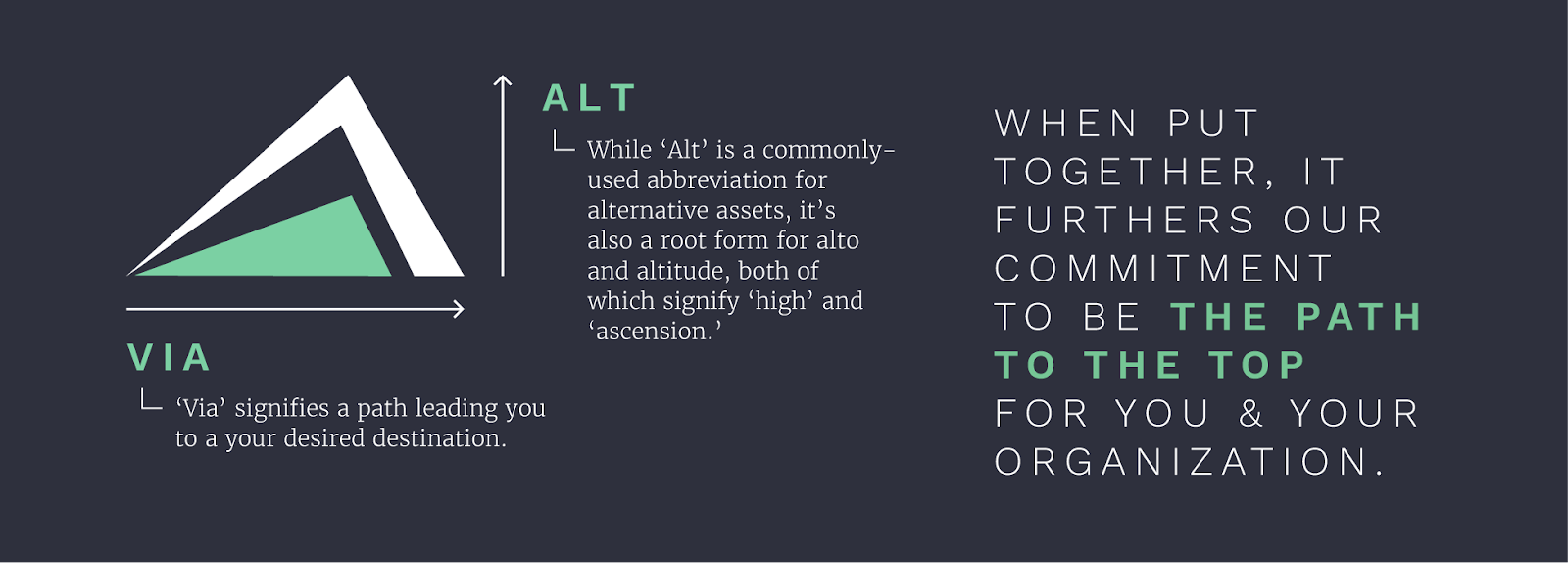
Altvia, at its core, is a fusion of two powerful concepts. It was selected with much consideration for our brand, company culture, and our vision for the future. “ALT” is shorthand for “alternative assets,” a nod to the alternative investment market that the company serves with passion and precision. “ALT” is also a root form of altitude, which is a small nod to being headquartered in the beautiful mountain state of Colorado. The second half, “VIA,” means “a way” or “a path.” It signifies the journey that Altvia’s technology enables for its users—a journey toward better workflows, smarter data management, and ultimately, success in the competitive world of private capital markets. Together, our Brand “Altvia” symbolizes a clear path through the complexities of alternative investments, guiding fund managers toward delivering a superior investor experience.

What Industries Do We Serve?

At Altvia, part of our culture is bringing unmatched expertise to help our clients navigate the complexities of the private capital markets. We started with deep roots in the Private Equity, Venture Capital, and Fund of Funds space, so we know what it takes to succeed in this industry. Over the years, we’ve expanded our expertise and now serve a broad range of sectors within the private capital markets, such as Real Estate, Hedge Funds, Consultants and Family Offices . Our solutions are designed to meet the unique needs of each industry we serve, ensuring that our clients can confidently manage their investments, data, and relationships.

“I” Before The “V” or “I” Before The “A”?

As Altvia has grown and gained global recognition, a little quirk has come along for the ride: the occasional misspelling of our name as “Altiva.” We’ve noticed it enough times that it’s become a humorous little part of our story—a small, unintended twist in our name’s journey.

Now, we get it. Maybe it’s just a slip of the keyboard or perhaps “Altiva” has a certain ring to it. But to set the record straight, it’s Altvia—with the “i” before the “a.” Our name was carefully chosen to reflect our commitment to providing a clear way (“via”) through the world of alternatives (“alt”). It’s a name that embodies our mission and our dedication to guiding our clients through the complexities of the industry. So, whether you find us through a correct search for Altvia or stumble upon us by typing “Altiva,” know that you’ve discovered a company that’s dedicated to making your journey in alternatives a smoother and more successful one.

More About Altvia

Since our 2006 founding in Broomfield, Colorado, Altvia has stayed true to the meaning behind our name. Our purpose-built and fully integrated technology platform empowers fund managers to simplify data complexities, efficiently raise and deploy capital, and deliver a modern LP experience. It’s a mission that resonates with hundreds of world-class clients and supports over 100,000 LP investors worldwide.

As we continue to innovate in the private capital markets, we wear our name with pride. And remember, it’s “Altvia”—because the path and technology partner you choose for success truly makes all the difference.

Centralizing Data: The Essential Action for Operational Excellence

In an era where data drives decisions and shapes private equity and alternative market strategies, centralizing your data isn’t just an IT initiative—it’s a game-changer for your entire organization. Centralizing your data enables you to aggregate and integrate information from various departments into a single, cohesive system. Without a unified data source, you risk fragmented insights that can hinder decision-making. By centralizing data, you create a single source of truth that integrates finance, marketing, and operations data, providing a comprehensive view of your business. This holistic perspective empowers you to make more informed strategic decisions and drive growth.

At Altvia, we believe that efficient data management is critical to achieving streamlined operations and gaining unified insights across all departments in a firm. Here are four reasons why centralizing data is essential and how it can transform firm operations:

Streamline Operations for Maximum Efficiency

Manual processes and disparate systems can bog down productivity and create process inefficiencies. Centralizing private equity data and other investment metrics addresses these issues by automating manual tasks and integrating workflows across the organization. Altvia’s solutions automate routine tasks and integrate workflows, eliminating bottlenecks and reducing the time spent on repetitive tasks. Our centralized data systems enhance productivity by enabling real-time updates and seamless information sharing across your organization. This means your team can focus on what truly matters—driving firm success.

Ensure Data Accuracy and Consistency

Using data analytics in private equity for increased accuracy is critical for making reliable decisions. Centralizing your data ensures that every department works from the same accurate, up-to-date information, minimizing discrepancies and errors. By breaking down data silos and automating data handling, you create a consistent and trustworthy data environment. This consistency supports precise analytics and reporting, leading to more confident decision-making.

Drive Unified Analytics and Reporting

To make data-driven decisions, you need integrated analytics that act as your internal data center and provide a comprehensive view of your firm. Altvia’s centralized data solutions offer unified analytics and reporting, allowing you to track performance metrics and key indicators across all departments. This integrated approach facilitates better trend analysis, performance monitoring, and strategic forecasting, enabling you to navigate complex business environments with clarity.

Integrate with Existing Systems

Worried about how centralizing data will fit with your current systems and private equity tech stack? To gain meaningful insights, it’s essential to have access to integrated and unified analytics. Centralized data systems allow for comprehensive reporting and analytics across all departments, providing a holistic view of performance metrics and key business indicators. Being purpose-built atop the #1 global CRM in the world, Altvia is uniquely positioned to seamlessly integrate with your existing software and data sources. Whether you’re using CRM, portal, or analytics solutions, we ensure smooth integration to enhance the functionality of your current tech investments. This means you can leverage the full potential of your existing systems while benefiting from a centralized data approach.

Summary: Leverage Centralized Data for Strategic Advantage

Centralizing your data is more than a technical upgrade—it’s a strategic advantage that transforms your organization’s operations and decision-making. With Altvia’s powerful ability to centralize private equity and alternative investment data, you can achieve cohesive insights, streamline processes, ensure data accuracy, and drive unified analytics. This transformation not only enhances efficiency but also positions your firm for long-term success. Ready to unlock the full potential of your data? Contact us today to learn how Altvia’s solutions can help you centralize your data for improved insights, streamlined operations, and greater productivity. https://altvia.com/book-a-meeting/