

Category: Private Equity Technology

Maximizing Efficiency: Strategies for the Alternative Markets

Efficiency is no longer a goal – it’s a necessity.

Following a challenging fundraising year in 2023, 2024 has proven equally demanding for fundraising efforts in private equity and venture capital, characterized by a notable reduction in hiring within firms. This shift is forcing alternative asset managers to continuously innovate to streamline operations, optimize resource allocation, and maintain robust investor relationships.

As this landscape continues to unfold, alternative investment market software and technology providers have become crucial partners to navigate strategic considerations to maximize operational efficiency. This blog post delves into the strategies and technologies that firms are leveraging to maximize productivity and stay competitive in an increasingly difficult environment.

Utilize a Centralized or All-in-One Platform

Centralized platforms tailored for alternative asset managers play a pivotal role in enhancing operational efficiency. Consolidating disparate processes and systems across your firm can help eliminate silos and improve transparent, firm-wide collaboration. While no perfect technology solution exists, firms working with an all-in-one platform that seamlessly tracks deal sourcing, monitors investment performance, manages investor communications, generates and distributes comprehensive reports, and transforms data are finding an operational edge.

Embrace Advanced Technology Solutions Over Consultants

Moreover, investing in an alternative market-specific technology solution tailored to the investment industry offers distinct advantages over hiring a generic Salesforce implementation consultant. Unlike consultants who provide generalized advice, technology solutions with features designed to meet industry-specific challenges deliver measurable ROI and sustainable efficiencies. Additionally, using an industry consultant to customize a generic solution can be less time and cost-effective compared to leveraging an out-of-the-box solution that is already purpose-built to solve your needs.

Automate Routine Tasks

Automation is another game-changer in maximizing efficiency within alternative asset management software. By automating routine tasks such as data entry, report generation, and relationship tracking, firms can significantly free up valuable time for strategic initiatives. This operational streamlining not only boosts productivity and reduces the risk of manual errors, but also enables teams to focus more on value-added activities like investment analysis and relationship management.

Harness AI and Machine Learning

Artificial intelligence (AI) and machine learning (ML) are changing how alternative asset managers analyze data, identify investment opportunities, and manage risks. These technologies enable firms to leverage predictive analytics to forecast market trends, optimize portfolio performance, and uncover actionable insights from large datasets.

However, while AI and ML offer transformative potential, asset managers must exercise caution against adopting these technologies merely for the sake of adoption. Additionally, it’s important to be wary of providers that use AI and ML as buzzwords without substantiating the practical benefits.

Firms should approach AI for alternative investment markets strategically, identifying specific pain points or inefficiencies within their operations that these technologies can address. Forming strategic committees dedicated to evaluating AI solutions or consulting with a trusted technology partner ensures that investments in these technologies align closely with business objectives and operational needs.

Balance Efficiency with Relationship Management

While operational efficiency is crucial, maintaining strong relationships with investors and stakeholders is the key to long-term success in the alternative asset world. Technology enhances this by facilitating transparent communication, providing real-time insights, and delivering superior client service experiences. By integrating a modern, digital experience that complements face-to-face interactions, firms can ensure seamless and efficient engagement that meets the evolving expectations of investors.

Partner with Technology Experts

This means not only implementing the right tools but also ensuring that you have a team of experts that understands the entirety of your daily workflow. By having a knowledgeable technology partner that can seamlessly integrate technology into your operations, you can effectively enhance firm-wide collaboration and trust, anticipate investor needs more accurately, and drive sustainable growth for your alternative investment firm.

Benefits of Adopting a Strategic and Technology-First Mindset

Maximizing efficiency in the alternative investment market isn’t just about cutting costs or speeding up processes—it’s about adopting a strategic mindset that integrates technology, automation, and data-driven insights into everyday operations. By embracing these strategies, firms can unlock new levels of productivity, innovation, and growth while navigating the complexities of the alternative market.

Ready to elevate your firm’s efficiency? Explore how advanced technology solutions, like Altvia, can propel your firm forward. Contact us today to learn more about implementing these strategies for efficiency: altvia.com/book-a-meeting.


Outlook for Success: Assessing Private Equity Fund Performance for 2H 2024

As we hit the midpoint of the year, it’s a pivotal moment for Private Equity Fund Managers to reflect on the journey thus far and strategize for the road ahead. The halfway point of the year offers a unique opportunity to pause and critically assess the performance of your portfolio, understand the evolving market dynamics, and recalibrate your strategies to ensure a strong finish to the year. By conducting a thorough mid-year performance review and setting clear, actionable goals for Q3 and beyond, firms can navigate the complexities of the market with confidence and precision. 

To help private equity and alternative investment firms optimize success for the remainder of the year, consider these key steps of performance analysis, market assessment, strategic adjustment, and effective investor communication:

Performance Analysis: Reflecting on the First Half of the Year

The first step in strategic planning is to conduct a thorough analysis of your fund’s performance over the first half of the year. This involves:

  1. Recap of Achievements and Milestones:
    • Highlighting key deals closed and successful exits.
    • Noting any significant partnerships or expansions within portfolio companies.
  2. Detailed Performance Analysis:
    • Comparing your portfolio’s performance against benchmarks and industry standards.
    • Identifying top-performing sectors and standout investments that have driven growth.
  3. Learning from the Past:
    • Evaluate any underperforming investments to identify areas for improvement.
    • Using these insights to avoid similar pitfalls in the future.

To effectively execute on this step, technology plays a key role. A powerful private equity CRM platform that centralizes and organizes data enables you to track, monitor, and analyze key metrics in real-time. This integrated approach ensures you have comprehensive, up-to-date insights into your fund’s performance, allowing for more informed decision-making and strategic planning.

Market Outlook: Understanding the Current Landscape

With the analysis complete, it’s essential to understand the current market conditions and how they may influence your strategies:

  1. Market Trends and Economic Indicators:
    • Examining current trends in the economy, including interest rates, inflation, and market liquidity.
    • Identifying sectors that show strong growth potential in the latter half of the year.
  2. Risk and Opportunity Assessment:
    • Evaluating potential risks that could impact your portfolio, such as geopolitical events or regulatory changes.
    • Highlighting emerging opportunities, including technological advancements and shifts in consumer behavior.

Strategic Adjustments: Planning for Success in 2H:

Based on your performance analysis and market outlook, it’s time to adjust your strategies to help ensure continued success:

  1. Revisiting Investment Strategies:
    • Modifying your investment approach based on insights from the period review.
    • Exploring new investment opportunities and diversifying into promising sectors.
  2. Risk Management and Contingency Planning:
    • Strengthening risk management practices to safeguard against potential downturns.
    • Developing contingency plans to address unforeseen challenges.

Integrating advanced technological tools, such as data analytics and visualization, can significantly enhance your market outlook analysis and strategic adjustments. These technologies provide deeper insights into market trends and investment strategies, enabling more accurate forecasting. Additionally, risk and opportunity assessments can be improved through real-time data monitoring and predictive analytics, allowing for proactive adjustments to your strategy. By utilizing domain-specific platforms, like Altvia, you can streamline data collection, improve decision-making processes, and stay ahead of market shifts, ultimately supporting a more informed and agile investment approach.

Investor Communication: Strengthening Relationships

As you optimize for the second half of the year, effective communication with your investors is key to maintaining their confidence and support:

  1. Transparent Performance Reporting:
    • Sharing detailed mid-year performance reports with your investors.
    • Providing context around achievements and areas for improvement.
  2. Engaging Stakeholders:
    • Utilizing digital platforms and solutions for seamless and secure communication with investors.
    • Hosting webinars or virtual meetings to discuss mid-year performance and future plans.

Operational Efficiency: Optimizing for Growth

Lastly, ensuring operational efficiency can significantly enhance your fund’s performance:

  1. Process Evaluation and Optimization:
    • Reviewing internal processes to identify areas for improvement.
    • Implementing technology solutions to streamline operations and enhance decision-making.
  2. Talent Management and Development:
    • Focusing on team development and providing training to enhance skills.
    • Retaining top talent by fostering a supportive and growth-oriented work environment.

The right technology helps you optimize for growth by enabling data-driven insights, automation of processes, and the ability to adapt quickly to market changes. By identifying and implementing operational improvements, you can drive strategic growth, support sustainable expansion, and maintain a competitive advantage in the marketplace.

2H 2024 Recommendation Summary

As we move into the second half of the year, a comprehensive mid-year performance review and strategic planning are essential for Private Equity Fund Managers aiming for continued success. By analyzing past performance, understanding the market landscape, adjusting strategies, communicating effectively with investors, and optimizing operations, you can set the stage for a strong Q3 and beyond.

At Altvia, we provide the solutions and insights you need to make informed decisions and achieve your strategic goals. Contact us today to learn how we can support your fund’s growth and success in the coming months: https://altvia.com/book-a-meeting/

The Power of 1,000+ Women: Key Takeaways from the Women’s Private Equity Summit

The 2024 Women’s Private Equity Summit convened senior leaders across LPs, GPs, and advisors to the industry to explore the latest trends and strategies shaping the private equity landscape. As we reflect on the illuminating discussions from this year’s conference, distinct themes emerged, each offering valuable insights and guiding principles for navigating the evolving market dynamics. Keep reading to hear about our biggest takeaways.

1. Prioritize Value Creation Amidst Complexity.
In today’s evolving landscape, marked by challenging macroeconomic factors, the imperative to prioritize value creation has never been more pressing. With higher interest rates amplifying operational challenges, successful investment strategies must transcend reliance on valuation multiples. Instead, a comprehensive approach, integrating capital solutions with operational excellence is essential. Focusing on fundamental practices such as team prioritization, working capital optimization, and strategic M&A discipline were discussed as key levers to drive enduring value.

2. Think Outside The Box to Deliver Tailored Strategies.
In an era defined by fluctuating valuation uncertainties, creativity has emerged as a cornerstone of successful portfolio company management. Off-the-shelf solutions are no longer sufficient; instead, the ability to craft bespoke strategies tailored to specific challenges is paramount. Leveraging innovative instruments and structured solutions empowers investors to optimize capital structures and operational hurdles, fostering resilience and sustainable growth in portfolio companies.

3. Embracing NAV Loans as a Form of Liquidity.
A notable trend underscored at the Summit was the increasing prevalence of GPs leveraging NAV loans as a creative solution to provide their LPs with cash. With the challenging fundraising market and re-up rates at risk, GPs are looking at NAV loans to inject liquidity into their portfolio companies and to fill fundraising gaps. While some LPs may see this strategy as problematic, the general theme at the Summit was that GPs should be transparent with their LPs, as it shows creativity during a challenging market.

4. Follow Through On Your Execution Plan.
While formulating a robust investment strategy is crucial, achievement ultimately hinges on disciplined execution. Rigorous follow-through and early relationships ensures alignment with objectives and maximizes the potential for value realization and the right exit for companies. And given the intricate nature and multitude of variables involved, leveraging technology and AI tools facilitates monitoring performance and execution.

5. Harness AI as an Accelerator for Efficiency.
Unlocking the potential of generative AI presents unparalleled opportunities to enhance operational efficiency and drive strategic insights, for not only your firm, but also for portfolio company operations. By understanding the landscape of AI-driven tools, firms can help portfolio companies streamline processes, mitigate risks, and uncover latent value, enabling them to achieve more with limited resources.

6. LPs Have More Choice.
2023 saw limited distributions, and with many LPs relying on distributions to re-up with existing GPs or allocate to new managers, this led to a difficult fundraising environment. This has unsurprisingly shifted the power to LPs who can now wait to see how portfolios shape up or how the managers have fared during a difficult year. Summit attendee advice to GPs who are fundraising in 2024?

  1. Be realistic about fundraising targets and timelines. GPs who request extensions open themselves up to renegotiations, especially around management fees. 
  2. Identify what differentiates you as a manager and use that to engage LPs; whether it’s sector focus, management team, deals in the pipeline, LPs like to see a clear story. 
  3. First close discounts on management fees have become quite popular. LPs will put in the work to commit to first close for existing managers or those they have strong conviction about.

In summary, the prevailing sentiment at the 2024 Women’s Private Equity Summit was one of optimism. Despite challenges in the fundraising landscape, numerous LPs are embracing opportunistic approaches and seeking out GPs with not only a historical track record of successful returns, but also GPs who are being innovative and showing that they are being resilient through macroeconomic challenges. As you navigate the complexities of today’s market, we hope that these key insights serve as a guide to seize opportunities and navigate uncertainty with confidence and agility.

For more tips to navigate the evolving market dynamics, check out these resources:

Cutting Edge Tech, Software, and Focus for PE and VC Markets in 2023

As the new year is in full swing, it’s time for our annual predictions in Private Equity and Venture Capital for 2023! If you’ve ever seen our #RiskyBets series before, you know we’re here to make our own assumptions and push the industry forward, and it starts by reflecting on 2022.

There were many changes in 2022, but one thing that we’ve been keeping our eye on is how the markets are shifting power from GPs to LPs. We believe this is a tremendous tailwind toward our vision for how the future of the Private Equity and Venture Capital markets will operate. So with that, let’s get into our 2023 #RiskyBets:

1. TRANSPARENCY. LPs’ demands for transparency, together with their more selective manager commitments, will lead us to see fundamental changes to how GPs share information with LPs. We are already in the early innings of this – Altvia was one of the early providers that offered the ability to share dynamic, real-time data visualization within our LP Portal software product, ShareSecure. But what we’re predicting for 2023 is the next evolution. It will become more mainstream for GPs to share information and will quickly become something GPs feel pressured to do by increasingly selective LPs demanding more transparency.

2. TRUST. Differentiated GPs will go on the offensive with clarity and use improved tech to begin offering real-time, self-service data not just to existing LPs, but to prospective LPs as well. One of the things that has prevented GPs from being proactively transparent with data is the fear that comes with not understanding their own data. So, as the pressure mounts from LPs to understand this same data, GPs will increasingly move towards investing in systems that help them organize data. And while it will still be a far reach to proactively let LPs peruse through data, the early adopters amongst GPs that begin to extend trust to LPs will quickly learn that there is opportunity and tremendous uptick by differentiating themselves in the market.

3. TECHNOLOGY. Technology will play a transformative role in creating new GP-LP relationships. “Democratization” is a word that has been increasingly thrown around in this market, and while it’s a trend and perhaps not a #RiskyBets to discuss, we’re here to talk about democratization with a new tune. About two decades ago, the idea of online dating was thought to be revolutionary. People connecting via technology? No way that works. Speed up to today, online dating has democratized opportunities to build relationships and connect. The similarity runs deep within our PE and VC industry software and interfaces.

Many still believe that the thought of GPs and institutional LPs meeting via technology is unlikely, but at Altvia, we believe it is inevitable. It’s important to clarify that while having GPs connect with LPs via technology will be a more efficient way to meet, it will not cannibalize the standing practices in the marketplace. This will be a natural evolution of being more transparent and providing self-service data to current and prospective LPs. This is also a natural evolution of creating a more democratic marketplace and more efficient way to meet new LPs that are also interested in meeting GPs.

There you have it – our top three predictions and #RiskyBets for the Private Equity and Venture Capital markets in 2023. If you’re ready to stay ahead of the curve and want to benefit from digital modernization, please reach out to Altvia! Sign up for our monthly newsletter, check out the Preferred Return podcast, or follow us on social.

Jeff Williams, Chief Strategy Officer, Altvia – Jeff Williams started with Altvia in 2011, bringing with him deep technical understanding and industry experience as an Associate at a leading Fund-of-Funds, Greenspring Associates. Through his tenure, he has worked extensively internally leading various departments from product, development, and marketing and externally with clients to make the vision of Altvia come to life through the development and launch of products solving the issues facing GPs and LPs.

Have additional thoughts? Connect with me on Linkedin!

Today’s Differentiated GP: Modern Data & Technology Strategies – Webinar Recap

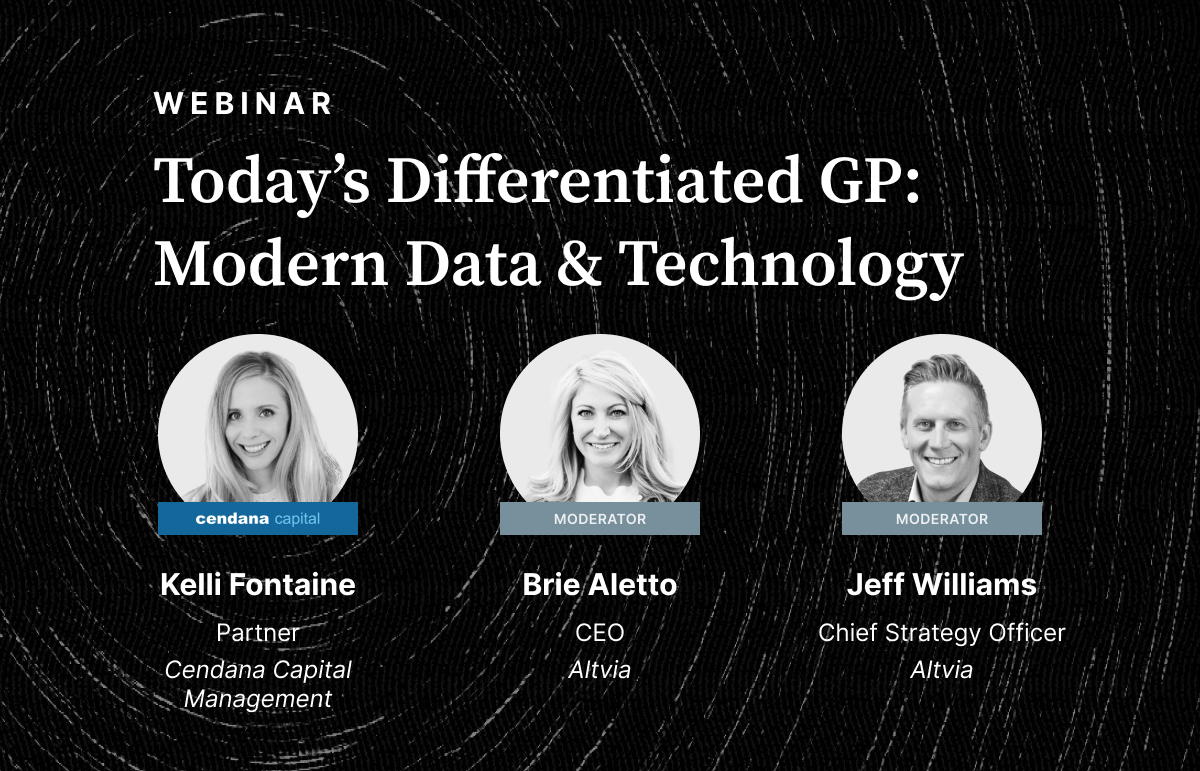
Recently, Altvia CEO Brie Aletto and Chief Strategy Officer Jeff Williams were joined by Cendana Capital Partner Kelli Fontaine for a webinar on effective data and technology strategies in today’s LP market. Titled Today’s Differentiated GP: Modern Data & Technology Strategies, the live, online event was attended by more than 250 people and provided a wealth of insights in key areas.

Data Models

The panel starts by discussing the surprising fact that two-thirds of institutional investors surveyed believe that GP information is “less than good,” and 92% feel it’s “less than excellent.” Kelli makes the point that given those numbers, organizations shouldn’t be targeting “industry standard” leveraging of data, as that’s a very low bar today. You can (and should) stand out by exceeding that standard.

The panelists agree that fund management is a business, so you have to think about how you want to run it. And as a GP, you’ve got to understand not just how individual companies are doing, but also how your portfolio is performing in general.

As Jeff says, the overriding issue is that failing to fully leverage your data to offer a superior “customer experience” is a missed opportunity. And Kelli adds that you can’t know “what’s going right and wrong” with a portfolio if you don’t use data wisely.

Systems & Infrastructure

The session continues with Jeff explaining Altvia’s “PEriodic Table of Technology” (including joking that the slide title should probably be trademarked!) and Kelli agreeing that it’s problematic when the functional groups within an organization don’t share data effectively.

She also explains that Cendana is small in terms of headcount but is able to manage billions in assets thanks to having the right technology and properly structured data. That requires putting time and effort into assessing what information is available to you and how you’ll gather, manage, and utilize it.

Kelli also shares and describes an interesting slide with sample Cendana data sets and emphasizes the importance of proprietary data. She then explains Cendana’s data ingestion process, use cases, and data flow.

She goes on to talk about her challenges in finding a technology partner that understands both Salesforce (as the foundation of a data management system) and her firm’s specific need—and how Altvia meets those critical criteria. She mentions products like AIM and Altvia Answers, with both being critical to her firm’s operations and the latter being a “game-changer.”  

An Informative Demo

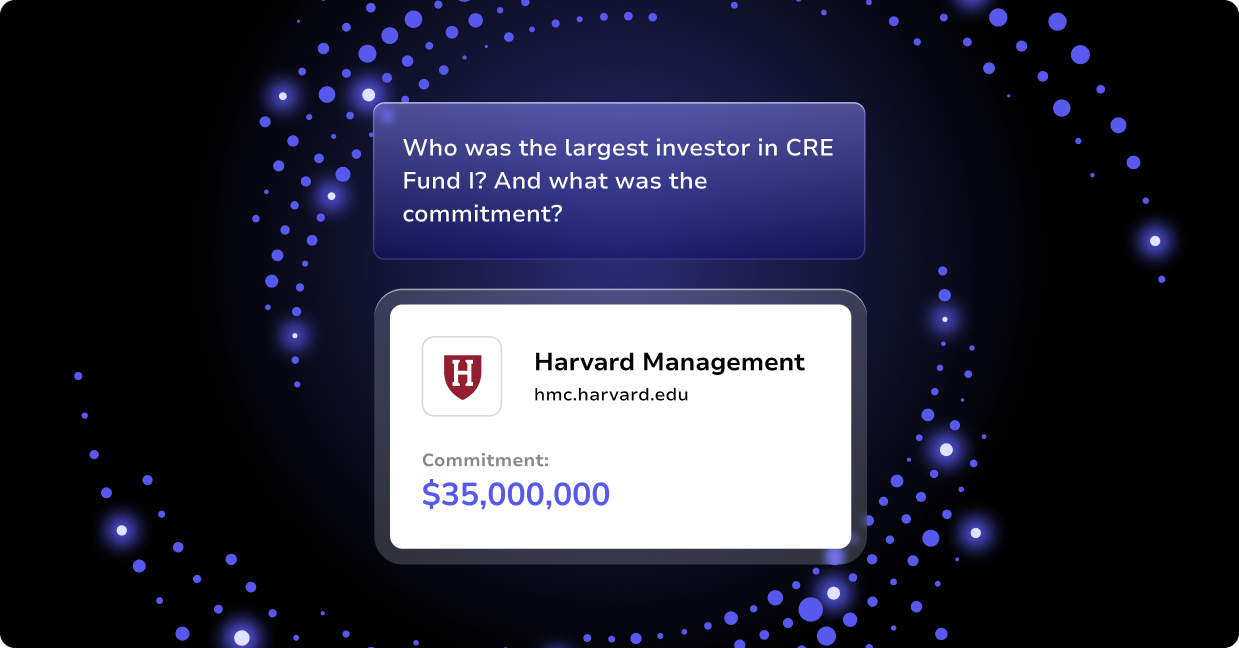
The session continues with a software demo, starting with actual data in the Altvia Answers product. Kelli explains how Cendana uses Answers to its advantage, noting that users can generate the data requested by any stakeholder in seconds.

Jeff then switches to a demo database to show more Altvia capabilities.

Great Questions and Insightful Answers

We’re grateful that an engaged audience asked excellent questions throughout the session. Their participation allowed the panelists to share essential insights on the Altvia suite of products, what integration capabilities it has, and how firms can leverage data and technology effectively.

We encourage you to check out this information-rich webinar. And if you have questions about Altvia products and services, contact us today to request an informative demo.

How to Measure a Company for ESG Performance

It’s no secret – to remain relevant in today’s market, businesses need to think about, and take action toward, how they’re making an impact on the planet. After all, sustainability is the new aspiration for companies, and the key to achieving it is developing enhanced ways to measure ESG initiatives, performance, and overall impact.

However, measuring ESG performance is easier said than done. So how can PE/VCs ensure they’re on the right track? It starts by determining how to measure the relative value of any given ESG metric and understanding the pitfalls to avoid misleading investors along the way. 

Understanding ESG Performance

At its core, ESG performance is a measurement that shows how a company is performing against set criteria of ESG (environmental, social, and governance) values. This measurement is used by investors to fuel decision-making and compare brands against competitors. ESG performance is also a leading factor consumers and employees use to determine if a brand is aligned with their values before deciding to do business with or work for them. 

When it comes to comparing ESG ratings, three main approaches are used by investors: 

  1. Comparing ratings to peers managing comparable portfolios
  2. Leveraging a standard industry benchmark index
  3. The investor’s history and internal data

However, each approach comes with caveats. The appropriateness of each depends on an investor’s particular situation, including the risk profile of the portfolio, the composition of stakeholders, and any fiduciary obligations. 

Comparing ESG performance is not an apples-to-apples game, though. When comparing specific ESG performance indicators, investors are often misled, given how much ratings can vary by industry, company, and value point.

Measures that Mislead Investors

Because one of the biggest challenges in measuring ESG performance has been the lack of consistency surrounding industry benchmarks and performance measurement metrics, investors face challenges when evaluating performance. This becomes increasingly tricky when comparing the performance of one company to another, including competitors. 

Whatsmore, most ESG data available is often self-reported by companies, which means there are significant gaps in data availability, not to mention somewhat biased information. 

Measurement also often fails to provide insight into messy underlying processes. For example, data shows that adding women to executive teams will produce better outcomes. However, that data point doesn’t take specific outcomes into account, such as decision-making that reflects diverse perspectives. This is why investors must look beyond the numbers to learn how, why, and under what circumstances the decisions came about. 

Performance Pitfalls to Avoid

It’s recommended that firms follow a “zoom in, zoom out” approach. This means “zooming in” to focus on better integrating ESG factors and their values within the portfolio while also being sensitive to issues of concentration, tracking errors, and risk. By “zooming in,” firms can create risk frameworks that pinpoint ESG threats and failures. By “zooming out,” they can better understand issues and underlying processes while gaining insight into bigger-picture strategies and opportunities. Without a broad and narrow look at investments, PE/VCs risk missing opportunities to improve performance. 

Finally, it’s imperative to maintain a single source of truth for ESG benchmarks and metrics. A trusted, reliable data source that arms management teams with confidence in their numbers and transparent reports for investors is critical to effectively measure ESG performance.  

Track and Measure Your ESG Performance with Altvia

To track and measure ESG performance with confidence, your firm needs to rely on the right tools to effectively transform your ESG commitments and data into transparent reports for your stakeholders. 

To turn your goals into an operational ESG strategy and effectively measure your progress along the way, a tool like Altvia can help. From evaluating risks, to monitoring competitor insight and internal performance, Altvia’s software can arm your firm with transparent, quantified metrics on the impact of your ESG initiatives. 

To see how Altvia can supercharge your firm’s ESG initiatives and performance tracking, contact a member of our team to start a conversation.

Why Firms Should Get Everyone (Or At Least Most) Team Members On The CRM

Choosing the right technology to meet your firm’s immediate needs and long-term goals will not only streamline operations today but will position your firm to take on future challenges and flourish in an ever more competitive environment.

Your firm is like no other and your technology should be flexible enough to accommodate and improve your unique business processes. In the long run, technology will make new levels of efficiency and transparency available, and provide a way to differentiate your firm from the competition.

With executive sponsorship, company-wide buy-in, a strategic approach, and a collaborative round of testing and optimizing, you can be up and running with more transparency and efficiency than ever before.

Firm-Wide Effort

A data transformation takes firm-wide effort and a well-thought-out strategy. But once you are underway, you’ll quickly see your investment pay off.

  1. Drive the Implementation in the Right Direction

Software implementations of any type require planning, technical setup, training, and change management. None of this can be done effectively without proper buy-in from all levels of the organization.

Without the right people backing your decisions and driving the implementation in the right direction, even an ideal software solution can fall flat and wind up being a waste of time and money.

Having executive sponsorship is critical to a successful software implementation.

Executive sponsorship means a senior-level executive is responsible for the business success of a project. Usually, there is a small team of people in charge of making the decisions on whether or not to purchase a new technology solution. This can be troubling since implementing new software, like a CRM, will have lasting impacts on almost everyone in the business.

An executive sponsor on the software implementation team significantly increases a project’s likelihood of success. It helps ensure that the software is being set up in a way that will support business needs at a higher level of the organization. Plus, the sponsor should prove to be a valuable technology advocate for the rest of the firm.

  1. Increased Transparency & Visibility with LPs

Sharing information with Limited Partners often involves multiple phone calls and emails. Not only are these traditional communication methods slow, but they also don’t offer the kind of transparency Limited Partners require. Today’s solutions often include an investor portal that empowers Limited Partners to find the information they need quickly, easily, and efficiently. A robust investor portal will allow firms issuing documents in a secure platform to request signatures, track and manage documents, and see who has already viewed the document.

  1. Quicker Knowledge Exchange

Many firms have the information they need to be stored in siloed systems. Logging into and transferring information from various locations slows productivity and even increases human error if not checked properly. 

Today’s solutions are designed to work with one another—either within one solution or through a third-party integration that connects to other solutions. Private Equity firms can enjoy a faster, more efficient process when connected to important systems such as data and analytics reporting, financial accounting, investor relations, customer relationship management, and portfolio management.

Digital Portfolio Management and Use of Dashboards

There’s a reason auto manufacturers don’t design cars with the speedometer on the ceiling, the fuel gauge under the driver’s seat, and the check engine light in the trunk. In order for a driver to operate a vehicle effectively, they must have critical information that they can check quickly and efficiently. 

Alternative investment firms also need vital data where it’s easy to view. That’s why leading firms implement portfolio management tools that include advanced dashboards. The industry is moving faster than ever today. If you don’t have the information you need to make important decisions wisely and rapidly, it’s likely that you’ll lose deals to other organizations that can.

Essential Data for Portfolio Management

Needless to say, your portfolio management dashboard must provide the specific data that are important for your firm and the types of deals you pursue. But generally speaking, there are three broad categories of data you should be able to see at a glance in your dashboard:

  1. Financial information. Portfolio managers need clear, concise details on forecasts, actual figures, and budgets. They also need access to information on cost breakdowns, different types of expenses, compliance costs, and much more. If their dashboard has the right data, managers can spot trends quickly and make course corrections as needed. They can also identify opportunities and start their pursuit before competitors are even aware of them.
  1. Strategic assessment. How is your portfolio’s performance aligning with your business objectives? You’ve got to be able to answer that question to ensure you focus your efforts on the right areas.
  1. Project visualizations. Often what a portfolio manager needs is access to the status of their projects at a glance. Well-designed dashboards provide summaries of project health using key metrics that are displayed graphically and easy for viewers to understand.

Altvia Answers provides this type of operational analysis. An additional benefit of having this kind of data at your fingertips is that it enables you to differentiate from your competitors. The comprehensive view that Answers produces helps portfolio managers paint a compelling performance picture rather than just reciting facts and figures.

Avoiding Portfolio Monitoring Dashboard Mistakes

Firms that implement a portfolio monitoring dashboard simply so they can say they have one may be doing more harm than good. You must optimize your dashboard to report on the KPIs and metrics that matter to your team and investors.

To do that, you’ve got to avoid common dashboard development mistakes. For example, you must include the correct information in your dashboard. Too often, firms create dashboards that contain data that isn’t useful and become “noise” that makes it harder to find crucial information.

It’s also essential that you achieve the right balance in your dashboard. If it has too little information, it doesn’t help you make well-informed decisions. If it provides too much information, it’s challenging to identify the insights you and your investors need to be successful. And once you’ve identified the right amount of data, you must ensure that it’s always current.

Enabling Proactive Portfolio Management

Finally, your dashboard should enable you to assess dependencies between and among your projects and portfolios. It also must make it easy to spot KPI trends, analyze their impact, and determine what actions you should take to address them.

And increasingly today, firms are looking for solutions that enable predictive analytics. Your portfolio monitoring dashboard should help you do more than react to evolving market conditions and other factors. You must be able to anticipate them and modify your tactics accordingly.

To learn more about Altvia’s industry-leading solutions for alternative investment firms and their portfolio monitoring capabilities, request a demo below.

The VC Tech Stack: Tools Used by VCs

We’ve advocated for it before – PEs/VCs that take the time now to empower their team with data and technology have an easier time differentiating from the competition. The first step to level up your strategy is building a solid tech stack.

With so many tools available, how can you be sure you’re choosing the right software and tools for your firm?

Read on as we break down the current landscape of tools available to compile an industry-leading tech stack.

The Core Components of the Modern Tech Stack 

The modern PE/VC firm should be stacked with tools that help throughout each stage of the deal process, from consolidating scattered spreadsheets into a centralized platform to ensuring transparency of communications with leads and portfolio members across the entire firm. 

There are a few core areas every tech stack should address: 

  1. Traditional data

    From company financials to expert opinions and forecasts from leading research providers, traditional data can be leveraged to help inform your firm on new deals. This data is especially important during the research and due diligence phases.

    To access all of that public information and centralize it in one place, firms can leverage leading tools like S&P’s Capital IQ, along with publically available websites like Crunchbase.

  2. Alternative Data

    Unlike traditional data, alternative data combines information from non-traditional sources like social media, consumer transactions, web traffic; data that is typically not readily available internally through traditional sources.

    By leveraging alternative data sources, firms can identify deals earlier on in the sourcing process and single out the best investment opportunities for their firm that much faster. Incorporating alternative data tools like Capterra and G2 can arm PEs/VCs with powerful insights to compile compelling stories and industry information for stakeholders.

    To take it a step further, firms can push their alternative data to a centralized hub,  like Altvia, to transform that information into visual charts that help tell a stronger story, providing additional value for LPs and portfolio members. 

  1. Research

    You already know how important research is in the sourcing stage of the funnel. Ensuring you have the right tools available to help streamline that process is critical to your firm’s success.

    While traditional research tools like Forrester can help provide deeper insight into how certain world events impact industries and businesses, software like PredictHQ can help firms predict the impact of real-world events or market shifts. Access to this kind of predictable scenario building will arm your firm with the insight and knowledge needed before making decisions.

  2. Portfolio Management

    The more members in your portfolio, the harder they can be to manage. With portfolio management software, PEs/VCs can organize and unify all of that information in one place. From fund and equity information and reports to KPI monitoring and reporting, portfolio management systems, like VestBerry and Altvia, can help aggregate that data down to the fund level. 

  1. Dealflow CRM

    A firm builds its success upon a foundation of strong relationships, and the right CRM can help bolster those. However, not all deal flow CRMs are created equal, and, without relationship-driven AI built-in (like Salesforce, for example), they serve as more of a transactional source rather than a virtual assistant to your business.

    CRMs, like Altvia, can serve as a centralized source of truth, connecting data from your entire tech stack and helping optimize it across the firm, such as providing AI-driven insights, like helpful alerts on when to follow up to keep conversations flowing. 

Take Your Firm from Low-Tech to Tech-Driven 

Despite growing investments in high-tech industries, venture capital has a reputation for being a traditionally low-tech industry. However, that’s quickly changing as more and more firms embrace software and data to differentiate. But, with this change also comes the need to juggle new tools and software.  

As you begin to shift from spreadsheets to streamlined software, a simplified approach to your tech stack can make the migration a bit easier – and Altvia can help. From portfolio management to AI-powered insights, Altvia can serve as your firm’s single source of truth. 

To learn how Altvia’s solutions can fit into your firm, contact a member of our team to start a conversation.

The Most Prevalent (and Perhaps Costly) Cloud Cybersecurity Myth

In the early days of the cloud, there was a myth that storing data “out there” was not as secure as storing it on your server. The concern and confusion were understandable since it was new technology, but the idea of cybersecurity is becoming increasingly more important.

However, there is no truth to that myth, particularly today. Cloud solution providers have access to the strongest, enterprise-grade security measures available.

A good way to look at the security of your data online versus locally is to compare it to banking. Would you consider your cash to be safer in an online bank or under your mattress? Not many people would choose the latter!

Cybersecurity, Salesforce, and Your Data

Altvia solutions leverage the Salesforce architecture. In the metaphor above, Salesforce would be the “bank.” When you store your assets (data in this case) there, you benefit from all the resources and security expertise of a multi-billion-dollar company. 

If you instead store your assets on a local server—even a server protected by security software—your digital defenses simply don’t compare. And the truth is, your local server almost certainly is connected to the internet. So, having your data there isn’t even comparable to having your money under your mattress. Hackers can “see” your server even though it’s inside your office.

Protection in the Event of a Catastrophe

In addition to the cutting-edge cybersecurity you get from Salesforce and the Altvia solutions built on the Salesforce framework, you also benefit from the fact that Salesforce backs up your data regularly. Should a fire, flood, or other catastrophe damage your office, you can access your data from an alternative location.

In fact, even if one of Salesforce’s servers were damaged, your data would be safe thanks to the concept of redundancy. As the company explains on its website: “Customer Data is stored on a primary database server with multiple active clusters for higher availability. Customer Data is stored on highly redundant carrier-class disk storage and multiple data paths to ensure reliability and performance.”

Cybersecurity and Email

Riskier than storing your data in the cloud is sending it from person to person via email. Most email platforms are unencrypted. That means that if a hacker intercepts an email, any data it contains is compromised.

The fact that you log in to your email program doesn’t mean that your messages are protected. Attachments like spreadsheets and forms are vulnerable as they move from your outbox to the recipient’s inbox.

Then, of course, there’s also the risk of sending an email to the wrong recipient! Enter one incorrect character or leave a character out when typing someone’s email address, and you send sensitive information to the wrong person. That would be like putting an envelope of cash in the mail to the business next door to your bank—or down the street or across the country.

That being the case, storing your data “out there” in the cloud and sharing it using encryption is much safer than keeping it in-house. And in a heavily regulated industry like ours, failing to protect your data properly can be disastrous.

Fortunately, with Altvia and Salesforce watching out for you, you can focus on your job confident that your data is very secure.