Altvia partnered with UserEvidence to survey 187 alternative investment professionals in September 2026 on market pressure, LP expectations, technology, and AI. The full report publishes in November, 2026. Here is an early look at some of the findings.
AI adoption is real, but uneven
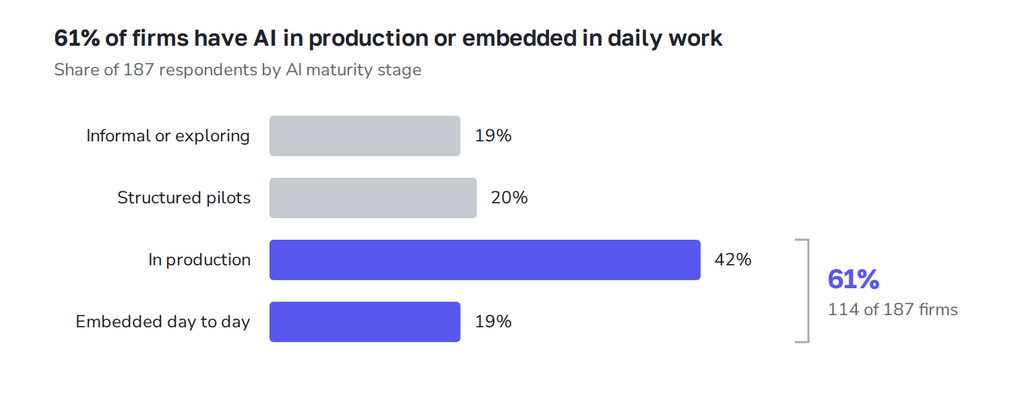
Firms are spread across the maturity curve, and most are past the pilot stage.
The other 39% are still at the pilot stage or earlier.
The barriers aren’t about the models
When we asked what stands in the way of adopting or expanding AI, the top five answers were:
Security or confidentiality concerns: 49%
Integration with existing systems: 48%
Trust in AI outputs and accuracy: 47%
Lack of in-house skills or expertise: 40%
Data quality or readiness: 37%
None of these is about how capable the models are, they’re about safety, connection, trust, and who can use the tools. Only 16% cited unclear return on investment.
The barrier changes as firms mature
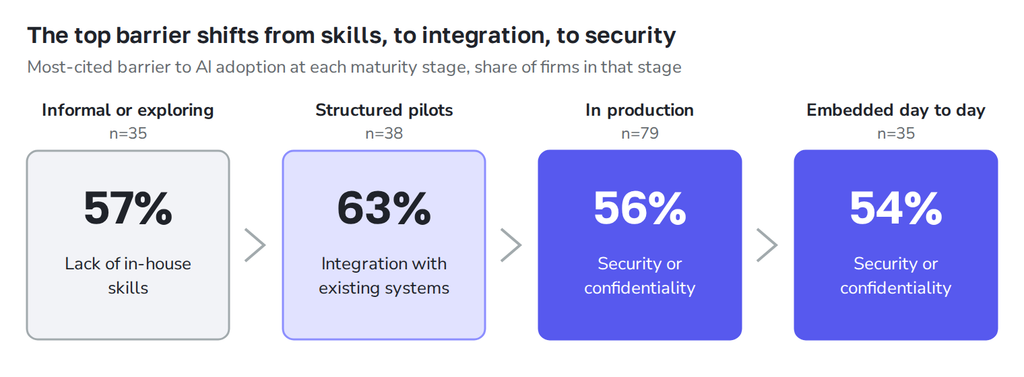
The biggest obstacle is not the same at every stage. Early on, the problem is skills. At the pilot stage, it is connecting AI to existing systems. Once AI is in production, security and confidentiality take over.
Security concern jumps from 23% of firms still exploring to 55% of firms running pilots, and stays above 50% from there.
Skills concerns fade as firms gain experience, falling from 57% of early-stage firms to 32% of those in production. The same three themes appear throughout: who can use the tools, whether the guardrails hold, and whether the data is connected and current. Ryan Keough explores why in 3 Things to Learn from the Automobile When Deploying AI.
Ambition is running ahead of the foundation
91%expect to spend more on AI.53%are investing in the data it depends on.
The firms that are investing report more progress:
Investing in data infrastructure
Not investing
AI in production or embedded
69%
52%
Technology helps them keep pace
82%
66%
“Without quality data, AI can’t do its job,” says Lisa Lewis, Industry Product Manager at Altvia. “Data infrastructure is the next big Achilles’ heel, but unlike launching a pilot or establishing a policy, it’s often a multi-year commitment that nobody gets credit for.”
LP expectations are rising across the board
Respondents reported higher LP expectations over the past 12 months in every area we measured:
LP expectation
Share reporting an increase
Transparency into fund performance
87%
Speed of response to requests
86%
Frequency of reporting and updates
85%
Self-service access to data
84%
Detail and granularity in reporting
82%
What’s next
The full report goes deeper on how these patterns vary by firm size and role, and on what firms are doing about them. Subscribe to get the report.
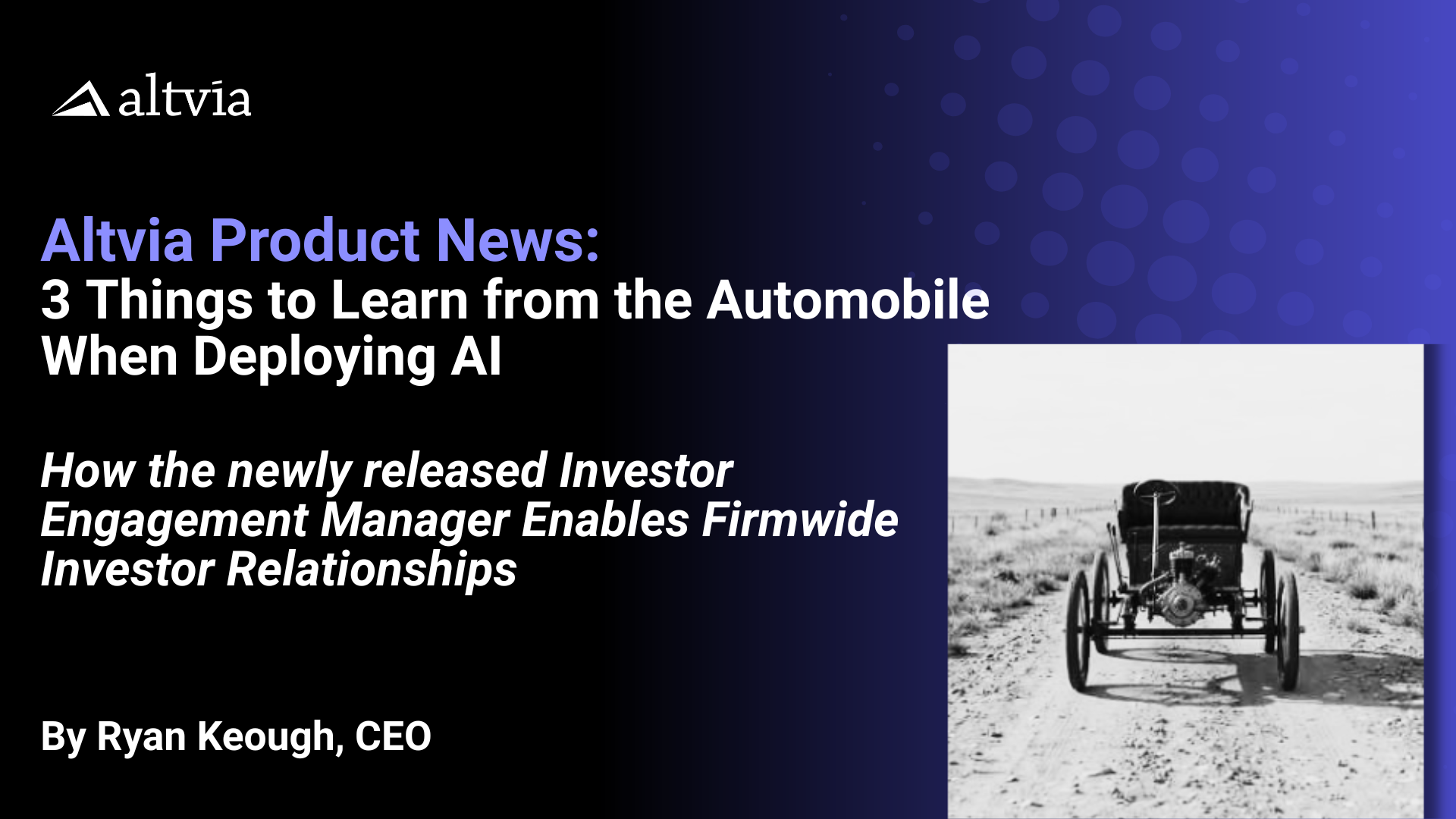
How Investor Engagement Manager Enables Firmwide Investor Relationships
Summary: Most AI in investor relations delivers value only to the people with the expertise to operate it. Turning that into a strategic advantage the whole firm holds, and one that accelerates, takes three things in place at once. The automobile needed the same three, and took thirty years to assemble them.
By Ryan Keough
For AI to actually move an organizational objective such as investor relations, fundraising, or the strength of every LP relationship a firm holds, three elements have to be in place at the same time.
There is a version of AI success that firms are quietly settling for, and the awkward thing about it is that it works. It produces genuinely useful output, but only for the people who know the data, know how to ask, and can tell a good answer from a plausible one.
That is a real skill. It is also unevenly distributed, and today’s AI is almost entirely dependent on it. The value a firm gets is capped by how many people it has who hold that expertise, and the colleague at the next desk gets something worse without being able to say why.
The three elements
That is a set of capable individuals, not a capable firm. It does not compound, because the value lives in the operators rather than in the organization. And it is not fixed by training, because the dependency is structural: a system that only works in expert hands will only ever reach as far as your experts do.
One. It has to be accessible to the entire team. Usable by everyone who touches the relationship, not dependent on an expert user who knows how to work it.
Two. The guardrails have to be in place. Safe, reliable and governed, which is what allows a team to move fast rather than what slows it down.
Three. It has to have the essential inputs. Clean, connected, current data, arriving continuously, without anyone hand-crafting it.
Any two without the third leaves you with a pilot. All three together is a different thing entirely.
The automobile is the proof
The car is the clearest example of all three arriving, and of how little the machine alone was worth until they did.
Accessible. Early automobiles were for mechanics and enthusiasts: difficult to start, harder to maintain, and priced for the wealthy. The Model T mattered because an ordinary person could afford it and operate it1. Mass value required mass accessibility, not a better engine.
Guarded. Then the roads. Early roads had no lane markings, no stop signs, no signals, no right-of-way conventions and no requirement that the driver knew how to drive. The control layer was invented piece by piece over two decades. Center lines appeared in several states between 1911 and 1917, the first stop signs and signals around 1914 and 1915, and national uniformity only with the first Manual on Uniform Traffic Control Devices in 1935.2 Until then, driving at volume was dangerous rather than useful.
Fueled. And the fuel. Crude oil does not run an engine; gasoline came out of a refining process, as a byproduct of making lamp kerosene, and was so plentiful that refiners burned it off.3 It was never scarce. It simply was not where the driver was. Before filling stations you bought it in cans from a pharmacy or a blacksmith, and planned long trips by telephoning ahead.4 Quality varied with whatever crude it came from, and the property that actually mattered, knock resistance, had no agreed measure until the octane scale arrived in 1930.5
A car nobody could drive, on roads nobody could survive, running on fuel nobody could find, is a hobby. All three together built an industry.
And what the three delivered together was not a better car. It was access. Ordinary people could travel routinely and arrive safely, which changed where they could live, where they could work, and how far a business could reach. Freight moved by road. Rural isolation eased. A machine that had been an enthusiast’s curiosity became infrastructure an entire society ran on, and the people who had it could do things the people who did not simply could not do.
The elements were the enabler. The advancement was the point.
The same three, in our clients’ own numbers
We asked 187 private markets professionals in September what is blocking them.6 The answers map onto those three elements almost exactly.
THE ELEMENT
IN THE CAR ERA
IN AN AI SOLUTION
BARRIER IN OUR SURVEY
Accessible to everyone
A car an ordinaryperson could afford,start and drive, not amachine for mechanicsand enthusiasts.
Value available to the whole team without an expert operator in the middle.
In-house skills: 40%
Guardrails in place
Signs, painted lines, barriers, and rules of the road, so speed was survivable.
Permissions, traceability, auditability, and human approval, so the firm can move fast.
Security 49%, trust 47%
The essential inputs
Refined fuel, available where you needed it, at consistent quality.
Clean, connected, continuously replenished data, delivered without manual effort.
Integration 48%, data readiness 37%
Security 49%, integration 48%, trust in outputs 47%, in-house skills 40%, data readiness 37%. Not one of the top five is a model problem. Every one is one of the three elements being absent.
It shows where firms are stuck: 19% informal or exploring, 20% running structured pilots, 42% in production, and only 19% with AI embedded in day-to-day work. Four in ten have not reached production at all. The middle of that curve is crowded with firms that have proven something works for somebody and cannot get it to work for everybody.
Investor Engagement Manager was built around these three elements rather than around a model. Each one is a deliberate design decision, and the combination is what turns AI from a capability into an advantage a firm actually holds.
How IEM puts the three together
ONE · ACCESSIBLE TO THE ENTIRE TEAM
IEM changes how the work gets done, and it does it for everyone.
The expertise the current generation depends on is not something IEM asks the user to supply. The intelligence is surfaced by the system and embedded in it, rather than drawn out of it by someone who knows how. There is no prompt to compose, no need to know where the data lives, no judgment call about whether an answer can be trusted, and nothing a person has to understand about how AI works in order to benefit from it. IEM surfaces what changed across every LP relationship, explains what is driving it, and puts a recommended next step in front of the person who covers it.
That design choice does something a better model cannot. Because the experience is the same for everyone, the quality of preparation is the same for everyone. The associate, the IR lead and the partner all start from the same place. Value stops being a function of who is good at the tool, which means it scales with the size of the team rather than with the number of experts on it.
TWO · GUARDRAILS THAT LET THE TEAM MOVE FAST
A system that moves first has to meet a higher standard, and IEM is built around four commitments.
Secure. IEM reads inside the firm’s existing permissions rather than building a second access model beside them. What it surfaces to any individual stays bounded by what that person could already see.
Traceable. Every alert, assessment and draft ties back to the record it came from. Nobody is asked to accept a number on faith.
Auditable. What was surfaced, what was recommended, who saw it, who approved it and what was done, all reconstructable afterward.
Human-led. Nothing consequential reaches an investor or changes a record until a person approves it.
The instinct is to read that list as friction. The roads say otherwise. Lane markings and signals did not restrain traffic; they are the reason traffic could move at volume and at speed without constant collision. Guardrails are what make speed possible, and they are the difference between a firm piloting AI in one corner and a firm running it everywhere.
THREE · THE INPUTS THAT MAKE IT WORK
No firm in private capital is short of data. It accumulates as a byproduct of the work, whether email, documents, fund reporting or notes, and like crude in the ground, none of it runs anything in the state it arrives in. It has to be refined: resolved, connected, deduplicated, put in context. Most of it never is. It sits where it landed.
Firms tend to judge their data by whether the CRM looks populated, which is the equivalent of grading fuel by specific gravity: easy to measure, and not the property that determines whether the engine runs.
Altvia’s underlying data management and data model is what turns that raw material into an enabler rather than a constraint, and the governing principle is that refining cannot depend on the user. That is the lesson of every CRM adoption program ever run: if the value requires people to faithfully enter data first, the value does not arrive. So we handle it three ways.
1. We refine the data you already have. Existing records cleaned, connected and put right, so the firm’s history is usable from day one rather than after a migration project. Nobody starts with an empty tank.
2. We embed data consumption, so nobody hand-crafts the fuel. Integrations and imports keep other systems feeding in automatically. The picture stays current without anyone copying between tools or maintaining a second record by hand.
3. We consume unstructured email automatically. Email is the richest and least governed record of an LP relationship. It is captured, cleaned, organized and recorded into the CRM without user involvement, and made available to IEM without anyone filing anything.
The common thread is that none of the three require a person to be diligent for the system to work. That matters more than it sounds. A system reading only what people remembered to type is reading a fraction of the relationship, and the fraction is biased toward whoever is most dutiful about paperwork, which is rarely the person closest to the investor.
This is how siloed data becomes organizational intelligence: refined, pumped into the tank, and available to everyone entitled to see it.
No one person holds the whole LP relationship. With the inputs handled this way, the firm holds it, even when the individual who built it has moved on.
From changing the work to changing what the firm can do
Each element on its own is worth something and capped. Accessibility without guardrails is a fast car on an unmarked road. Guardrails without accessible value is governance over a pilot nobody uses. And either of those without clean, continuous inputs is an engine with nothing in the tank.
Together they change the work itself. Coverage stops depending on how many relationships a team has the bandwidth to work. Preparation arrives assembled rather than assembled by someone. The quiet relationship that was drifting gets surfaced while there is still time, and the re-up picture arrives months before a launch rather than during the raise.
But the change to the work is the smaller half of it.
Mass access to the automobile did not simply make individual journeys easier. It changed what was possible for the people and the businesses that had it, and it did so at the level of the whole enterprise rather than the single trip. The same thing happens here. A firm where every person works from the same quality of preparation, where coverage no longer tracks bandwidth, and where institutional memory survives the departure of the person who built the relationship, is not performing the old job more efficiently. It is operating at a level its competitors cannot reach by working harder, because working harder is precisely what the constraint always was.
That is a strategic advantage, not an operational improvement. And unlike an operational improvement, it accelerates.
Every interaction connected makes the next connection sharper. Every proactive pass improves the one after it. The firm’s accumulated history becomes an asset a competitor starting today cannot simply buy, because the only way to acquire it is to have been compounding it already. The gap does not stay the same size; it widens in favor of whoever assembled the three elements first.
That is the difference between deploying AI and gaining ground because of it.
Launching with all three
Investor Engagement Manager is available today, with the data refined and continuously replenished, the guardrails built in rather than promised, and the value accessible to every person on the team without an expert in the middle.
The automobile needed thirty years to assemble those three elements, and the assembling is what cost the time. The findings are published now. There is no reason for a firm in private capital to repeat the experiment.
Altvia Launches Investor Engagement Manager, an AI-Native Solution for the Full Life of an LP Relationship
The new, always-on solution manages LP relationships across their full life, not just when fundraising. Source-cited and human-approved before anything consequential happens
Key Facts (At-a-Glance)
Launch: Altvia is expanding its GP Engagement Platform with Investor Engagement Manager (IEM), an AI-native, always-on solution that manages LP relationships across their entire life, from the first conversation through every fund an investor is in, and the fundraising process alongside them.
Capability: IEM reads across a firm’s investor relations and fundraising data, explains what is changing in any LP relationship and why, prepares a next step, source-cited, inside the firm’s existing permissions, and is human-approved before anything consequential happens. It requires no prompting and no manual record-keeping to work. When a fundraise opens, the same data becomes the live view the team runs the fundraise from.
Why It Matters: GPs face a market where LPs expect better service, relationships grow more complex as the wealth channel arrives at scale, and every new vehicle adds complexity most firms’ systems weren’t built to absorb. That service has to hold for the life of every LP relationship, often a decade or more, because capital goes first to managers LPs already know, and a firm that loses one between fundraises without noticing still has to win it back from zero.
DENVER, CO—October 20, 2026—Altvia, the GP Engagement Platform for private capital, today launched Investor Engagement Manager (IEM), an AI-native solution that keeps every LP relationship in view across every fund an investor is in, without anyone opening a report or typing a prompt. The context is assembled, the issue has surfaced, and the draft is written before anyone goes looking.
What’s New
Always on, at every stage. IEM reads every LP relationship a firm has and surfaces drift or opportunity, from an LP whose engagement has quietly thinned to a co-investment appetite emerging in what someone has been reading, each finding tied back to its source.
Service for investors in funds already closed. Most of a GP’s relationships at any moment are with LPs in prior vehicles. IEM keeps those relationships in focus between fundraises, so the team can service them deliberately instead of reactively.
A pipeline that updates itself. IEM reads the same relationship activity it tracks between fundraises to drive the fundraise view. Stage, commitment, close date, and open items shift as the relationship actually changes, not as someone remembers to update a field.
No prompting, no manual record-keeping. IEM captures and connects data on its own, with no prompts to write and no CRM to keep current, closing a data-entry gap that has limited CRMs for years.
A memory that belongs to the firm. IEM assembles one current picture of each relationship, available to everyone entitled to see it, so the firm holds the entire relationship even when no single person does. When someone leaves, a new hire inherits the context instead of starting over.
“The alternative market is evolving quickly, and the GPs who treat that shift as an opportunity will be the ones who come out ahead,” said Ryan Keough, CEO of Altvia. “We built Investor Engagement Manager to help our clients meet that moment, and to change how the work happens. What firms want is not only efficiency, it’s outcomes: relationships that grow stronger, not relationships that just get tracked.”
Efficiency and Growth
Reporting tells a firm what already happened; a dashboard only answers the question someone thought to ask. Both depend on someone going looking, so LP coverage is capped by bandwidth.
IEM removes that cap. The efficiency is immediate: context assembled, drafts prepared, nothing to enter by hand. The larger, uncapped return is growth that was already sitting untapped, like a relationship quietly weakening or a prior investor ready for more who hasn’t said so, opportunities a firm never books today because nothing told it they were there. A single commitment won, or one relationship saved, can outweigh a year of hours saved.
Built for the Work of Private Capital
Horizontal AI is table stakes. What matters is whether the solution it sits inside understands the work. IEM knows what a re-up cycle is, why a side letter changes a relationship, and what an LP going quiet before a close implies that the same silence afterward does not. A horizontal assistant can read a document; it cannot tell a firm which relationship is drifting, because it has never seen what drifting looks like in private capital.
Enterprise Ready
No firm scales AI it cannot trust to operate safely. A system that acts on a firm’s behalf has to meet a higher standard, and IEM is built around five enterprise-scale commitments:
Secure. IEM reads inside a firm’s existing permissions rather than building a second access model beside them. What it surfaces to any individual stays bounded by what that person is authorized to see.
Trusted. Every figure IEM surfaces is grounded in the firm’s own data, matched and resolved as it arrives, so what a person sees reflects the depth of the relationship, not a stale or unreconciled one.
Traceable. Every alert, assessment, and draft ties back to the record it came from.
Auditable. What was surfaced, recommended, and approved can be reconstructed afterward.
Human-led. Nothing consequential happens until a person reviews it. IEM prepares the work; a person decides and acts.
“Explainability, citations, and firm context are what turn an AI finding into a decision a team can stand behind,” said Sebastian Holst, Chief Product Officer at Altvia. “When Investor Engagement Manager flags a relationship at risk, it shows the records behind the call, the factors that drove it, and how that LP sits within the firm’s own funds and history. Every step can be checked before anyone acts, and that is what gives a team both velocity and the confidence to move decisively.”
To learn more about Altvia’s Investor Engagement Manager, visit altvia.com/iem.
About Altvia
Altvia is the GP Engagement Platform for private capital, trusted by hundreds of private equity, venture capital, and other alternative asset firms. Altvia unifies fundraising, investor relations, and deal sourcing in one place, giving IR, capital formation, and investment teams the full relationship context to make every interaction more informed than the last. From a firm’s first raise through decades of ongoing engagement, Altvia is the operational foundation that compounds with every fund cycle. For more information, visit altvia.com.
In the first post of this series, we argued that every AI strategy has to answer four questions: what advantages does AI create, what are the risks, what is the integration plan, and in what sequence should that plan be executed?
The first two questions, what the advantages are and what the risks are, have answers specific to each firm. This post expands on the advantages and risks for the relationship that matters most to a GP: the one with the LP.
What AI can do for the GP/LP relationship
The obvious answers to the question of AI advantages are already familiar:
Draft an LP email
Read a year of interactions and estimate how healthy a relationship is.
Summarize a call and flag an overdue follow-up
Fill in the fields nobody filled in
These are useful, and every serious platform will offer some version of them. They are also generic AI use cases with a private markets vocabulary applied. A firm that stops there has bought a faster version of work it already does.
The strategic advantage is the firm’s capacity to hold LP relationships at depth. Today that capacity is set by headcount and memory. A team of three can know forty relationships well, and the rest get the newsletter. Institutional knowledge like who cares about what, what was promised in the last meeting, and which contact is the actual decision-maker, lives with the people who happen to cover the account. And then it’s lost when they leave the firm.
The advantage AI can deliver, if it’s built for this purpose, is that this deep relationship context, the kind of context that isn’t typically found in an account record, is housed and understood across the firm, all the time. Partner-level judgment can be applied on any of them at the moment it matters.
Why LP relationship depth matters more between fundraises
Capital is concentrating with managers LPs already know. Bain’s 2026 Global Private Equity Report finds that 53% of LPs are constrained from making new commitments because capital they already pledged has not been called, up 15 points in a year. The number of buyout funds reaching a close fell 23%. In this market, the relationship a firm carries into the fundraise decides most of the outcome before the first meeting.
The benefits of a deeper relationship compound in ways that show up across the private markets business:
An LP who knows the firm re-ups, and at a larger allocation
Diligence moves faster, because the DDQ confirms what is already established rather than examining it
First closes get anchored, which pulls the rest of the roster forward
Co-investment and separate account conversations get a serious hearing
A continuation vehicle has real support behind it when the firm needs one
A difficult quarter comes with room, and with people who speak well of the firm to the consultants and peers who shape the next fundraise
Every one of those outcomes is earned in the quarters when no fund is in market and where relationship capital is built through interactions like reporting delivered on time, questions answered fully, and follow-ups kept.
How LP relationships are lost between fundraises
It’s in these same quarters where relationships are lost, and they’re lost quietly. Most of the LPs a firm loses are still on the list when the fundraise opens. They took the calls, they received every report, there’s nothing in the file that indicates anything changed. Then the commitment comes back smaller, or as a polite note that this cycle is a pass.
This kicks off an internal process where the team tries to dissect the moment it went wrong. Was it a quarterly report that landed late during the LP’s reallocation? A champion who moved to a different mandate and a successor who never got the call? A follow-up from the annual meeting that stayed in a drafts folder?
Commitments recede before anyone declines. A firm can lose an LP before the fundraise begins and still has to earn every commitment when it does.
Why CRM and a disciplined IR team stopped being enough
Ten years ago, a good CRM and a disciplined IR team was a system that worked. Both still matter, what’s changed is the shape of the business around them. Firms added continuation vehicles, co-investment sleeves, separately managed accounts, and new strategies to stay relevant to the same LPs. Each addition brought its own reporting calendar, its own LP segment, and one more place for the story to diverge.
In Altvia’s interviews with IR teams this year, the recurring theme was learning about an important LP change later than they wanted and not having a system that would have surfaced it. They all knew the data was somewhere within the firm, but nobody had time to find it.
The risk question: the LP relationship answer
The generic risks are leakage and fabrication, and every vendor addresses them. The specific risks within an LP relationship define what the tools have to do.
Under the SEC Marketing Rule, a communication that offers advisory services to prospective or current private fund investors can be considered an advertisement and carries the obligations that follow. The line between an ordinary LP update and an advertisement is not always obvious. A system that drafts for IR therefore has to stop before the send and wait for a person to take the next step.
Additionally, every figure carries the firm’s reputation, so a number with no visible source is a number nobody can defend in the meeting. Partners want to know what the model can access and where the data goes. In one beta conversation this year a partner returned to that question three separate times.
And the IR and fundraising function is starting from behind: in Altvia’s forthcoming 2026 Private Markets Survey, investor relations and fundraising respondents report the lowest AI maturity of any function, a mean of 3.1 on a 0 to 5 scale, and the lowest confidence in AI accuracy, 29% against 47% of all respondents. A strategy that hands them a general-purpose assistant and a training session has misjudged both the advantage and the risk.
A Standard Emerges
Put the advantage and the risks together and a standard emerges:
AI for the LP relationship holds the full relationship in one place, with the deal and fund context that shapes it, so the firm’s knowledge of an LP no longer depends on who covers the account.
It captures that relationship with less manual effort each quarter, because a system that depends on someone remembering to update it inherits the failure it was meant to fix.
It brings the right slice of the relationship to the right person at the right moment, with the source shown.
And it proposes while a person approves.
That standard is what Altvia means by a GP Engagement Platform. Stay tuned! The next post in this series delves into the third question: what’s the plan, in practice?
Sources
Bain & Company, Global Private Equity Report 2026, Fund-raising section (published February 22, 2026). https://www.bain.com/insights/outlook-gaining-traction-global-private-equity-report-2026/
U.S. Securities and Exchange Commission, Investment Adviser Marketing, Release No. IA-5653 (the Marketing Rule, Rule 206(4)-1 under the Investment Advisers Act of 1940). https://www.sec.gov/rules-regulations/2020/12/investment-adviser-marketing
An AI strategy in private markets has to answer four questions. What advantage does AI create in productivity, innovation, and quality? What risks come with it? What is the specific plan to integrate it? And in what sequence should that plan be executed, and how fast? For a general partner (GP), the answers turn on fundraising, investor relations, and deal sourcing, because that is where the firm’s longest relationships are and its highest compliance exposure.
The four questions an AI strategy has to answer
Every effective AI strategy answers four questions for its stakeholders:
What advantages can AI offer in productivity, innovation, and quality?
What risks and vulnerabilities come with integrating it, across the full range of use cases a firm might attempt?
Given honest answers to the first two:
What is the specific plan to integrate AI?
And in what sequence should that plan be executed, and how fast?
The four questions apply to any organization in any industry. The answers do not. Where private markets differ is in how the answers affect fundraising, investor relations, and deal sourcing.
Question 1: What are the advantages in productivity, innovation, and quality?
Sure, the generic answer centers around faster drafting, summarized records, and cleaner pipelines. Those are helpful, they’re tablestakes, and they improve the workflow without improving the decisions. The advantage that matters most to a GP is continuity of context across a fund cycle.
Bain’s 2026 Global Private Equity Report finds that 53% of limited partners (LPs) are constrained from making new commitments because capital they already pledged has not been called, up 15 points in a year, while the number of buyout funds reaching a close fell 23%. In a market that tight, an LP going quiet is expensive, and it is hard to see day to day.
It shows up as an LP that receded quietly during the quarters before launch — a commitment lost before the work began. Nobody decides to disengage; the engagement just thins. What changes the outcome is a system that reads the drift, explains what is driving it, and puts it in front of the person who covers the relationship while there is still time to do something about it.
Context retention is the difference between AI that works and AI that does not
MIT’s NANDA initiative found in its 2025 State of AI in Business report that 63% of executives want AI that retains context, and it named the ability to build on what happened before as the core barrier separating successful deployments from the rest.
Bring that into a GP’s world. A successful deployment retains the context of an LP relationship that spans years, vehicles, and people. It also learns from that relationship, and gets sharper with every interaction.
The measurable gain is less rework
In conversations I have had with Heads of IR, the advantage they actually measure is the reduction in rework and double-checking. An AI system that produces a figure a partner then has to go and verify has not improved the decision, and it has not saved anyone any time.
Question 2: What are the risks of AI in private markets?
Here too, the generic answer holds true: data leakage and fabricated output. And every AI vendor addresses those. But the risks specific to private markets are regulatory and reputational before they are technical. Data leakage and fabricated output apply to every industry, and every vendor addresses them. GPs must also assess three risks specific to their own firm:
Regulatory (SEC Marketing Rule). A page that reaches an LP is an advertisement, and it carries the obligations that come with that.
Compliance. An LP email, a quarterly letter, or a data-room summary sent without a person reviewing it is a compliance event.
Reputation. Every figure that reaches an LP carries the firm’s reputation, and a number with no visible source is a number nobody can defend in the meeting.
Partners repeatedly ask what the AI model can access and where the data goes. In our 2026 Private Markets Survey, security becomes the top barrier once firms reach production, displacing the skills and integration concerns that dominate earlier stages. In private markets, that barrier has a compliance officer’s name on it.
The structural risk: the function that owns the LP relationship is the least equipped to evaluate AI
There is a structural risk at play as well. In Altvia’s forthcoming 2026 Private Markets Survey, investor relations and fundraising professionals trust AI accuracy less than any other function: 29% against 47% overall. They name a lack of in-house skills as their top barrier. A strategy that hands this function a general-purpose tool and a training session has misjudged the risk.
Why general-purpose AI answers are not sufficient for private markets
Horizontal CRM, document, and marketing platforms answer the first two questions generically for every industry at once. A GP’s answers rely on things those platforms do not account for: commitments that attach to a subsidiary’s vehicle and roll up to a parent, side letters whose obligations come due on their own calendar, feeders and look-through investors, the reporting cycle, and the person who covers the relationship. The benefit of a system, and its risk, lives in those specifics.
This is where fundraising, IR, and deal sourcing have room to move ahead. The best answers to the first two questions will come from people who understand the LP relationship, working with tools built around it, on the platforms the firm already runs.
Question 3: What is the specific plan to integrate AI?
A plan is not a list of tools. It settles three things: who builds it, where it runs, and what it has to guarantee regardless of the first two. The first two are execution decisions. The third is a property of the system itself, and it is the one most plans leave out. Once the first two questions have honest answers, each of the three has a fairly obvious one.
Four questions a GP has to answer for themselves
1. Who can build and continue to develop the right solution? The NANDA study found that purchased solutions from specialized vendors, paired with partnerships, succeeded about 67% of the time, while internal builds succeeded about one-third as often. The sharpest gap was in financial services. For a firm whose IR function already names in-house skills as its top barrier, building in house compounds the very problem the project is meant to solve.
2. Where’s the data coming from? AI-ready data does not mean a new warehouse. It means one current representation of the LP relationship spanning the CRM, the investor portal, the data room, and fund reporting all captured with less manual effort each quarter and read by the AI where it already lives. Gartner projects that through 2026, organizations will abandon 60% of AI projects that lack AI-ready data. Most of those projects will not fail at the model. They will fail at the data underneath it.
3. Who’s accountable? It’s a trick question, you are! That’s why it’s so important that every output shows provenance and its paper trail. The system proposes; a person approves. This is not a feature to negotiate at procurement. It is the condition that lets a compliance officer, a partner, and an IR associate say yes to the same system.
4. Build or Buy? The build case fails on economics. The cost that sinks it sits underneath the model. Provenance on every output, entitlements that match the firm’s sharing rules, an audit trail a compliance officer will accept, and change control on models and prompts maintained every quarter thereafter. None of that differentiates one GP from another, and all of it has to be right before a single output reaches an LP. A specialist carries that cost across many firms and improves it with every deployment. A single firm carries it alone, for as long as the system runs.
Building is the right call when three conditions hold together: the workflow is genuinely proprietary, the governance stack already exists and is actively maintained, and the team is staffed to keep it current as models change. Few firms clear all three. When two hold and the third does not, the third is what fails, and it fails after the system is already producing work that reaches LPs.
Question 4: In what sequence should the plan be executed, and how fast?
Sequence first because most firms have it backward, and because the sequence is what sets the pace.
Our survey shows the top barrier shifting as firms mature: skills at the informal stage, integration during pilots, security in production, and return on investment only once AI is already embedded. ROI arrives last. Which means most firms are years into the work before they can say what the work was worth.
Reverse the order.
Start with the return. Choose one use case with an outcome you can measure, and define the measure before the pilot begins rather than after it. If you cannot say what success would look like as a number, you do not have a pilot. You have an experiment.
Require the vendor to demonstrate approval rules, audit trail, and data boundaries. Settle approval rules, the audit trail, and data boundaries while the stakes are still small, so security shows up as a solved problem rather than a blocker at the worst possible moment.
Select a system that already sits where the work happens, so integration is not a project you run. Run inside the systems the team uses now — CRM, investor portal, data room — rather than beside them. Integration stops being a project.
Let the skills barrier resolve itself. The skills gap that stalls informal-stage firms is largely an artifact of building rather than partnering. Answer Question 3 correctly and this one mostly disappears.
That sequence also answers the velocity question. Move quickly through the pilot and deliberately into production. A pilot’s only job is to produce a number, and that should take weeks, not quarters. Production is where the compliance exposure becomes real, and that deserves time. Firms that invert this, like a cautious year-long pilot followed by a fast rollout, take the longest to learn anything and carry the most risk when they finally do.
Pilot-stage firms are already choosing their anchor. In our same survey, 82% of firms at the pilot stage rank LP relationship visibility among their top three objectives, ahead of deal flow, compared with 56% of all other firms.
That is where the industry is placing its first serious AI bet. And because the pilot becomes the system a firm scales, the pilot stage is where that bet is effectively decided.
What is next in this series
Over the next several weeks we will take these questions in turn: the problem the LP relationship poses and the standard AI has to meet, the plan in practice, and what our survey says about sequence. The framework stays the same throughout. The answers are ours, and they are specific to private markets.
Frequently asked questions
What should a private markets AI strategy answer first? It should answer what advantage AI creates in productivity, innovation, and quality, and what risks come with it. Only after those two are answered honestly does a plan, and a sequence for executing that plan, become possible. For a GP, both answers are specific to fundraising, investor relations, and deal sourcing.
What are the biggest AI risks for a private equity firm? Beyond data leakage and fabricated output, three risks are specific to private markets: SEC Marketing Rule exposure, because a page that reaches an LP is an advertisement; compliance exposure from a draft sent without human review; and reputational exposure from any figure that reaches an LP without a visible source.
Should a GP build AI in house or buy from a specialist? MIT’s NANDA research found that organizations that purchased solutions from specialized vendors , paired with partnerships, succeeded about 67% of the time , while internal builds succeeded about one-third as often, with the widest gap in financial services.
What does AI-ready data mean in private markets? AI-ready means one current representation of the LP relationship — across the CRM, the investor portal, the data room, and fund reporting — captured with less manual effort each quarter and read by the AI where it already lives. Gartner projects that through 2026, organizations will abandon 60% of AI projects that lack AI-ready data.
In what order should a GP roll out AI, and where should it start? Start with one use case whose outcome you can measure, and define the measure before the pilot begins. Govern before production, run the pilot inside the systems the team already uses rather than beside them, and partner rather than build so the skills gap does not become the gate. In Altvia’s 2026 Private Markets Survey, 82% of pilot-stage firms rank LP relationship visibility among their top three objectives.
About the author
Sebastian Holst is Chief Product Officer at Altvia, where he leads product strategy for the platform private markets firms use to run fundraising, investor relations, and deal sourcing. This is part one of a four-part series on AI strategy in private markets.
Methodology: Altvia 2026 Private Markets Survey, 187 respondents. Pilot-stage figures rest on 38 respondents and investor relations and fundraising figures on 21. Treat both as directional. All percentages are shares of respondents.
A year of AI conversations in private capital, and the question that is still unsettled.
By Ryan Keough, Altvia
I have spent the past year in a lot of rooms. Customer calls, user sessions, conferences, panels, and more industry reports than I would like to admit reading end to end. AI came up in every single one. What I have not heard, in any of them, is a definitive answer to the bottom line question: where does AI earn its keep?
First, let’s kill the framing that keeps showing up in survey data: adoption is not the constraint. Nearly every firm I talk to is doing something with AI, and most are increasing what they spend on it next year. The interesting variance is not between the firms that have started and the firms that have not. It’s between firms that have deployed very different things under the same word.
Broadly, I see three approaches.
1) Tooling that improves an existing workflow. Summarize the call notes. Draft the first pass of the update. Clean the list. These are real gains, and I do not want to be dismissive of them, a lot of time gets recovered here. But the ceiling is what it is. You are doing the same job, in the same sequence, slightly faster.
2) Connected models / MCP. This is where most work is happening, and where results vary the most. Connecting a model to your systems is the easy part. What determines the answer is everything underneath: whether the model knows what your fields actually mean, whether it is allowed to see what it is reading, and whether anyone can trace the number back to the record it came from.
Most of what I have seen is built without those three things. A model with open access to a CRM guesses at field names, ignores who is permitted to see what, and returns a figure with no provenance. The output is directionally correct and unverified. Useful for exploration. Not something you take into an LP conversation.
Most of the market is somewhere in one of the first two scenarios. A third approach is:
3) Reimagining the work itself
This is a different approach entirely. Not a faster version of what you do now. This is the hardest to build, and the only one that changes what an IR team’s week looks like.
When thinking about the third approach to AI, creating a different process entirely, you have to start with what the current default costs you. Reporting tells you where you were; it never tells you where you are. A dashboard answers the exact question you thought to ask, not the gist or the inference, and certainly not a follow-up. A chat box is still a blank prompt that is your problem to solve. Each of these waits for someone to go looking, which means coverage ends up being a function of bandwidth, and you end up working the relationships that surfaced this week, not the ones that changed.
Your LP relationships don’t change quarterly. Your visibility shouldn’t either. The re-up conversation shouldn’t be the first time you learn where you stand. When reimagining the best approach, the process needs to be action oriented. It’s always watching, across every relationship rather than the ones on this week’s list, and it notices change when it happens rather than when someone reports it.
Noticing is not enough on its own. Awareness without a recommendation is just another alert, and nobody needs more of those. The bar is a change, an explanation, and a suggested next step, delivered together and in time to matter. Not only what moved, but what the system thinks you should do about it.
From there, the question is whether it can carry that step through. There is a real difference between a system that hands you a recommendation and one that can prepare the outreach, update the record, and move the work forward when you say go. In other words, advice adds to your list, action takes something off of it.
The second major component that is critical to change the work process is…say it with me…data! Listen, the data exists, we know that. It’s a matter of where it exists and with whom. Today, no one person has the whole relationship, it’s spread across your organization and with your CRM, the inbox, the data room, a spreadsheet someone maintains, and a colleague’s memory. The firm as a whole should have it even when no individual does. Institutional memory, without anyone having to remember. That’s what makes the analysis worth acting on, and it is also why this is hard: the data foundation underneath is the real work, and most of the market would rather talk about the model.
When the process changes and the data foundation underneath is working correctly, what changes is both mundane and significant at the same time. Monday morning used to be prep; now it is follow-up. You stop deciding who to call based on who emailed you last. Your team stops being the integration layer between five systems. New hires inherit the relationship instead of starting over.
How it delivers ROI
Different AI approaches will garner different returns, and it’s up to the firm to decide what they’re looking to accomplish.
1) Tooling: automate the work, same result. The output is what it always was; it took fewer hours. Real savings, capped savings.
2) Connected models / MCP: Insight without precision. A view you did not have, directionally right, unverified. It informs a decision. It does not make one.
3) Change how the work happens. Always watching, proactive about what it surfaces, and able to take direct action rather than handing the work back as a task.
This approach shows up as work getting done that wasn’t getting done before. Coverage stops depending on how many relationships your team has bandwidth to actively work.
This approach enables you to be always watching, proactive about what it surfaces, and able to take direct action rather than handing the work back as a task.
The first two save you time. The third gives you coverage you did not have and that is where the return is found, because it shows up in the situations the old way never surfaced at all.
An LP whose engagement has been quiet for two quarters and on nobody’s list because nothing happened. An opportunity is noticed such as a co-invest appetite visible in the pattern of what someone has been reading, while there is still time to act on it. None of these announce themselves. They are only found by looking, and no team has the hours to look everywhere.
The return is a relationship strengthened before it needed repairing, or an opportunity worked while it was still open.
This approach is also the only approach that has to earn the right to operate that way. The more a system moves first, the more it has to show its work, every figure tied out to the record it came from, every action proposed before it is taken, every step a person can check.
Human-led by default. Enterprise ready, secure, traceable, and auditable. Those are not the brakes on a proactive system. They are the reason a firm can let one move quickly on its behalf at all.
In the end, Investor Relations can focus on the relationship and opportunities.
Private equity has always rewarded patient capital. What it couldn’t always offer was a credible path to liquidity before a fund wound down. That’s changed with GP-led secondaries, continuation vehicles, and structured liquidity solutions which have matured from tactical workarounds into a strategic layer of the alternatives market.
Secondaries make the asset class more functional, more accessible, and more attractive to a broader range of investors. The GPs who understand how to use them will carry a distinct advantage into every fundraise they run.
What Changed, and Why It Matters Now
Secondary market activity has grown into one of the most dynamic segments of private capital, driven by two forces that reinforce each other.
LP expectations around liquidity have shifted: institutional investors who receive real-time marks and daily attribution across their public portfolios are now making explicit comparisons to the ten-year lockup in a closed-end fund, and directing capital toward GPs who close the gap.
At the same time, GPs have recognized that offering a credible liquidity path is a fundraising argument in its own right. LPs evaluating a new commitment increasingly factor in anticipated secondary market access alongside track record and investment thesis.
The Two Structures Worth Understanding
Not all secondary market activity looks the same, and the distinctions carry real operational implications.
LP-led secondaries are the oldest structure: an existing LP sells their fund interest to a secondary buyer. For GPs, this is largely a passive event, but one that requires operational readiness. Current data rooms, accurate NAV information, and an IR team capable of supporting buyer diligence without disrupting fund operations are table stakes. Firms whose data infrastructure isn’t organized for this kind of scrutiny find out quickly.
GP-led secondaries are where most of the structural innovation is happening. These transactions move assets from a fund approaching end-of-life into a new continuation vehicle, giving existing LPs the choice to exit at a fair price or roll their interest forward. Done well, this preserves value and extends the GP’s relationship with high-performing assets. Governance and pricing transparency are non-negotiable here. Conflict of interest concerns are real, and how a GP handles them shapes LP trust well beyond the transaction itself.
The Operational Implication GPs Are Underestimating
Every secondary transaction, regardless of structure, requires a GP to respond to institutional-grade diligence. Buyers want current portfolio data, detailed LP economics, side letter summaries, and clean documentation across the fund’s history. GPs whose records are fragmented across spreadsheets, shared drives, and institutional memory face a painful scramble every time a transaction surfaces.
But the operational burden starts well before a transaction closes. Managing a pipeline of secondary activity introduces its own layer of complexity that most mid-market GPs aren’t systematically tracking: monitoring asset-level exposures and buyer interest across multiple potential transactions simultaneously, managing bid processes with discipline, and maintaining a clear view of how underlying portfolio company exposures shift as secondary transactions progress. Without infrastructure built for this, GPs end up managing high-stakes processes through email threads and disconnected spreadsheets, which creates both operational risk and a credibility problem with sophisticated counterparties who can tell the difference.
This is the operational constraint that catches mid-market GPs off guard. The secondary market’s growth doesn’t just create opportunity, it raises the floor for what organized looks like. LPs who observe a disorganized GP response to a secondary process file that observation away. It shapes how they think about re-up decisions and how they describe the GP to their peers.
The firms building the infrastructure to manage this proactively with centralized LP data, current documentation, clear co-invest records, pipeline tracking with asset-level visibility, and real-time reporting capability are building the operational foundation that makes every LP interaction more credible.
Where This Is Heading
The parallels to public equity market development are instructive here. When block trading and alternative liquidity mechanisms entered institutional equity portfolio management, they didn’t replace the primary market. They made the asset class more functional for institutional capital at scale. Liquidity options reduced the friction of large allocations and opened the door to broader institutional participation.
The same dynamic is playing out in alternatives. Secondary market depth makes the asset class more accessible to a broader set of LPs, including the wealth channel now entering at scale. As vehicle structures and secondary market depth make alternatives more accessible, wealth channel capital is increasingly in play. RIAs, broker-dealers, and wealth platforms serving HNW individuals are actively building allocation infrastructure, per McKinsey’s 2025 asset management research, and liquidity optionality is part of what makes the commitment decision easier. Evergreen structures and interval funds already exploit this. Secondary market liquidity does the same work for closed-end vehicles.
Investment track records will always matter. But the GPs who define the next decade of private capital will be those who build an operational track record to match, one that demonstrates the capacity to serve a broader, more demanding investor base across the full fund lifecycle, including when those investors need a path to liquidity.
Recently, senior IR leaders gathered at the PEI IR Forum to get specific about what’s changing in fundraising and LP relationships. What came through were genuine discussions around real operational gaps, current LP expectations, and the role AI is starting to play in both. The distance between knowing it and doing something about it is where firms are separating.
Here’s a recap of the most salient points from the event:
Trust is the rarest asset in the room
Professor Paul Argenti opened the Forum with a number that stops the conversation: only roughly 30% of stakeholders trust private markets firms. The response from the room wasn’t panic, but it wasn’t dismissal either. The firms earning trust aren’t doing it through volume, they’re doing it through consistency, clarity, and alignment between what they say internally and what they communicate to LPs. The GP who tells a different story in the quarterly letter than they did in the last fund close creates an LP who remembers both versions. That gap leads to the next point….
LPs are already using AI on your communications
This point came up in a panel on resiliency in a shifting macro landscape, hosted by Ray Grant, VP of Strategic Initiatives and Partnerships at Altvia. The panel’s central argument was that consistent, proactive communication across multiple channels is the baseline for maintaining LP confidence:
Email updates that don’t wait for the quarterly cycle
LP portal as an always-on resource, not a document dump
Direct outreach timed to material events, not just scheduled intervals
One of the more memorable moments came from a panelist who made the case for embedding your firm narrative into internal culture, not just external communications. The analogy: put broccoli in front of your kids every day until they start eating it. The teams sending consistent messages to LPs are the ones who have made that narrative part of how the firm operates internally, across every function that touches an investor relationship.
LPs are also raising the stakes on consistency in a more direct way. They are running AI tools against the full history of their GP relationships, checking prior communications against current ones, looking for inconsistencies, promises not kept, language that drifted. The implication is direct: if LPs now have a complete, searchable view of the relationship, IR teams need to as well. The information asymmetry that GPs once held has inverted.
On AI: don’t build your own
There was notable consensus in the room against firms attempting to build proprietary, integrated AI solutions. The reasoning may seem counterintuitive: off-the-shelf commercial tools impose standard operating procedures on users while custom builds create perpetual exceptions. As one panelist put it, private markets firms are not technology companies and shouldn’t pretend otherwise. Find a trusted technology partner. Don’t reinvent the infrastructure.
That said, AI is genuinely useful in specific applications:
Drafting LP communications
Accelerating data hygiene
Flagging engagement signals
Where it falls short is in replacing the human judgment that distinguishes a fund update from a form letter. Panelists flagged “AI voice” as a real risk in quarterly reports, where the prose starts to read like no one in particular wrote it. The consensus: AI works best as an enabler of better thinking and faster execution, not a shortcut for strategy or voice.
IR and marketing are converging on compliance
One of the more practical sessions focused on cross-functional alignment. One panelist described an IR team that was unaware of a capital call posted the day before an on-site LP meeting. The LP asked questions the team couldn’t answer. That kind of gap is no longer acceptable. The firms getting ahead of that problem are the ones bringing IR, legal, compliance, and finance together earlier, treating compliance as a partner in messaging rather than a final checkpoint. It’s a structural change, not a process tweak.
The thread running through all of it
IR has to be proactive. As one keynote framed it, you’re fighting for the re-up every single day in every touch between formal raises. That’s not a new idea, but the operational requirements for actually doing it are changing. LPs are more sophisticated, better equipped, and more willing to redirect capital based on the experience of the relationship rather than performance alone. The gap between what LPs can see and what GPs can see is closing, whether GPs are ready for it or not.
None of it works without the foundation
Near the end of the AI panel, the moderator asked for a show of hands: who feels confident they have a single system capturing all LP data across IR, fund administration, and accounting? Zero hands went up.
That moment was the most honest summary of where the industry actually stands. Proactive IR, AI-enabled communications, co-invest tracking, re-up intelligence: all of it depends on LP data that is clean, connected, and current. Fragmented systems don’t just slow teams down. They create the exact gaps that LPs are now finding for themselves.
Altvia is built on that foundation: a platform purpose-built for the full capital raise and LP engagement lifecycle, with data integrity at the core rather than bolted on after the fact. If any of this maps to conversations your own team is having, we’d welcome the next one. Request a demo.
There is a version of an investor portal that most private equity IR teams are familiar with: a password-protected folder where quarterly PDFs live until an LP asks where they are, then you email them directly. It is functional in the same way a fax machine is functional. It works.
LP expectations have shifted structurally, not cyclically. The bar for what constitutes an acceptable investor experience in private markets has been reset, and the firms that understand this are using their portal as a competitive advantage. The firms that do not are quietly losing ground on re-ups and relationship quality without always knowing why.
Here is what the data shows, what LPs say they want, and where most GP portals fall short.
The gap between what GPs deliver and what LPs expect is widening
A Preqin survey found that 73% of LPs cite inconsistent reporting from managers as a significant challenge when investing in alternative assets. That number alone should give IR teams pause. Nearly three out of four limited partners have a meaningful frustration with how their GPs communicate with them and reporting is the primary channel through which that relationship is maintained.
For more on the importance of reporting see our recent blog on reporting bottlenecks here.
The frustration is not simply about formatting. Sophisticated institutional LPs and increasingly savvy high-net-worth investors now expect continuous reporting and instant access to information. The quarterly PDF delivered 45 days after quarter-end is no longer the standard. It is the floor and for many LPs, it is already below the floor.
According to CSC’s Limited Partners Guide to Fund Operations, 68% of LPs now prioritize operational transparency over even performance track record. That is a remarkable inversion. LPs are telling the market that how you run the relationship matters as much as what you return.
What LPs actually want in a Portal
When you strip away the survey language and talk to IR teams who interact with LPs daily, three things come up consistently.
1. Self-service access to their own data
LPs do not want to email IR to find out their current NAV or distribution history. Many LPs now expect on-demand access to essential data, not just quarterly reports on unrealized value. A portal that requires a support request to answer a basic balance question is not a portal. It is a bottleneck with a login screen.
The self-service expectation extends beyond documents. LPs want to be able to filter by fund, by year, by entity, and see their capital account in real time (or close to it!). A modern investor portal should provide LPs with direct access to real-time or quarter-end fund and portfolio data, historical performance, capital activity, and supporting documentation, all in one place.
2. Dashboard-style reporting, not static documents
LP expectations now highlight a preference for secure digital portals with 24/7 access to information and dashboard-style reporting rather than static documents. This does not mean GPs need to build a Bloomberg terminal. It means LPs want to see their key metrics (IRR, TVPI, DPI, capital called, distributions) in a format they can actually interact with rather than a table buried in a PDF.
LPs want to understand the underlying drivers of performance, assess risk exposures in real time, and gain a deeper understanding of the operational aspects of portfolio companies. A static quarterly report answers none of those questions. A dynamic portal with drill-down capability does.
3. Proactive communication, not reactive delivery
The worst version of an LP portal is one that only activates when the GP remembers to upload something. That’s a document dump with a login screen. What LPs value is always-on access to current information they can pull themselves, on their own schedule, without having to request it from IR.
That shift — from GP-pushed documents to LP-driven self-service — is exactly what a modern portal makes possible. When live fund data, capital account history, and performance metrics are available on demand through a single login, the LP doesn’t need to wait for a quarterly email or chase down a statement. The information is there when they need it. That frees IR teams from fielding basic data requests and lets them focus on the relationship conversations that actually matter.
The fundraising implications are real
LPs are requesting bespoke reporting to meet regulatory or internal requirements, and GPs’ willingness to accommodate these requests varies depending on the operational burden. The firms with a modern portal infrastructure can accommodate these requests more broadly, while the firms without one will be deciding, one LP request at a time, whether the relationship is worth the manual effort.
This is not just an IR operations issue. Your reporting stack is now part of the due diligence process. Prospective investors are looking at how you communicate. They are assessing your operational sophistication. And they are comparing your platform against others they have used.
LP experience during the fund lifecycle directly affects fundraising outcomes on the next raise. A committed LP who feels well-served, well-informed, and genuinely cared for is more likely a re-up than a committed LP who spent two years chasing documents and never felt like a priority.
Diving deeper into the CSC report, not only do 68% of LPs surveyed stated they are focusing on operational transparency, but many LPs believe technology is a major differentiator when looking at competitor GPs. They expect technology that offers real-time data access, integrated systems, automated reporting, and strong cybersecurity.
Technology is now part of the GP selection criteria. Not as a box-checking exercise, but as a genuine signal of whether a firm will be easy or difficult for investors to back.
What separates a portal that works from one that just exists
What’s the difference between an investor portal that strengthens LP relationships and one that simply checks a compliance box? It comes down to three things: the data, the platform and the experience.
The data foundation. A portal is only as good as what goes into it. If fund admin data is not connected directly to the portal or if someone is manually uploading an Excel file every quarter then your portal is a document delivery tool, not an investor experience platform. A portal that pulls live data from fund accounting and administration systems ensures what LPs see is always current, but that’s only the beginning of the platform question.
The platform play. A portal disconnected from your CRM, VDR, and IR communication tools doesn’t just create extra work; it creates a fragmented experience for both the firm and its LPs. Your team is maintaining the same data in multiple places, and your LPs are logging into multiple systems. When something needs to be updated, it has to be updated everywhere, manually, by someone. A connected platform eliminates that.
When the CRM, the portal, the VDR, and IR communications run on a single system, data flows where it needs to go without anyone manually moving it. The LP sees a consistent, current picture of their relationship with your firm. Your IR team sees a complete record of every interaction, document, and communication in one place. That is not a technology preference. That is the operational foundation that makes a genuine LP experience possible at scale.
The experience. LPs are sophisticated consumers of technology in every other part of their professional and personal lives. A clunky login experience, confusing navigation, or documents organized in a way that makes no intuitive sense will not be tolerated with the same patience it once was. The bar for design and usability has been set by the platforms LPs use everywhere else.
How to know if it’s working.
The clearest measure of a portal’s effectiveness is what happens to inbound LP communication after it goes live. If IR teams are still fielding the same volume of “can you send me my K-1” emails six months after implementation, the portal is not working. A well-designed portal should materially reduce ad hoc requests by making the answer self-evident.
The bottom line
LP expectations around the investor portal are not aspirational. They are current. The firms that invest in building a genuine digital experience for their limited partners, one that gives them real-time access, self-service capability, and proactive communication, are using that investment as a fundraising differentiator. The firms that treat the portal as a document archive are handing their competitors an advantage every quarter.
The question for IR teams is not whether to upgrade the LP experience. It is how much runway you have left before that decision gets made for you.
Altvia’s IR Operations workflow provides a connected LP portal and CRM built directly into the Altvia platform, giving IR teams a single system to manage documents, data access, and investor communications across the full fund lifecycle. To see how it works, request a demo.
We’re just back from the With Intelligence Women’s Private Equity Summit in Arizona, where more than 1,400 women across private markets spent two days in the kind of frank, practitioner-level conversation that rarely makes it into published reports.
WPES has a way of surfacing what firms are actually grappling with, not just what they’re presenting to LPs. And this year, the operational themes were hard to ignore. The frustrations being voiced in both sessions and hallways track closely with what we hear in conversations with GPs, IR teams, and fund operators across the market. Five of them are worth unpacking.
1. Speed Is the New Competitive Variable in Fundraising
The firms that are closing faster are not necessarily running better strategies. They’re running tighter operations.
Across conversations at WPES and in our broader work with private capital firms, the consistent pressure point is the gap between relationship activity and execution. Meetings happen. Notes get taken. Then the follow-through slows down because moving information from an LP conversation into a structured record, a task, and an investor communication requires manual work at every step.
That friction compounds quickly. In a fundraising environment where LPs are receiving more outreach, evaluating more managers, and consolidating commitments, the speed at which a firm can respond, update, and advance a relationship is a real differentiator.
What firms need is not more effort, it’s automation of the repetitive handoffs: meeting to CRM system, CRM record to follow-up, follow-up to investor communication. The firms building that infrastructure now are shortening their cycles. The ones that haven’t are spending the same time on processes that their competitors are spending on relationships.
2. Most Firms Know What Good LP Communication Looks Like. Fewer Have Built It.
This is the operational challenge that has been acknowledged for years and solved by very few.
GPs know they need to communicate with LPs consistently. They know that transparency and responsiveness are core to re-up decisions. They also know that when multiple people on a team interact with the same LP across different contexts, and none of it is centrally tracked, the quality of that communication degrades fast.
What gets surfaced at events like WPES is not a new problem. It’s the same problem, stated with more urgency. Firms need a complete, accessible view of every LP interaction across the team. They need communication workflows that create structure without creating friction. And they need visibility into where relationships are strong, where they’ve gone quiet, and what needs attention before it becomes a problem.
The firms that have operationalized this are not doing anything heroic. They’re using better systems and more disciplined processes. The gap between them and the firms still managing LP communication in spreadsheets and inboxes is widening.
3. Data Is the Prerequisite. AI Is the Benefit.
AI came up constantly at WPES, and the conversation has matured considerably from where it was a year ago. Nobody is talking about replacing human relationships with automation. The focus is on what AI can do when it’s embedded directly into fundraising and IR workflows: capturing data, surfacing patterns, flagging follow-ups, generating insights from relationship history.
But there was a consistent thread of honesty running through those conversations. AI only works well on good data. Firms that haven’t solved their data capture problem – meeting notes that never make it into a system, interaction history that lives in individual email threads – are not going to get meaningful value from AI tools layered on top of that foundation.
The sequencing matters: data ingestion first, data quality second, AI-powered insights third. Firms that try to skip to the third step are going to be disappointed. Firms that treat data infrastructure as a prerequisite are positioning themselves to extract real value from the AI investments they’re already making.
This is not theoretical. The use cases that are gaining traction right now are narrow and practical: auto-generating account record entries from meeting notes, identifying LPs who are overdue for outreach, combining fund administration data with relationship data to produce more meaningful LP reporting. None of it is complicated. All of it requires clean, connected data to work.
4. AI Adoption Is Still Experimental, and That Window Is Closing
The honest read on AI in private markets right now: most firms are in the experimentation phase. Pilots are running. Use cases are being tested. Measurable impact is still limited.
That is not a criticism. It reflects where the industry genuinely is. But the firms that treat experimentation as a permanent state are going to fall behind the ones that are building toward adoption at scale.
What separates those two paths is change management. Technology does not change behavior on its own. If an AI tool requires a new workflow and nobody is accountable for driving adoption of that workflow, the tool will be used by the three people who were already interested and ignored by everyone else.
The firms making real progress on AI are treating adoption as an operational problem, not a technology problem. They are defining what behavior change looks like, measuring it, and holding teams accountable for it.
5. Raises Are Continuous. Most Operations Aren’t Built That Way.
The session that resonated most at WPES reinforced something that shows up in our own data and client conversations: the strongest fundraising firms are not raising episodically. They are managing LP relationships with the same discipline between closes as they apply during an active raise.
LPs said it plainly. They want proactive engagement, not just inbound responses when a fund is in market. They want to know what is happening in the portfolio, what has changed in the team or strategy, and that their GP is thinking about them specifically, not sending the same update to a distribution list of 200.
The operational implication is significant. Building and maintaining that kind of continuous relationship management requires infrastructure. It requires a system that tracks every interaction, surfaces the right follow-ups, and enables a small IR team to sustain meaningful engagement across a large LP base without losing quality.
That is what purpose-built private capital platforms are designed to do. And it is what general-purpose CRMs adapted for private markets consistently fail to deliver.
The Pattern Across All Five
Look at the five themes above and a single thread runs through all of them: the work is operational. Speeding up the fundraising cycle, maintaining consistent LP communication, building a data foundation that makes AI useful, driving adoption rather than just deployment, sustaining relationship engagement between closes – none of it happens without operational infrastructure behind it.
That shift is creating a new kind of competitive differentiation in private markets. Firms with disciplined IR operations are responding to LPs faster, communicating more consistently, and entering each raise better prepared. The advantage compounds because the infrastructure carries forward across funds.
Altvia is built for exactly this layer of the business. Connecting fundraising workflows, LP communication, analytics, and reporting into a single platform gives IR teams the visibility and workflow structure to operate with that kind of consistency, not just during a raise, but every day leading up to it.