Category: AI & Automation

5 Themes That Keep Surfacing in Private Capital Operations (And What to Do About Them)

We’re just back from the With Intelligence Women’s Private Equity Summit in Arizona, where more than 1,400 women across private markets spent two days in the kind of frank, practitioner-level conversation that rarely makes it into published reports.

WPES has a way of surfacing what firms are actually grappling with, not just what they’re presenting to LPs. And this year, the operational themes were hard to ignore. The frustrations being voiced in both sessions and hallways track closely with what we hear in conversations with GPs, IR teams, and fund operators across the market. Five of them are worth unpacking.


1. Speed Is the New Competitive Variable in Fundraising

The firms that are closing faster are not necessarily running better strategies. They’re running tighter operations.

Across conversations at WPES and in our broader work with private capital firms, the consistent pressure point is the gap between relationship activity and execution. Meetings happen. Notes get taken. Then the follow-through slows down because moving information from an LP conversation into a structured record, a task, and an investor communication requires manual work at every step.

That friction compounds quickly. In a fundraising environment where LPs are receiving more outreach, evaluating more managers, and consolidating commitments, the speed at which a firm can respond, update, and advance a relationship is a real differentiator.

What firms need is not more effort, it’s automation of the repetitive handoffs: meeting to CRM system, CRM record to follow-up, follow-up to investor communication. The firms building that infrastructure now are shortening their cycles. The ones that haven’t are spending the same time on processes that their competitors are spending on relationships.


2. Most Firms Know What Good LP Communication Looks Like. Fewer Have Built It.

This is the operational challenge that has been acknowledged for years and solved by very few.

GPs know they need to communicate with LPs consistently. They know that transparency and responsiveness are core to re-up decisions. They also know that when multiple people on a team interact with the same LP across different contexts, and none of it is centrally tracked, the quality of that communication degrades fast.

What gets surfaced at events like WPES is not a new problem. It’s the same problem, stated with more urgency. Firms need a complete, accessible view of every LP interaction across the team. They need communication workflows that create structure without creating friction. And they need visibility into where relationships are strong, where they’ve gone quiet, and what needs attention before it becomes a problem.

The firms that have operationalized this are not doing anything heroic. They’re using better systems and more disciplined processes. The gap between them and the firms still managing LP communication in spreadsheets and inboxes is widening.


3. Data Is the Prerequisite. AI Is the Benefit.

AI came up constantly at WPES, and the conversation has matured considerably from where it was a year ago. Nobody is talking about replacing human relationships with automation. The focus is on what AI can do when it’s embedded directly into fundraising and IR workflows: capturing data, surfacing patterns, flagging follow-ups, generating insights from relationship history.

But there was a consistent thread of honesty running through those conversations. AI only works well on good data. Firms that haven’t solved their data capture problem – meeting notes that never make it into a system, interaction history that lives in individual email threads – are not going to get meaningful value from AI tools layered on top of that foundation.

The sequencing matters: data ingestion first, data quality second, AI-powered insights third. Firms that try to skip to the third step are going to be disappointed. Firms that treat data infrastructure as a prerequisite are positioning themselves to extract real value from the AI investments they’re already making.

This is not theoretical. The use cases that are gaining traction right now are narrow and practical: auto-generating account record entries from meeting notes, identifying LPs who are overdue for outreach, combining fund administration data with relationship data to produce more meaningful LP reporting. None of it is complicated. All of it requires clean, connected data to work.


4. AI Adoption Is Still Experimental, and That Window Is Closing

The honest read on AI in private markets right now: most firms are in the experimentation phase. Pilots are running. Use cases are being tested. Measurable impact is still limited.

That is not a criticism. It reflects where the industry genuinely is. But the firms that treat experimentation as a permanent state are going to fall behind the ones that are building toward adoption at scale.

What separates those two paths is change management. Technology does not change behavior on its own. If an AI tool requires a new workflow and nobody is accountable for driving adoption of that workflow, the tool will be used by the three people who were already interested and ignored by everyone else.

The firms making real progress on AI are treating adoption as an operational problem, not a technology problem. They are defining what behavior change looks like, measuring it, and holding teams accountable for it.


5. Raises Are Continuous. Most Operations Aren’t Built That Way.

The session that resonated most at WPES reinforced something that shows up in our own data and client conversations: the strongest fundraising firms are not raising episodically. They are managing LP relationships with the same discipline between closes as they apply during an active raise.

LPs said it plainly. They want proactive engagement, not just inbound responses when a fund is in market. They want to know what is happening in the portfolio, what has changed in the team or strategy, and that their GP is thinking about them specifically, not sending the same update to a distribution list of 200.

The operational implication is significant. Building and maintaining that kind of continuous relationship management requires infrastructure. It requires a system that tracks every interaction, surfaces the right follow-ups, and enables a small IR team to sustain meaningful engagement across a large LP base without losing quality.

That is what purpose-built private capital platforms are designed to do. And it is what general-purpose CRMs adapted for private markets consistently fail to deliver.


The Pattern Across All Five

Look at the five themes above and a single thread runs through all of them: the work is operational. Speeding up the fundraising cycle, maintaining consistent LP communication, building a data foundation that makes AI useful, driving adoption rather than just deployment, sustaining relationship engagement between closes – none of it happens without operational infrastructure behind it.

That shift is creating a new kind of competitive differentiation in private markets. Firms with disciplined IR operations are responding to LPs faster, communicating more consistently, and entering each raise better prepared. The advantage compounds because the infrastructure carries forward across funds.

Altvia is built for exactly this layer of the business. Connecting fundraising workflows, LP communication, analytics, and reporting into a single platform gives IR teams the visibility and workflow structure to operate with that kind of consistency, not just during a raise, but every day leading up to it.

The Advantage of One Platform for Private Capital Firms

Private equity, private credit, and other alternative investment firms are under increasing pressure to operate faster, communicate with greater clarity, and scale without introducing additional complexity.

Most firms did not design complexity into their operating model. They accumulated it over time. A CRM was implemented to manage relationships. A portal was added to support LP engagement. A VDR addressed diligence. Spreadsheets filled the gaps. Individual point solutions solved specific problems.

Individually, each system delivered value. Collectively, they created fragmentation. What once felt practical now creates operational friction, inconsistent reporting, duplicated work, and growing risk. In today’s environment, that fragmentation has become a liability.

In response, many firms are rethinking their architecture and consolidating onto a single connected platform that brings fundraising, investor relations, deal sourcing, and analytics into one system of record. This shift is not about reducing tools. It is about creating a foundation that allows performance to scale.

Here is why that architectural change matters.


Growth Without Rebuilding

A unified platform enables firms to expand across fundraising, investor relations, deal sourcing, and portfolio workflows without repeatedly reconfiguring their systems.

New capabilities build on the same data foundation rather than introducing new silos. As firms launch additional funds, strategies, or vehicles, they maintain consistency across teams and reporting structures. Growth compounds instead of resetting.


One Source of Truth for Fundraising and IR

When fundraising and investor relations operate from the same data model, alignment improves by design. Reporting becomes consistent, metrics are defined centrally, and leadership spends less time reconciling numbers across systems.

Instead of debating which spreadsheet is correct, teams can focus on capital strategy and LP engagement.


AI That Operates Across Workflows

Artificial intelligence is only as effective as the breadth and quality of the data it can access.

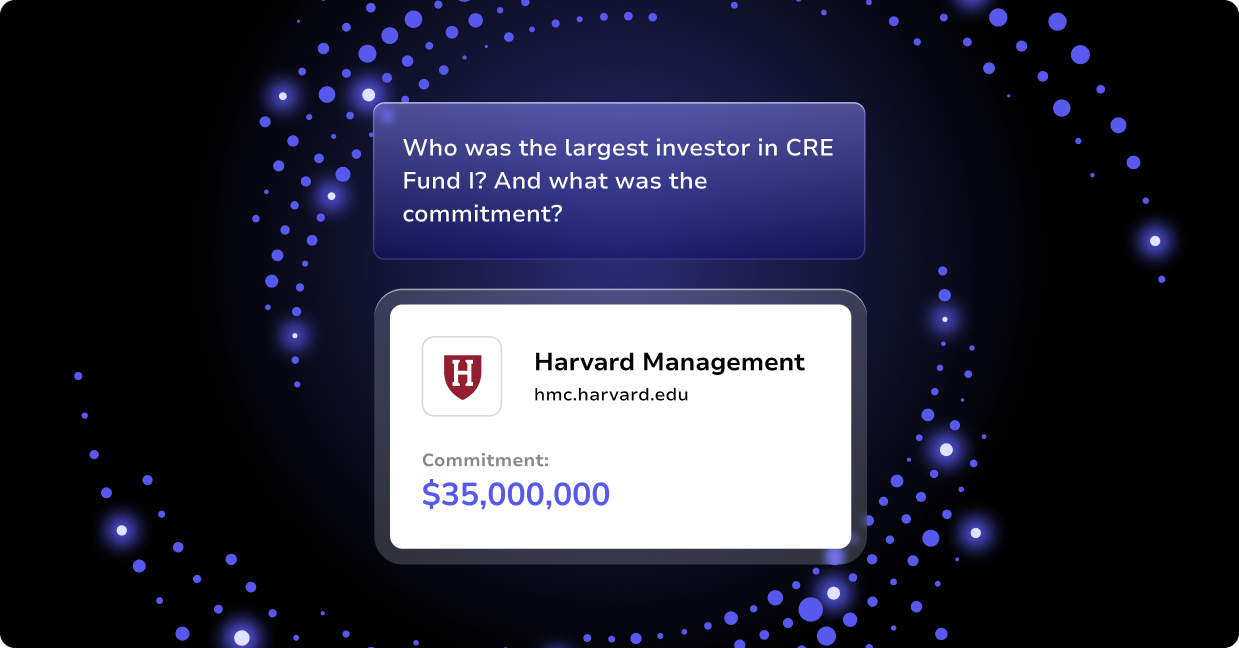
When fundraising activity, LP engagement, deal sourcing, and communications exist within one connected system, AI can identify patterns, surface relationship intelligence, and automate manual tasks with far greater precision. Insights improve over time because the data remains connected and contextual.

In fragmented environments, AI is limited to isolated datasets. In a unified platform, it becomes compounding leverage.


Consistent Execution at Scale

Fragmented systems do more than fragment data; they fragment behavior. Teams develop workarounds, local processes, and informal dependencies that increase institutional risk.

A shared platform supports standardized, repeatable workflows across teams while still allowing flexibility by fund or strategy. Onboarding accelerates. Handoffs become clearer. Execution becomes more predictable as the organization grows.


Compliance Embedded Into Daily Work

As private capital firms scale, compliance becomes harder, not because regulations increase, but because systems multiply.

When data lives across disconnected tools, firms are forced to manage permissions, audit trails, retention policies, and controls in multiple places. Risk increases quietly, and oversight becomes reactive.

A unified platform embeds compliance directly into everyday workflows:

  • Centralized permissioning and access controls
  • Consistent audit trails across fundraising, IR, and deal activity
  • Clear data ownership and governance
  • Fewer handoffs, fewer gaps, fewer workarounds

Compliance stops being a parallel process and becomes part of how the firm operates — reducing risk while increasing confidence for LPs, regulators, and internal stakeholders.

A unified platform embeds compliance directly into operational workflows. Permissioning, audit logs, retention policies, and data governance operate within the same system that teams use every day. Risk decreases because control is built into the architecture rather than layered on afterward.


Data as a Strategic Asset

Private capital firms generate extensive relationship, engagement, and operational data. In fragmented systems, much of that information remains dormant.

Within a connected platform, data can be activated inside workflows. Engagement trends inform outreach. Reporting reflects real behavior. Decision-making becomes grounded in live intelligence rather than static exports. The firm’s data becomes an asset that compounds rather than a collection of disconnected records.


Integrated Portals, Not Isolated Destinations

Investor portals should reinforce the firm’s operating model, not sit outside it.

When portals integrate directly with CRM, communications, and analytics, LP engagement feeds into fundraising and IR workflows in real time. Reporting becomes more accurate, and teams gain a clearer understanding of investor sentiment and activity.

A unified platform also integrates third-party systems such as fund administrators, accounting platforms, and data providers once and makes that data available across workflows. External information strengthens the entire operating model rather than benefiting a single function.


The Real Advantage of One Platform

The advantage of a unified, connected platform is not about reducing the number of tools. It is about designing an architecture where workflows reinforce one another, data compounds over time, and execution scales without friction.

The firms that create durable advantage will not necessarily be those with the most technology. They will be the firms whose systems are intentionally connected, whose data informs every workflow, and whose operating model supports capital formation rather than complicates it.

In an environment defined by speed, scrutiny, and rising LP expectations, a unified operational architecture is strategy.
Private Equity in 2025: AI, Fundraising, and the Race to Stay Ahead

Private equity is evolving, but not in ways that should surprise anyone paying attention. AI is shifting from hype to real implementation. Fundraising remains tough, with LPs holding more leverage than ever. And firms that know how to operationalize their data—not just collect and sit on it—are the ones pulling ahead.

At this year’s Women’s Private Equity Summit, these themes weren’t just talking points; they were challenges that firms are actively working to solve. The question isn’t whether the industry is changing—it’s how firms are adapting to stay competitive.

Here are my takeaways from the discussions:

AI in Private Equity: From Hype to Execution

AI continues to dominate conversations in private equity, and for good reason. But despite the excitement at the event, one fundamental question still lingered in the background: How are firms actually adopting AI in ways that drive tangible value?

The discussions at the summit reminded me of the digital transformation conversations from five years ago. There’s wide recognition of AI’s potential, yet many firms are still figuring out what it can actually do for them, how to implement it effectively, and how to measure the impact of AI’s outputs.

Too often, AI is framed as an abstract concept. It doesn’t have to be. In private equity, AI isn’t about replacing human expertise or overhauling entire workflows. It’s about:

  • Eliminating inefficiencies in data and relationship management
  • Accelerating workflows for fundraising and dealmaking
  • Operating at an accelerated pace with a leaner team
  • Reducing data and system complexity
  • Enhancing decision-making with faster insights and improved accuracy

Yet, the real-world application of AI often gets lost in these buzzwords. At Altvia, we think about AI in two essential ways:

  1. Data hygiene is everything. If AI is going to work for you, clean, structured data and a culture that prioritizes it are non-negotiable. No matter how advanced the tool, it won’t function properly without a strong data foundation. If you’re interested in exploring how to take control of your data—we will be writing a whole other blog on that.
  2. AI should accelerate the mundane. The best applications of AI don’t replace expertise; they remove friction in your daily work and allow you to operate leaner:
Quickly finding relationship data when you’re on the go Automate logging interactions
Automate creating tasks in your CRM Summarize pipeline status and progress
Identifying trends in investor sentiment and deal flow Help LPs digest AGM materials for better meeting preparation

And the list goes on. But even with all these capabilities, AI’s impact always comes back to data hygiene. In this world, the volume of data is growing at an unprecedented pace—but more data isn’t always better. In fact, data overload can do more harm than good. Quality over quantity is key. Without a disciplined approach to data, firms risk drowning in information, losing time, and missing critical insights.

This is why firms need a technology partner—not just a tool. AI must be contextualized for alternatives, helping firms take control of their data, separate what’s valuable from what’s not, and prioritize what truly moves the needle. The goal isn’t just automation—it’s making data actionable so firms can respond to investors faster, raise and deploy capital faster, report on portfolio performance faster, collaborate internally better, make long-term partnerships better, and so on.

Panelist Hot Tip from the Event: Be the human in the loop. Drive AI adoption at your firm, ask the “dumb” questions, and ensure data isn’t just accessible—but truly usable.

Fundraising: The LPs are in Control—Are you Ready?

You don’t need to have attended the Women’s Private Equity Summit to know that raising capital in 2025 won’t be any easier than it has been for the past three years. But the conversations around how firms are navigating this tough environment were insightful.

A few key takeaways stood out: LPs continue to gravitate toward alpha-firms they trust to deliver predictable returns. Competition has never been fiercer, with spinouts and new funds forming seemingly nonstop. Beyond a compelling thesis/pitch, firms now need to demonstrate past performance, a differentiated firm culture, proven operational value creation strategies, and firm talent to win LP commitments.

So where does that leave lower and middle-market firms competing with big names for capital? And what strategies are firms using to stand out?

The answer lies in firms that prioritize long-term, trust-based relationships with LPs. The ones proactively communicating, being transparent about portfolio performance, and demonstrating operational excellence. Here are some strategies shared by industry leaders at the event:

  • Ultra-Transparent Communication: Investors value transparency and long-term partnerships. The firms that openly communicate their strategies to investors—rather than keeping them under wraps—will gain an edge. For example, given the state of the market, fund finance strategies are evolving—NAV loans, subscription lines, and sponsor-backed leverage are becoming more common. If you keep investors in the loop on your financing strategies, they’re more likely to see you as a good partner.
  • Take Control of Your Data: LPs aren’t just looking at short-term performance in their diligence efforts—they’re digging deeper. Firms that own their data and leverage it strategically to showcase their track record will stand out. If you can’t easily tell your fund’s story with data, you’re already behind.
  • Provide Proactive Updates: LPs want real-time visibility into fund performance, not just periodic updates. A centralized investor portal makes it easier to keep them engaged and confident in your strategy. And a portal that can have real-time fund/portfolio performance embedded within it? Game-changer.

None of this is unattainable, but there’s a reason why certain firms consistently rise to the top. They prioritize operational excellence, investing in the right technology, processes, and talent to ensure they can execute seamlessly. These firms recognize that investor confidence isn’t built overnight; it’s earned through consistent transparency, proactive engagement, and a data-driven approach to decision-making.

In short, firms that win in today’s fundraising landscape understand that success isn’t just about having the right story and strategy—it’s about having the right infrastructure and processes in place to back it up.

The Future Belongs to Firms That Execute

The insights from WPES 2025 are clear: Success in private equity today isn’t about just keeping up—it’s about taking decisive action. Firms that embrace AI thoughtfully, build trust with LPs through transparency, and leverage data as a strategic asset will be the ones shaping the industry’s future.

At Altvia, we empower firms to turn insights into execution. Whether optimizing capital workflows, making data work for you, or integrating AI for real impact, we help firms stay ahead of the curve. Let’s start a conversation.

Book a Demo: Here

Contact us at sales@altvia.com.