
Category: Uncategorized

The IR AI Balancing Act, Part Two: LPs Are Asking the Questions Now

A perspective from Annie Eissler, CMO, Altvia

Last month I wrote about what I heard at PEI’s IR Network meeting: I saw a room full of IR professionals working out, in real time, how to use AI without letting it do the thinking for them. A few weeks later I was back in the room, this time at another PEI IR Network meeting. The same core questions were on the agenda, but this time was different.

Last month’s conversation was mostly internal: how do we use AI? How do we not get it wrong? What will our LPs think if they find out? Last week, the conversation had shifted. LPs aren’t just forming opinions about AI use anymore. They’re asking directly how GPs are using it, and that means GPs have to think differently about their AI strategy.

Here’s what stood out.

Personalized LP communications are the clearest AI use case, and also the trickiest one

The most concrete idea I heard came from a conversation about turning deal memos into short, personalized notes for LPs, rather than generic updates. It’s a good use case: the raw material already exists, and AI is well-suited to reshaping it into something that reads like it was written for one person rather than a distribution list.

But the group was candid about where the line sits. There’s a real distinction between the low-hanging fruit (a quick capsule summary) and what would actually be meaningfully impactful. This almost always requires pulling data from a lot of different sources and takes real work to get right: IC summaries, LP meeting notes, and reporting all live behind different systems, often in different formats. Nobody in the room felt like they’d fully solved this. As one person put it, the real bottleneck is data quality: garbage in, garbage out. The hard part isn’t the AI, it’s getting information into a usable format in the first place. It’s a theme that came up again and again last week: technology is rarely the constraint. The underlying data infrastructure is.

Confidentiality is a harder line than it was six months ago

This came up more specifically at last week’s meeting. Sub docs and other sensitive materials can’t just get pushed into a general-purpose LLM. That’s not a compliance nicety; it’s a real operating constraint that shapes which tools a firm can actually use and how. It’s consistent with what Deloitte found in its 2025 GenAI in M&A Survey of 1,000 corporate and PE dealmakers: data security was the single most-cited barrier to GenAI adoption, ahead of every other concern. For private capital firms, where sub docs, LPA terms, and side letters are about as sensitive as documents get, that distinction isn’t theoretical.

At the same time, LPs want more from their GPs, not less. More data and more transparency. So GPs are stuck trying to do both at once: securely share more, but never make it feel like a bot did it. One comment from the room stuck with me: “Nobody wants their IR comms to read like ‘a bot.'” That’s the same reputational risk I wrote about in my last post, except now LPs are actually asking the question, not just wondering about it.

LPs are starting to ask GPs directly how AI is used in the firm

It’s no longer hypothetical that an LP might wonder about a GP’s AI adoption. LPs are now asking. The data backs this up: Private Equity International’s LP Perspectives 2026 Study found that nearly half of LPs surveyed are closely monitoring how their GPs adopt AI in investment and operational processes, and almost as many report mixed feelings about it, largely driven by risk concerns. The ILPA DDQ framework, which the majority of institutional LPs now use as a baseline for manager evaluation, continues to expand with each cycle, and it would be reasonable to expect AI governance to become a standard section, rather than an ad hoc follow-up question.

If your firm doesn’t yet have a clean, honest answer to “How do you use AI, and what guardrails are in place?” it’s time to build one. Not because someone will send it back with a red pen if you get it wrong, but because you should probably be able to answer that question clearly, regardless of who’s asking.

The fee conversation nobody wants to have, but needs to

If firms are getting more efficient because of AI, will LPs start asking why fees haven’t come down? It was framed as hypothetical, but it’s not disconnected from what’s actually happening in the market. Bain’s 2026 GP Outlook already points to real downward pressure on headline management fees, particularly at scale. A recent bfinance poll found that a large share of LPs report fee reductions for like-for-like private market strategies, with softer fundraising and disappointing distributions shifting real pricing power toward investors.

AI efficiency gains and fee pressure are two separate trends right now. But it’s not hard to see an LP putting them next to each other, and GPs should probably have a point of view before that question shows up in a meeting. The best response is to show where the efficiency actually goes: faster answers, better reporting, more time for the relationship itself. That’s a different story than “we cut costs and kept the fee the same.”

MCP servers came up, unprompted

Someone in the room made an offhand comment: if you already know what an MCP server is, you’re ahead of the curve. It’s a small signal, but it’s consistent with where the infrastructure conversation is heading. Most firms are still thinking about AI at the level of individual tools and prompts. Fewer are thinking about the underlying protocols that let those tools connect to a firm’s systems and data securely. That gap between “using an AI tool” and “having AI infrastructure” is expected to keep widening.

Where this leaves us

The first meeting focused on where and how IR teams should utilize AI. The second made it clear the conversation has moved past that. LPs are asking direct questions, fee dynamics are shifting underneath the AI conversation whether anyone planned for that or not, and the confidentiality line between what can and can’t touch a general-purpose LLM is getting firmer, not softer.

The through-line from both meetings hasn’t changed, though: the firms that feel most at ease are the ones with real infrastructure and clear answers, not the ones with the most impressive prompt. If anything, last week’s session raised the stakes on that point. An LP asking how you use AI in a DDQ isn’t looking for enthusiasm. They’re looking for governance.
The IR AI Balancing Act: Still a Work In Progress

A perspective from Annie Eissler, CMO, Altvia

I recently moderated a panel at PEI’s IR Network meeting in Chicago and spent the rest of the afternoon in roundtables and side conversations with IR professionals across the industry. While the official topic of my panel was AI and technology in IR workflows, AI ended up being the dominant theme in every panel and conversation throughout the day. 

What struck me most were the incredibly thoughtful conversations, insights, and concerns that were discussed throughout the day. The real conversation wasn’t whether AI matters, it was how teams are actually using it without letting the tool do the thinking for them.

Here are a few of my key takeaways from the day:

No definitive playbook yet, but significant experimentation 

What came across loud and clear was that teams are experimenting, comparing notes, running pilots, and making judgment calls in real time. But the pace of change in AI right now is often outrunning internal approval cycles, compliance reviews, and honestly, most people’s capacity to keep up.

Several attendees who felt optimistic and comfortable about their team’s AI usage had one thing in common: clear guidelines and guardrails in place. Some examples included:

  • Building tools that can be deployed across the firm, as opposed to individual prompting.
  • Specific processes that include where tech is used and where human review/touchpoints are along the way.
  • Establishing a rule: AI used for operational leverage, but all communications need human eyes. 

LP attitudes on AI are mixed and that should shape how you use it

One of the more clarifying moments of the day came when LP attitudes on AI came up directly. The feedback was genuinely split. Some LPs say they don’t mind knowing AI is being used in the communications they receive, while others said they identify it in the first few words and move on. 

But here’s what was consistent across the IR side of the room: nobody wants their LP thinking “AI wrote this.” Not because AI can’t produce good output, but because the moment an LP feels like they’re on the receiving end of a template, the relationship takes a hit. 

However, I urge teams not to fall into the trap of trying to hide that AI was used, and to remember that the goal is to make sure what you’re sending is relevant, truthful, and specific enough to signal that you actually know who you’re talking to. Attendees all agreed that communications should be brief enough to respect LP’s time, and human enough to warrant a response.

The human element is non-negotiable

What came through clearly on the IR side is that no matter where LPs land on AI-generated outreach, IR professionals don’t want to be in a position where an LP feels like the relationship is being managed by a bot. The reputational risk is real, and it’s shaping how carefully teams are thinking about what AI touches and what it doesn’t.

AI can handle the prep, the research, the first draft, the operational lift. It cannot build a relationship, and it can’t do business. 

There was a story that surfaced in the room about an IR associate who used AI to fix a problem in some analysis. When asked how it was fixed, the answer was “I don’t know, Claude did it.” That’s a risky sentence, and reiterated the need for firm-wide guidelines about where human judgment stays in the process.

Compliance is top of mind

SEC regulations and compliance considerations are sitting in the back of everyone’s mind when it comes to AI in LP communications. Nobody had clean answers. But the awareness is there, and it’s shaping how cautious teams are about what they automate and what they don’t. That guardrail question isn’t resolved yet for most firms, but continues to be a top priority.

Build a tool, not just a habit

One perspective I heard and gave me pause was that there’s a difference between using AI as an assistant and building AI into your infrastructure. Meaning, an assistant answers the specific question posed, but if you build a tool it builds and refines over time. IR professionals should be thinking about how to make their AI capabilities repeatable and institutional, not dependent on an individual’s prompting prowess.

The operational gap is real and unglamorous

This theme came up here, it also came up in our recent webinar with Private Markets Group as well, and it’s boring and unglamorous – data sources, data integrity, and data completeness remains an underlying issue. 

Reporting, deal stages, getting notes from a multi-person LP call into the CRM with the right context attached all came up as workflows people want to solve. Excel is still everywhere for portfolio monitoring, and most teams are on CRMs that weren’t built for private markets. The tools people want exist in pieces. 

A cohesive AI-native solution for an IR team, end to end, doesn’t really exist yet as a product in this market, and teams continue to look for tools that streamline data and operations. 

Relationship building at the center of the conversation

Across every conversation, the through-line cut to the heart of the IR function – how do you build, maintain, and strengthen relationships. Common knowledge is not to show up in front of an LP only when you need them, but to maintain consistent, low-stakes engagement like sharing something relevant or following up after an event. 

Of note: short-form content is resonating well. Firms are finding that consistency and thoughtfulness matter more than production value. 

The focus has shifted to the institutional relationship, not just at the individual contact level. Where AI entered this chat was in a question posed: “How can AI help me operationalize these consistent, but personalised, engagement points?” 

At the end of the day: What does real AI usefulness look like? 

One of the reasons I enjoy attending the PEI networking events is that the size lends itself to real conversations about what’s happening across the board in the IR function. If I had to summarize the day in one sentence, it’s that Investor Relations remains a relationship business. Any successful tool or technology that is implemented will make LP engagement feel more personal, not less, but will alleviate operational busywork on the backend. 

Nobody has the full playbook yet, but the questions the industry is asking are spot on.

At Altvia, those are the questions driving our product direction.

We build LP and deal sourcing engagement software for private capital firms. If you’re thinking through what AI-enabled IR looks like in practice, we’d like to be part of that conversation.

Schedule time to talk to our team.

What Rising LP Sophistication Demands

On May 1, 1975, the SEC abolished fixed commissions in public equity markets. Captive investors, information asymmetry, pricing power, all dynamics that broker-dealers had taken for granted for generations collapsed almost immediately. Discount brokerages proliferated. Retail investors entered at scale. Many firms adapted and rebuilt their operating models around what the new investor base actually needed, others that didn’t were absorbed.

That transformation took three decades and the same structural forces are moving through alternative investments today, but they are moving faster.


What LP sophistication actually looks like now

The LP who accepts a static PDF summarizing their private holdings ninety days after a quarter closes is the same LP receiving real-time marks, granular exposure data, and daily attribution across their public portfolio. They have noticed the gap. More importantly, they are acting on it.

Operational quality has become a formal gating criterion, not a secondary consideration. Research from CSC Global found that 85% of LPs have rejected an investment opportunity over operational concerns alone, and 68% now rank operational clarity above historical returns when evaluating a GP. For a growing number of institutional LPs, the quarterly reporting cycle is a disqualifying signal.

Dedicated private markets teams with data infrastructure, proprietary evaluation frameworks, and multi-fund coverage models are now standard among large endowments, sovereign wealth funds, and pension systems. Preqin data shows that the median fundraising cycle stretched to 19 months in 2024, nearly five months longer than a decade prior. 

LPs are benchmarking responsiveness, data availability, and communication discipline as proxies for operational maturity. With public market benchmarks as their reference point, institutional LPs are now evaluating GPs on criteria that would have once been considered secondary:

  • A slow response to a data request
  • An inconsistent reporting format across funds
  • A re-up conversation that only starts when the GP needs capital

The pull model is structurally broken

The traditional GP communication model runs on pull. LPs request information, GPs respond at scheduled intervals. The LP carries the burden of staying informed, knowing when to ask, and interpreting whatever arrives. That model has been the industry standard for decades, and it persists today mostly because replacing it requires operational investment that many GPs have not made.

GPs who invert the model by pushing timely, targeted intelligence to LPs continuously rather than waiting for the quarterly window create a compounding relationship advantage:

  • A portfolio company experiencing material developments warrants communication before the next scheduled update.
  • An LP nearing their allocation limit in a sector needs context before they make a decision that removes them from a future raise.
  • A re-up conversation that starts six months before a fund close, grounded in documented relationship history and engagement data, is categorically different from one that starts at the deadline.

In a recent Altvia-hosted webinar, Matt Curtolo, LP & GP Advisor, MC Advisory, who managed hundred of GP relationships, put it plainly:

“After every LP conversation, the discipline that separates durable IR operations from reactive ones is recording what the LP needs to see and when they want to hear from you again, and then actually doing it.”

That is not a technology observation. It is a relationship management discipline observation. But at any meaningful scale, that discipline requires infrastructure to execute.


The operational infrastructure requirement

The cultural shift from reactive reporting to proactive intelligence delivery is real, but culture alone does not produce personalized LP communications at scale or surface relationship risk signals before they become visible problems.

That requires a data foundation where every LP interaction, commitment event, document exchange, and engagement signal is captured as structured information, and where that information informs what happens next.

Most GPs are still assembling reporting packages by hand and building re-up lists in spreadsheets. The firms pulling ahead are doing something structurally different: treating LP behavioral data as a strategic asset: tracking who is engaging, with what, at what depth, and when.


The compounding consequence of not moving

The wealth channel is entering the alternative market space at scale. High-net-worth and ultra-high-net-worth individuals in the US alone collectively hold an estimated $8 trillion in global wealth, with alternatives representing a fraction of most portfolios. GPs who build the operational infrastructure to serve a high-volume, intermediary-mediated investor base will access a transformative capital source. Those who cannot execute the proactive intelligence model at scale may find that channel effectively inaccessible regardless of investment performance.

The LP sophistication shift is not a temporary condition to be managed until market dynamics ease. It is a structural reset of the baseline expectations that govern institutional capital commitment decisions. The equity market transformation took decades because technology cycles were slow and capital markets were regionally fragmented. Neither condition holds today.

The playbook from that transformation is available. Firms that adapted early thrived. Firms that waited were marginalized or absorbed. The pattern is not obscure. The question is whether you use it.


Download the Altvia whitepaper, Massive Alternative Market Shift: Déjà Vu?, for the full analysis of where the alternatives industry is heading and what it demands operationally.

The Infrastructure Advantage: How Private Capital Firms are Building for the Next Decade of LP Growth

For most of private equity’s history, the operational model was built around a concentrated investor base. Deep relationships. Manual processes that worked because the volume was manageable and the relationships were few enough to hold in your head.

That model served the industry well, but it’s running out of runway.

The investor base entering alternatives right now is categorically different in size, composition, and expectation. The proportion of RIAs planning to increase their allocations to private equity moved from 45% in 2024 to 74% in 2025, according to KKR’s 2025 RIA Survey. Family offices, high-net-worth individuals, and wealth platforms are committing capital across fund strategies, co-investments, and secondaries simultaneously. The firms that build the operational infrastructure to serve this investor base at scale are positioned to grow in ways that were structurally unavailable five years ago.

The question is not whether to build for it, but rather how to start and move quickly.

What scaling to thousands of LPs actually changes

Going from hundreds of institutional LPs to thousands wealth-channel investors is not a linear increase in workload. It is a different category of operational challenge entirely.

With hundreds of LPs, a skilled IR team can manage relationships through memory, judgment, and high-touch communication. Reporting can be assembled manually. Co-invest preferences can be tracked in a spreadsheet. Re-up conversations can be initiated based on what a partner remembers from the last meeting.

At thousands of LPs across fund commitments, co-investments, secondaries, and continuation vehicles, none of that holds. Consider what changes:

  • A single LP may now have three or four distinct relationships with your firm across different vehicles, each with its own reporting requirements, fee economics, and communication cadence.
  • Co-invest pipelines require real-time preference tracking across a much larger population. The LP who passed on deal X but has expressed interest in sector Y needs to be identified and contacted before the window closes.
  • Wealth-channel investors expect reporting formats compatible with their portfolio management platforms, not quarterly PDFs assembled by hand.
  • Re-up conversations cannot start at the deadline when you have thousands of relationships to manage. They have to start six months out, which means you need to know where each relationship stands before anyone picks up the phone.

Over 84% of wealth managers surveyed by BNY Pershing expected their alternatives allocations to increase, according to a February 2025 survey. That capital is moving toward GPs who can receive it operationally, not just those who have the best investment track record.

The firms moving fast are doing three things now

The good news is that the infrastructure gap between where most mid-market GPs operate today and where they need to be is closable. The firms that are moving quickly share a common approach.

  • They are treating LP data as a strategic asset, not a record-keeping function. Every interaction, commitment, co-invest conversation, and communication preference gets captured in a structured system. Not because it is tidy, but because that data is what makes proactive engagement possible at scale. Knowing that an LP opened your Q3 report three times but has not responded to your last two emails is an early signal. Knowing that a family office has taken co-invest on two deals but passed on a third tells you something about their appetite. That intelligence exists in every firm. Most firms cannot access it systematically.
  • They are segmenting LP workflows before they need to. Institutional LPs, family offices, and wealth-platform investors do not have the same reporting expectations, communication cadences, or service models. Firms that build segmented workflows before volume forces the issue, scale without the friction of retrofitting. Firms that wait are rebuilding infrastructure mid-fundraise, which is the worst possible time.
  • They are thinking about re-up earlier than feels necessary. The re-up conversation that begins six months before a close looks nothing like the one that starts at the deadline. The difference is not relationship quality or intent, it’s whether you have a system that tells you where each LP stands before anyone picks up the phone. At 500 LPs, that kind of advance visibility does not happen through institutional memory. It requires infrastructure in place before you need it.

Where the public equity parallel is instructive

The equity market transformation of the 1970s and 1980s offers one honest lesson for alternatives GPs: the firms that built for the new investor base before the volume arrived ended up with compounding advantages. The firms that waited until volume forced their hand rebuilt while their competitors were already operating from a position of accumulated institutional intelligence.

The alternatives industry is in an earlier stage of the same transition. In the United States, evergreen vehicles and semi-liquid fund structures grew to $348 billion in AUM and attracted $64 billion in inflows in 2024. (McKinsey, Asset Management 2025: The Great Convergence) That is not the ceiling. It is the starting point.

The operational infrastructure that allows a firm to serve 1000+ LPs across multiple vehicles with the same relationship quality it delivers to 400 does not get built overnight. But it does get built incrementally, and every fund cycle that a firm invests in it compounds the advantage. The LP relationship data captured in Fund III informs the re-up strategy for Fund IV. The co-invest preferences tracked across wealth-channel investors sharpen the pipeline for the next deal. The communication workflows built for one vehicle extend to the next without starting over.

That accumulation effect is the real opportunity. Not just operational efficiency, but institutional intelligence that makes each subsequent raise faster, each LP relationship more durable, and each new team member immediately effective from their first day.

The firms that see that clearly and start building now are not just preparing for a future state. They are creating an advantage that is available right now, with the LPs they are already managing, in the fund cycle they are already running.

Altvia Named a Finalist and Winner in the Eleventh Annual Family Wealth Report Awards 2024

We are excited to announce that Altvia, a leading financial service provider in the family office and family wealth industry, was selected as a finalist and winner in the following categories at the Eleventh Annual Family Wealth Report Awards 2024 program:

  • Winner: CRM System
  • Finalist: Women in Wealth Technology (Individual) – Brie Aletto

Altvia President & CEO, Brie Aletto, and Chief Financial Officer, Christine Dye, were in attendance to accept the award and honored to be recognized amongst such high-caliber finalists at the Gala Ceremony at the Mandarin Oriental Hotel in Manhattan, New York, on May 2, 2024.

The annual Family Wealth Report Awards program recognizes achievement and showcases top-class performance, innovation, and distinction of those who serve the family office, family wealth, and trusted advisor communities in North America.

Brie Aletto, President & CEO of Atlvia, commented on the nominations: “It is a great honor to be selected by the judges among a shortlist of well-respected finalists for these prestigious awards. This recognition is a testament to the hard work that the team puts in every day to ensure our clients are getting best-in-class products and services. Thank you to the Family Wealth Report for highlighting the vigor, variety, and complexity of this industry, and congratulations to everyone who took part in the awards.”

Stephen Harris, ClearView Financial Media’s CEO, and publisher of Family Wealth Report was first to extend his congratulations to all winners and highly commended companies. “Every winning entrant has been subjected to a rigorous and independent judging process and should be rightly proud of the success they have achieved this year. This year we have seen a marked increase in entrants and interest in all our global awards programmes and the Family Wealth Report Awards are no exception. These awards give organisations and individuals the opportunity to clarify their strategic thinking, have it independently validated, be recognized internally and externally and to celebrate in style with their peers. I offer my congratulations and best wishes for the future to all winners and highly commended firms – they are all worthy recipients who join the prestigious list of wealth management professionals who form the global elite of Family Wealth Report winners.”

For more information about the Eleventh Annual Family Wealth Report Awards 2024, check out the program, Acclaim. (Altvia is featured on pages 16-17.)

About Altvia

As the technology pioneer for private capital markets, Altvia drives innovation for GPs to deliver a best-in-class LP experience. Altvia is the first solution to successfully build a fully integrated CRM platform atop Salesforce – empowering private equity, venture capital, and other alternative asset professionals to simplify data complexity, efficiently raise and deploy capital, and provide a modern LP experience.

With a commitment to excellence in service, product innovation, and having a deep understanding of the unique needs of the industry, Altvia has become a trusted partner for firms seeking to optimize their processes and achieve unfounded success in the competitive market. Founded in 2006, and acquired by Marlin Equity Partners in 2022, Altvia is headquartered in Broomfield, Colorado, and serves a top-tier global client base.

About ClearView Financial Media Ltd (“ClearView”)

ClearView Financial Media was founded by Chief Executive, Stephen Harris in 2004, to provide high quality ‘need to know’ information for the discerning private client community. London-based, but with a truly global focus, ClearView publishes the WealthBriefing group of newswires, along with research reports and newsletters, while also running a pan-global thought-leadership events and awards programme.

Altvia’s Comprehensive CRM Platform Chosen as a Winner in the 2024 Drawdown Awards

Altvia was selected as a finalist in two categories for The Drawdown Awards 2024: CRM & Deal Origination Technology and Investor Relations Technology. We are thrilled to announce that on June 13, 2024, at the awards ceremony in London, Altvia won the CRM & Deal Origination Technology category. This marks Altvia’s first time being nominated and winning this prestigious award.

The Drawdown Awards celebrate excellence and innovation within private fund operations and we are honored to be considered amongst several other leading service providers for the European private equity industry.

The extensive judging process, based on the views of a panel of leading private capital fund COOs, CFOs, CCOs, GCs, and CTOs, ensures these awards stand out from the crowd as ‘ones to win’ and they aim to act as a catalyst to drive up service standards and operations across the sector.

CRM & Deal Origination Technology

Altvia, a leading provider of CRM and deal origination software for private capital markets, provides alternative asset professionals with first-hand access to proprietary deals in the market, giving them a competitive edge. 

As the volume of dry powder reaches unprecedented heights, investment professionals face mounting pressure to source high-yield opportunities to deploy capital. This necessitates a delicate balance of strategic foresight, market intelligence, and adept networking skills. As the market is flooded with competition, the quest for distinctiveness in deal flow management is paramount – making the need for a robust operational infrastructure for deal origination execution paramount.

Altvia’s comprehensive AIM CRM empowers dealmakers to seamlessly transition their key relationships into the digital realm. And by streamlining the management of key connections, AIM enhances efficiency and effectiveness in deal sourcing and execution. 

For more information on how Altvia’s AIM CRM and deal management software can help you source and win more deals, visit altvia.com/aim-crm.

Investor Relations Technology

Altvia and Passthrough’s innovative and first-of-its-kind integrated solution links data normally trapped in sub docs with Altvia’s AIM CRM via a powerful, custom integration, OnboardingBridge.

Investors expect a streamlined onboarding experience where they don’t need to provide duplicative information, while fund managers need real-time visibility into the status of their raise and a single source of truth for their teams. That’s what OnboardingBridge solves. 

A fund manager’s CRM needs to be a reliable, single source of truth for the whole firm to use the data in it to make smarter decisions. OnboardingBridge—the first integration that connects sub docs with a purpose-built CRM for private equity—means information normally trapped in a sub doc automatically updates Altvia’s AIM CRM in real-time, and vice versa.

OnboardingBridge allows fund managers to use data already in Altvia’s AIM CRM to prefill a subscription document, invite investors to the platform to complete their agreement, and once the new limited partners complete their documents, both the investor’s information and status are automatically updated. That investor’s data can also be reused when they reinvest in a future fund.

For more information about our streamlined LP onboarding solution, visit altvia.com/partnerships/passthrough.

We’re honored that The Drawdown Awards has chosen to recognize our industry-leading innovation!

Announcing the recipients of the 2024 Colorado Titan 100

Originally posted on EIN Presswire
March 26th, 2024

Brie Aletto, President & CEO, Altvia, announced as a 2024 Colorado Titan 100.

Titan CEO and headline sponsor Wipfli LLP are pleased to announce Brie Aletto, President & CEO, Altvia, as a 2024 Colorado Titan 100. The Titan 100 program recognizes Colorado’s Top 100 CEOs & C-level executives. They are the area’s most accomplished business leaders in their industry using criteria that include demonstrating exceptional leadership, vision, and passion. Collectively the 2024 Colorado Titan 100 and their companies employ over 74,000 individuals and generate over $43 billion in annual revenues. This year’s honorees will be published in a limited-edition Titan 100 book and profiled exclusively online. They will be honored at an awards ceremony on May 30th, 2024, and will be given the opportunity to interact and connect multiple times throughout the year with their fellow Titans.

“The Titan 100 are changing the way that business is done in Colorado. These preeminent leaders have built a distinguished reputation that is unrivaled and preeminent in their field. We proudly recognize the Titan 100 for their efforts to shape the future of the Colorado business community. Their achievements create a profound impact that makes an extraordinary difference for their employees and clients across the nation.” says Jaime Zawmon, President of Titan CEO.

Brie Aletto, Altvia’s President and CEO brings over 15 years of experience as a seasoned SaaS executive in private equity-backed companies. Brie’s dynamic leadership, strategic foresight, and commitment to excellence in recruiting and developing top talent have contributed to their collective business execution and positioned Altvia as a frontrunner in the competitive landscape of SaaS solutions for private capital markets. Under Brie’s leadership, Altvia has seen noteworthy and sustained growth across various key metrics, reflecting the effective strategies and initiatives she and her team have implemented.

“As a CEO honored as a Titan 100, I am deeply humbled. This recognition reflects not just my own efforts, but the dedication of our entire team to lead with vision, integrity, and passion in Colorado’s business community. It’s a privilege to be part of driving positive change and progress in our industries.”

The annual Titan 100 awards celebration on May 30th, 2024, will be held at Magness Arena in Denver, CO. The home of champions, Magness Arena is a multi-use venue within the Ritchie Center. This unique cocktail-style awards event will gather 100 Titans of Industry for an evening unlike anything that exists in the Colorado business community.

“On behalf of all the partners and associates at Wipfli we congratulate all the Titan100 winners. It’s an honor to recognize this diverse group of leaders in the Colorado business community. We appreciate the lasting impact each leader has made, and continues to make, in building organizations of significance both here in Colorado and abroad. Your ingenuity and creativity have set you apart, and the honor of being seen as an industry Titan is richly deserved,” says Pete Aden, Partner at Wipfli.

Private Equity Industry Recognizes Altvia with Prestigious ‘Best New Solution Provider’ Award

Based on a widespread survey of more than 500 GPs and other key private equity industry participants, Altvia was recognized, for the third consecutive year, by Private Equity Wire US Awards as “Best New Solution Provider” for its alternative investments software.

DENVER, October 26, 2023 /PRWeb/ – Altvia, the leading technology provider in alternative investments announced it has been awarded “Best New Solution Provider” by Private Equity Wire’s US Awards 2023. Altvia drives innovation and transforms data for GPs to deliver a best-in-class LP experience through a purpose-built and fully integrated private equity CRM platform.

“We are honored to receive the Best New Solutions Provider award from PE Wire this year,” said Brie Aletto, CEO of Altvia. “We take great pride in this achievement as it reaffirms our dedication to delivering innovative technology solutions to our clients, which subsequently pushes the private capital market forward as a whole. This accolade not only recognizes our past efforts, but also inspires us to continue to push the boundaries with our products to uncover what is possible in the world of private equity technology.”

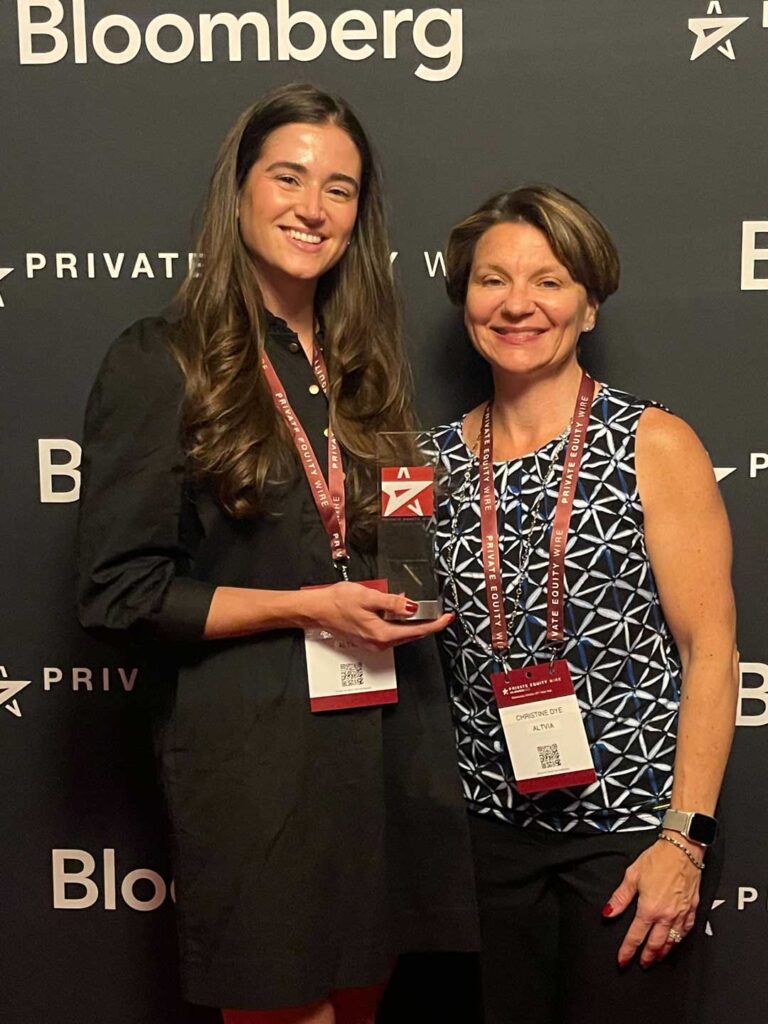
Alternative investments solution Altvia wins the Private Equity Wire 2023 Best new Solution Provider award.
Winners were announced last night during an awards ceremony and networking event held at The Penn Club in New York.

The Private Equity Wire US Awards recognize excellence among private equity fund managers and service providers in the US across a wide range of categories. Nominations for the service provider awards are based on a widespread survey of more than 500 GPs and industry leaders. Winners were announced last night during an awards ceremony and networking event held at The Penn Club of New York.

With a commitment to excellence in service, product innovation, and having a deep understanding of the unique needs of the industry, Altvia has become a trusted partner for hundreds of world-class firms seeking to optimize their processes and create a competitive edge in this competitive market. Acquired by Marlin Equity Partners in 2022, Altvia has increased its research and development investment to focus on transforming the way GPs deliver continuous value, real-time decision support, and secure communications to their valued investors.

With winning “Best New Solution Provider,” Altvia is proud to add a fourth Private Equity Wire Award alongside their dual wins of “Best Fundraising Solution” and “Best Secure Workflow Management Provider” in 2022 and “Best Secure Workflow Management Provider” in 2021.

To learn more about Altvia’s private equity CRM, alternative investment management software, and deal flow management solutions, or explore visit: https://altvia.com/platform/

About Altvia

As the technology pioneer for private capital markets, Altvia continues to drive innovation for GPs to deliver a best-in-class LP experience. Altvia is the first and only solution to successfully build a fully integrated CRM platform atop Salesforce – empowering private equity, venture capital, and other alternative asset professionals to streamline operations, enhance investor relationships, and extract valuable insights from their data. Learn more at www.altvia.com.

About Private Equity Wire

Private Equity Wire provides highly relevant and actionable information for GPs, service providers, and LPs.

Passthrough and Altvia Launch First CRM-Integrated Investor Onboarding Solution, OnboardingBridge

Enterprise leaders in fund workflow automation create multi-use-case and multi-purpose onboarding solution for fund managers.

September 6, 2023 09:00 AM Eastern Daylight Time

NEW YORK, NEW YORK – (BUSINESS WIRE) – Today, Altvia and Passthrough announced the launch of OnboardingBridge, the first solution to fully integrate a CRM with an investor onboarding solution, so that General Partners can provide a best-in-class investor experience.

Passthrough is a leader in fund workflow automation for investors, fund managers, and other fintechs. They enable investors to speed through the onboarding process, allowing fund managers to close capital commitments in minutes instead of weeks. Altvia is a market-leading software provider of CRM, Data Analytics, LP Portal, and Data Room. Their end-to-end solution, and unmatched expertise, help alternative investment firms seamlessly evolve and manage complexity as they grow, multiply funds, and expand their LP base. Since its initial announcement earlier this year, the strategic partnership with Altvia has enabled GPs to improve relationships with their LPs by providing a seamless, digital experience throughout the entire onboarding process.

Altvia’s OnboardingBridge powered by Passthrough, is the first solution to fully integrate a CRM with an investor onboarding solution. This strategic integration delivers rapid data processing, minimized onboarding risk, and expedites fund closures. This allows fund managers to close a raise weeks or even months faster by establishing one source of truth for investors. Altvia’s AIM CRM and Passthrough seamlessly transfer data back and forth by way of OnboardingBridge, which provides GPs with the most elegant and streamlined LP onboarding solution in private markets.

“Our objective has always been straightforward: to solve investor onboarding at the infrastructure level. By partnering with Altvia earlier this year, we leapt closer to that goal,” explains Tim Flannery, Co-founder & CEO of Passthrough. “Through OnboardingBridge, GPs can now prioritize relationship management without the burden of data administration. While Passthrough streamlines document completion and data system integration, GPs can get back to running their funds and utilizing readily accessible investor data.”

With OnboardingBridge, Passthrough and Altvia users will be able to efficiently utilize, import, and export accurate, pre-populated investor sub doc data for immediate use in Altvia’s AIM CRM. Additionally, rapid and seamless data transfer minimizes business delays, enabling teams to accelerate fund closing timelines without additional workloads. Its real-time visibility empowers firm-wide collaboration by providing a live onboarding status to investor relation teams within Altvia’s AIM CRM with no additional work.

“OnboardingBridge is a first-of-its-kind solution that’s directly addressing many of the data administration problems plaguing GPs and LPs everywhere,” says Jeff Williams, Altvia’s Chief Strategy Officer. “Especially as firms and GPs continue to grow and expand their LP base – we want to be providing them with the tools they need to seamlessly evolve and manage complexity. With the help of Passthrough, we’ve been able to do just that.”

“We’ve achieved data continuity throughout our fundraising process with OnboardingBridge,” says Sara Anderson, PennantPark’s Investor Relations Product Manager. “Because our fundraising and investor data seamlessly flows between our CRM and sub docs now, we’ve been able to use the time previously spent on manual processes for building relationships with our LPs, giving them a better experience all round. We can close our raise faster and our team is happier.”

To learn more about Passthrough and Altvia’s partnership, and how to get started with OnboardingBridge, please visit: https://passthrough.com/altvia or meet both teams in person at Private Equity International’s Investor Relations, Marketing & Communications Forum, held at Parc 55 in San Francisco on September 20 and 21.

About Passthrough
Passthrough turns workflows like subscription document execution into solved problems – seamlessly manages subscription document distribution, execution, and compliance in minutes. Founded by former leaders from the Carta Investors Services team Alex Laplante, Ben Doran, and Tim Flannery, Passthrough provides an integrated platform solution that makes the subscription document process turnkey for investors with replicable and verifiable identity information built in for future use. In addition to subscription documents, Passthrough also offers a comprehensive AML & KYC compliance product which collects information from investors so fund managers can remain compliant.

About Altvia
Altvia is a market-leading provider for CRM, investor and deal management systems specifically built for Private Capital Market firms. The company’s cloud-based platform (AIM, ShareSecure, Correspond, and Answers) is transforming the way GP’s deliver continuous value, real-time decision support, and secure communications to their valued constituents. Marquee firms across multiple verticals trust Altvia to optimize operational functions and enable critically important communications. Altvia is a Marlin Equity Partners portfolio company.

Media Contact:
Kathy Osborne
press@passthrough.com

Passthrough and Altvia Announce Strategic Partnership for Streamlined Investor Onboarding Process

Enterprise leaders in fund workflow automation partner for multi-use-case and multi-purpose solutions for fund managers

April 11, 2023 09:00 AM Eastern Daylight Time

NEW YORK–(BUSINESS WIRE)–Today, Passthrough and Altvia announce a new strategic partnership that will create a modern approach for Investor Relations teams to leverage data and technology to convert their fundraising funnel faster. Passthrough, a leader in fund workflow automation for investors, fund managers, and other fintechs, and Altvia, a purpose-built fund lifecycle platform to facilitate world-class partnerships between LPs and GPs, will be releasing an API integration later this year.

“By connecting with our infrastructure, Altvia’s fund managers can provide simplified investor onboarding relying on software instead of pen & paper so they can close their funds weeks or months faster.”Tweet this

Altvia is a market-leading provider of CRM, analytics, LP Portal, and Data Room software specifically built for Private Capital Market firms to help them gain visibility and insight with a real-time view of performance and activities across fundraising, investing, and LP engagement. Altvia’s end-to-end solution, and unmatched expertise, helps alternative investment firms seamlessly evolve and manage complexity as they grow, multiply funds, and expand their LP base.

Passthrough enables investors to speed through the onboarding process, allowing fund managers to close capital commitments in minutes instead of weeks. They turn workflows like subscription document execution and KYC/AML into solved problems – seamlessly managing subscription document distribution, execution, and compliance.

“We think investor onboarding should be solved at the infrastructure level and over API, which means we don’t need to be another destination for fund managers and investors to constantly check. Instead, we power the private capital market with a default investor onboarding tool for fund managers,” says Tim Flannery, Co-founder & CEO of Passthrough. “By connecting with our infrastructure, Altvia’s fund managers can provide simplified investor onboarding relying on software instead of pen & paper so they can close their funds weeks or months faster.”

Today, Altvia clients can sync historical investor information with Passthrough for a seamless document completion experience. With the upcoming integration, the information will sync live so investors will automatically be added to Passthrough’s investor onboarding solution for electronic subscription documents and KYC/AML offering. As part of the KYC/AML offering, Altvia customers will also be able to screen investors against sanctions lists on an initial and ongoing basis so they can monitor their risk.

“We are laser-focused on creating the private capital market’s most seamless and elegant investor experience technology” says Jeff Williams, Altvia’s Chief Strategy Officer. “To do that, we are partnering with best-of-breed solutions like Passthrough to provide similar experiences for our top tier client roster and their investors. The streamlined experience that comes as the result of this integration, together with Passthrough’s differentiated identity resolution data, made this partnership a natural fit, and we’re thrilled about what it offers the market.”

The initial real-time API integration will be released later this year. The strategic partnership between Passthrough and Altvia will continue to look for opportunities to extend the integration across products.

To learn more about Passthrough and Altvia’s new strategic partnership, please visit: altvia.com/passthrough.

Additionally, you can find the Passthrough and Altvia teams at the Private Equity International Investor Relations, Marketing & Communications Forum (PEI IR Forum) in NYC on April 19-20.

About Passthrough

Passthrough turns workflows like subscription document execution into solved problems – seamlessly manages subscription document distribution, execution, and compliance in minutes. Founded by former leaders from the Carta Investors Services team Alex Laplante, Ben Doran, and Tim Flannery, Passthrough provides an integrated platform solution that makes the subscription document process turnkey for investors with replicable and verifiable identity information built in for future use. In addition to subscription documents, Passthrough also offers a comprehensive AML & KYC compliance product which collects information from investors so fund managers can remain compliant.

About Altvia

Altvia is a market-leading provider for CRM, investor and deal management systems specifically built for Private Capital Market firms. The company’s mobile-optimized platform (AIM, ShareSecure, Correspond, and Answers) is transforming the way GP’s deliver continuous value, real-time decision support, and secure communications to their valued constituents. Marquee firms across multiple verticals trust Altvia to optimize operational functions and enable critically important communications. Altvia is a Marlin Equity Partners portfolio company.

Contacts

Media:
Kathy Osborne
press@passthrough.com