Author: Altvia Growth

The Raise Never Stops: Why Modern CFOs and IR Leaders Are Rebuilding Fundraising around Operations

For CFOs and Heads of Investor Relations, fundraising is no longer a periodic event. It’s a permanent state of readiness.

Every LP email.
Every quarterly update.
Every data room login.
Every follow-up question.

Each interaction quietly signals something to investors: how disciplined your firm is, how mature your operations are, and whether you’re truly institutional in how you run.

In today’s private markets, that signal matters almost as much as much as performance.

Because here’s the uncomfortable truth:

Being rich in data means nothing if you’re poor in intelligence.

Most firms don’t struggle because they lack information. They struggle because their information lives across spreadsheets, inboxes, point solutions, and tribal knowledge. The result is a familiar pattern:

  • LP questions require manual searches
  • Reporting feels like a monthly and quarterly fire drill
  • Updates describe activity, but not insight
  • Institutional knowledge walks out the door with people

This is not a talent problem, it’s not an effort problem, it’s an operations efficiency problem.

The highest-performing firms are quietly making a shift:
They’re treating fundraising and investor relations as a connected operational system—not a collection of tasks.

They are building what we call a Raise Every Day operating model.


Fundraising Readiness Is an Operational Capability

LPs increasingly expect:

  • Real-time answers, not static PDFs
  • Trendlines, not snapshots
  • Proactive communication, not reactive reporting
  • A firm that looks “fundraising ready” at all times

That expectation pushes fundraising out of the IR silo and directly into the CFO’s domain because fundraising readiness is now inseparable from:

  • Data governance
  • Systems architecture
  • Workflow automation
  • Adoption and accountability
  • Analytics and transparency

In other words: operational excellence.

Firms that recognize this early gain a structural advantage. Firms that don’t feel perpetually behind—even when performance is strong.


The Six Disciplines Behind Firms That Raise Every Day

The Raise Every Day framework outlines six daily disciplines that turn fragmented activity into a compounding operating system:

  1. Protect Data Integrity (and the Insights Behind It)
    Clean, structured, analytics-ready CRM data becomes the foundation of investor intelligence.
  2. Keep the VDR Investor-Ready
    Your VDR becomes a digital front door—not a dusty filing cabinet.
  3. Communicate with Clarity, Consistency, and Context
    Updates evolve from “what happened” to “what it means.”
  4. Make Every Interaction Count (and Actionable)
    Every meeting becomes structured relationship intelligence.
  5. Understand Users, Usage, and Ownership
    Adoption is measured, managed, and enforced.
  6. Ensure True Data Transparency
    One trusted source of truth across IR, Finance, Ops, and leadership.

Individually, each discipline improves execution. Together, they create something more powerful: a complete investor intelligence loop where engagement data, interaction history, reporting, and analytics continuously reinforce one another.


Why This Matters to CFOs

CFOs increasingly own:

  • Systems strategy
  • Data governance
  • Reporting integrity
  • Forecasting
  • Scalability

When investor data is fragmented, CFOs inherit:

  • Conflicting numbers
  • Manual reconciliation
  • Slower closes
  • Lower confidence in reporting

When investor data is connected, CFOs gain:

  • Predictable reporting
  • Trusted dashboards
  • Faster LP responses
  • Clear visibility into re-up risk and opportunity

Transparency doesn’t just build trust with LPs.

It builds trust inside the firm.


Why This Matters to Heads of IR

Modern IR is no longer defined by who sends the most updates. It’s defined by who delivers the most signal.

Signal looks like:

  • Knowing which LPs are engaging before they tell you
  • Understanding which topics resonate
  • Anticipating diligence questions
  • Proactively shaping narratives

That only happens when communication, CRM, VDR, and analytics are connected; not bolted together, not reconciled later, but designed as one system.


The Compounding Effect

Raise Every Day works because it compounds. Small daily actions like automated capture, consistent tagging, standardized workflows, and recurring dashboards create outsized results over time. 

Employing these daily actions results in:

  • Faster fundraising cycles
  • Stronger LP confidence
  • Higher re-up rates
  • Institutional memory that doesn’t walk out the door

Download The Playbook

Want the full framework, checklists, and 30-day implementation plan?

Download The Investor Relations Operations Playbook for Private Capital and start building your Raise Every Day engine.
How Inconsistent LP Communication Erodes Trust, and What to Do About It

LP confidence rarely disappears in one dramatic moment.

It doesn’t vanish because a fund misses a quarter. It doesn’t collapse because a portfolio company struggles. More often, confidence fades through a series of small, almost unremarkable experiences that quietly stack up over time.

An update arrives later than expected.
A number in a quarterly report doesn’t quite match what appeared in a previous deck.
A simple follow-up question takes days to answer.
Context has to be re-explained, again.

None of these moments feels catastrophic in isolation. But together, they form a pattern. And LPs are very good at recognizing patterns.

The pattern they infer is simple: this firm is having trouble keeping its own house in order.

In today’s market, that inference alone is enough to change how LPs allocate capital.


The Market Has Shifted from Storytelling to Reliability

Private capital has always been relationship-driven. But the nature of those relationships is evolving.

For years, strong narratives and access carried significant weight. If a GP could articulate a compelling strategy and point to historical performance, LPs were willing to tolerate a certain amount of operational messiness behind the scenes.

That tolerance is disappearing.

As fundraising cycles lengthen and portfolios grow more complex, LPs are increasingly underwriting not just the opportunity, but the organization itself. They want confidence that a firm can operate with discipline across cycles, structures, and market conditions.

That confidence is built less through polished storytelling and more through consistent execution.

LPs are paying attention to whether updates arrive when promised, whether numbers stay consistent across channels, and whether questions are answered quickly and clearly. These signals tell LPs far more about a firm’s maturity than any positioning statement ever could.

Reliability has become the new differentiator.


When Communication Becomes Unpredictable, Trust Starts to Leak

Many firms assume strong returns will buy them patience from LPs. In reality, strong performance raises expectations—and shortens tolerance for inconsistency.

When performance is good, LPs expect professionalism to match. Any operational friction feels disproportionate. It creates cognitive dissonance: if this firm is capable of generating strong returns, why does something as basic as reporting feel hard?

One mid-market buyout firm experienced this dynamic during a recent raise. Their track record was solid, and their strategy resonated. Yet diligence stretched on longer than expected. LPs kept requesting clarifications. Conversations felt repetitive.

The issue wasn’t that information was missing. It was that information wasn’t perfectly aligned across the deck, the data room, and follow-up emails. Slight variances created hesitation. LPs didn’t say they lacked trust—but their behavior changed. Timelines slowed. Internal LP committees asked for more verification.

What looked like a communication issue on the surface was actually an operating issue underneath.


Why Reactive IR Is Structurally Broken

Most IR teams still operate in a reactive mode. They assemble updates when deadlines approach. They pull information when LPs ask. They reconcile discrepancies after something looks off.

This model developed when fund structures were simpler, LP bases were smaller, and reporting expectations were lighter. It is poorly suited for today’s environment.

Reactive IR almost guarantees last-minute scrambles, manual reconciliation, and version-control problems. Even highly capable teams find themselves spending more time validating information than communicating it.

LPs feel this friction even if they never see the internal chaos. They experience it as delays, follow-up questions, and inconsistent answers.

Over time, those experiences shape perception. Not about effort. About maturity.


Proactive IR Is an Operating Model, Not a Personality Trait

Some IR professionals are naturally organized communicators. That helps. But proactive IR at scale cannot depend on individual heroics.

It requires an operating model designed for readiness.

Proactive IR means that data is clean before anyone asks for it. It means that reporting is continuously maintained, not reconstructed every quarter. It means that relationship context is captured in real time and accessible across the organization.

A growth equity firm that moved to this model saw a fundamental shift in how quarterly reporting worked. Instead of treating the quarter-end as a starting line, they treated it as a packaging exercise. Metrics were always current. Commentary was drafted throughout the quarter. By the time reporting was due, most of the work was already done.

LPs noticed the difference. Reports arrived earlier. Follow-up questions decreased. Conversations moved away from clarifications and toward strategy.

Nothing about the firm’s investment approach changed. The operating posture did.


The Root Cause Is Almost Always Fragmentation

Most firms didn’t design their tech stack intentionally. They accumulated it over time.

A CRM for contacts.
Spreadsheets for tracking.
An LP portal for sharing.
A VDR for diligence.
Email for everything else.

Each tool solves a local problem. Together, they create fragmentation.

Data ends up living in multiple places. Ownership becomes unclear. Different teams maintain different versions of “truth.” Inconsistency becomes inevitable.

A venture firm experienced this during co-invest diligence when multiple partners responded to LP questions using their own spreadsheets. The numbers were directionally correct, but not identical. LPs compared notes. Momentum slowed.

After consolidating deal, investor, and communication data into a single platform, future processes looked different. One source. One answer. One narrative.

LPs stopped cross-checking.


Raise Every Day: Designing for Continuous Readiness

High-performing firms assume they are always in market, even when they aren’t actively raising.

This is the foundation of the Raise Every Day operating model.

Raise Every Day firms design operations so that LP-ready data is always current, investor materials are continuously maintained, and relationship context is captured at the moment of interaction. They treat fundraising readiness as a daily discipline, not a quarterly project.

One buyout firm operationalized this by adopting a simple rule: if it isn’t in the system, it didn’t happen. Over time, CRM adoption increased, shadow spreadsheets disappeared, and reporting cycles compressed.

LP-facing outcomes followed naturally. Fewer clarifications. Faster responses. Greater confidence.


Where Technology Becomes Strategic

Technology alone doesn’t make firms proactive. But the right architecture makes proactive behavior possible.

When fundraising, IR, and deal workflows live inside a single private-capital platform, data stays connected, context travels with relationships, and reporting becomes reliable by default.

Altvia was built for this operating reality.

Not as a generic CRM.
Not as a collection of point solutions.

But as infrastructure for proactive IR.

The result isn’t just efficiency. It’s predictability.

And predictability is what LPs interpret as trust.


The Bottom Line

LPs aren’t losing confidence because firms lack returns.

They’re losing confidence when communication feels chaotic.

Delayed and inconsistent updates signal deeper operational risk. The fix isn’t sending more emails or polishing decks. It’s shifting from reactive IR to proactive IR. From communication as an event to communication as a system.

Firms that make this shift raise faster, retain LPs longer, and build durable advantages across cycles.


Learn how top IR teams operationalize proactive IR

Download the Raise Every Day Fundraising Operations Playbook or watch for our recent webinar:
Fundraising in 2026: What High-Performing IR Teams Do Differently

Because in today’s market, trust isn’t built quarterly.

It’s built daily.

Trust: The New Performance Metric

For most of private capital’s history, performance has had a fairly clear definition: strong returns, consistent distributions, attractive multiples.

Those metrics matter; they always will.

But in today’s market, they no longer tell the whole story of why capital flows to certain firms and not others. Increasingly, LPs are making allocation decisions based not only on what a firm has produced, but on how confidently they believe that firm can operate going forward.

That confidence has a name: trust. Not just brand trust or reputation, but operational trust.

And it is quietly becoming one of the most important performance indicators in private capital.


LPs Are No Longer Just Underwriting Funds. They’re Underwriting GP partners.

This shift didn’t happen overnight.

It emerged as fund structures became more complex, portfolios more global, and operating environments more volatile. Continuation vehicles, co-investments, private credit strategies, and hybrid structures now sit alongside traditional buyout and growth funds. Reporting expectations have expanded. Regulatory scrutiny has increased. LP organizations themselves have become more sophisticated.

In this environment, historical returns are no longer a sufficient proxy for future success. LPs still care deeply about performance, but they also want to understand how a firm actually runs. They want confidence that the organization behind the numbers has the discipline, visibility, and controls required to navigate uncertainty.

That confidence is built through day-to-day experience.

  • Do updates arrive when promised?
  • Do numbers remain consistent across materials?
  • Do teams respond quickly and accurately?
  • Are issues surfaced early or discovered late?

Over time, these experiences shape a quiet conclusion: this firm is in control—or it isn’t.


When Trust Is High, Friction Disappears

Many mid-market private equity firms encounter a version of this scenario. During raises, performance numbers look strong and strategies resonate, yet diligence still stretches longer than expected. LPs keep circling back with follow-up questions. Internal LP committees ask for additional validation. Timelines slow without any obvious red flag.

Nothing is materially wrong with the data.

But small inconsistencies begin to surface across decks, quarterly letters, and data room materials. No single discrepancy is alarming on its own. Collectively, they introduce hesitation.

LPs don’t say they don’t trust the firm, they simply stop moving quickly.

We’ve had clients come to us with this scenario, and after centralizing reporting and standardizing how data is captured and shared, something changes.

Follow-up questions decrease, diligence cycles compress and, importantly, conversations shift away from verification and back toward strategy.

The PE firm’s performance hasn’t changed. But by abandoning point solutions and adopting a connected system designed to unify capital raising and client service their operational trust now meets the execution expectations their returns imply.


Trust Shows Up as Speed, Not Sentiment

Trust in private capital rarely manifests as praise; it manifests as ease.

LPs who trust a firm assume competence before proof. They don’t scrutinize every figure. They don’t request the same data multiple times. They don’t second-guess every explanation.

That assumption of competence dramatically reduces friction.

A private credit manager experienced this after modernizing their IR operations. Beforehand, LP data requests routinely took days to fulfill because information lived across spreadsheets, inboxes, and individual desktops. After consolidating investor, portfolio, and reporting data into a single system, response times dropped to minutes.

LP behavior changed almost immediately.

Fewer ad hoc questions.
More real-time dialogue.
More strategic conversations.


The Hidden Driver of Trust: Operational Consistency

Many firms think of trust as a function of communication quality like clean decks, clear messaging, and polished updates. And while those things matter, they don’t create trust on their own.

Trust is created when a firm demonstrates, repeatedly, that it can produce accurate, consistent, and timely information without drama.

That capability is operational, not rhetorical.

It depends on:

  • Clean data at the source
  • Standardized capture processes
  • Shared visibility across teams
  • Repeatable reporting workflows

When those foundations exist, communication feels effortless. When they don’t, even talented teams struggle.

A growth equity firm managing multiple strategies saw this firsthand. Quarterly reporting used to require weeks of manual reconciliation between IR, finance, and deal teams. Last-minute changes were common. Confidence was eroding.

After implementing standardized data capture and reporting workflows, quarterly updates became routine. Metrics were always current. Commentary was drafted throughout the quarter. Reports went out earlier with fewer revisions.

LPs never saw the internal transformation, they simply experienced consistency. And consistency reads as competence.


Why Fragmentation Quietly Works Against Firms

Most private capital firms didn’t design their operating environments—they accumulated them.

A CRM for contacts.

Spreadsheets for tracking.

An LP portal for sharing.

A VDR for diligence.

Email for everything else.

Each tool solves a narrow problem. Together, they create fragmentation where operational efficiency is required.

Data lives in multiple places. Ownership becomes unclear. Different teams maintain different versions of “truth.” And inconsistency becomes inevitable—not because teams lack discipline, but because the operating model works against them.

Implementing more technology doesn’t fix this, and it doesn’t earn trust with LPs.

Trust is built through consistent execution: accurate information, timely responses, and the same answers every time. The role of technology is not to create trust, but to make that consistency possible at scale by reducing fragmentation and establishing a shared operational foundation.

When fundraising, IR, and deal workflows live inside a single private-capital platform, data stays connected. Context travels with relationships. Reporting becomes reliable by default, not heroic by effort.

Altvia was built for this operating reality.

Not as a generic CRM.

Not as a patchwork of point solutions.

But as infrastructure for how private capital firms actually operate.

The result is not just efficiency. It’s organizational confidence.

And organizational confidence is what LPs experience as trust.


The New Performance Lens

Private capital firms will always track IRR, DPI, and TVPI.

But the firms that outperform in the next decade will also pay close attention to quieter signals:

  • Time to respond to LP requests
  • Reporting error rates
  • Data reconciliation frequency
  • System adoption
  • Consistency across materials

These indicators predict something more powerful than last quarter’s return.

They predict whether LPs will bet on you again.


The Bottom Line

Returns still matter. But in today’s market, returns open the door.

Trust determines who walks through it.

Trust is no longer a soft concept. It’s an operational outcome. It’s a competitive advantage.

And increasingly, it is the performance metric that separates firms that raise consistently from firms that stall.


Learn how top IR teams operationalize trust

Download the Raise Every Day Fundraising Operations Playbook or watch our recent webinar:
Fundraising in 2026: What High-Performing IR Teams Do Differently

Because in today’s market, performance still matters, but trust decides who gets paid.

If You’re Chasing Data, You’re Already Behind: 5 IR Mistakes Slowing You Down (and How to Fix Them)

You know the feeling.

An LP email hits your inbox at 4:17 p.m. asking for updated exposure numbers or clarification on a metric from last quarter. You open the shared folder — three versions of the workbook. Slack a teammate — they think Finance updated it last night. Someone else sends a deck — but the numbers don’t match.

Fifteen minutes later, you’re still trying to figure out which version is correct.

And that’s before you even start answering the question.

If you’re constantly hunting for data, merging spreadsheets, digging through inboxes, or recreating decks from scratch, you’re not just behind — you’re operating inside a workflow that simply can’t keep up with modern LP expectations.

The problem isn’t your skill or effort. It’s the system. LPs now expect:

  • Faster response times
  • Deeper verification
  • Real-time transparency
  • Institutional-grade reporting

However, most IR teams are still running on tools and processes built for a different era. That gap creates stress for analysts, slower responses for LPs, and credibility risk for the firm. Here are the 5 IR workflow mistakes that are slowing you down (plus how to fix them).

Mistake #1—Treating Spreadsheets as the Source of Truth

Most IR analysts are juggling so many spreadsheets they could qualify for a technical certification. But the deeper issue isn’t volume—it’s versioning. When every report, deck, or update begins with “Which file is the right one?”, you’re behind and frustrated.

Spreadsheets multiply, drift out of sync, get copied into personal folders, and become unsupervised sources of truth. One formula shifts, one row is misaligned, one decimal slips—and suddenly LPs spot inconsistencies your team didn’t catch.

This creates a constant cycle of validating, revalidating, and triple-checking numbers. Not because the data is wrong—but because the systems around it are fragile.

How do you fix it? 

The fix is simple in concept but transformational in practice: a single connected source of truth. With Altvia, investor, fund, and performance data all live in one place, updated once and trusted everywhere. Analysts stop validating numbers and start using them.

Mistake #2—Managing Investor Updates Through Email

Email is where investor communication goes to disappear. Threads splinter, attachments get outdated, approvals vanish in multi-layer replies, and context gets buried beneath back-and-forth messages.

When an LP asks, “Didn’t you send this last month?” you shouldn’t have to dig through six threads or text a teammate to confirm.

Using email as the operational backbone for IR creates avoidable confusion:

  • No one knows which version was sent
  • No one sees whether LPs engaged with the content
  • No one can track past interactions without hunting through inboxes

LP relationships are built on clarity—but email creates fog.

How do you fix it? 

By shifting to a connected communication layer, IR teams get full visibility into what went out, who received it, and how they engaged. With an LP Portal and integrated communication history, analysts can answer questions instantly instead of reconstructing the past.

Mistake #3—Manually Compiling Reports and Decks

You know the drill: it’s reporting week, and nights disappear into formatting charts, validating formulas, and exporting updated numbers into slides—only to repeat the process again when finance sends a new version at 7 p.m.

These cycles aren’t just exhausting—they’re risky. Manual reporting is where errors hide. A misaligned column, an outdated screenshot, a mislabeled chart—LPs catch these instantly.

Analysts shouldn’t be spending their time maintaining spreadsheets and decks. They should be analyzing what the numbers mean.

How do you fix it? 

Modern IR teams automate the reporting foundation so humans can focus on interpretation, not assembly. AI tools like Altvia’s AIMe eliminate repetitive steps, build consistency into reporting workflows, and turn multi-hour production processes into minutes.

Automated reporting doesn’t just save time—it builds confidence.

Mistake #4—No Visibility Across IR, Finance, and Deal Teams

One of the fastest ways to lose LP trust is internal misalignment. Finance believes one thing, IR is sharing another, and the Deal Team is working off a completely different set of numbers. The LP asks a question that crosses teams—and suddenly everyone is scrambling.

This lack of visibility creates:

  • Conflicting answers
  • Duplicated work
  • Delays that signal risk to LPs

And often, the LP ends up with more real-time insight into the firm’s performance than the people in the room.

How do you fix it? 

A connected operational layer changes that dynamic completely. When IR, Finance, and Deal Teams all pull from the same system, answers become fast, consistent, and credible. Analysts get clarity, leaders get confidence, and LPs get transparency.

Mistake #5—Relying on Tribal Knowledge Instead of Connected Workflows

Every IR team has that one person who “just knows” where everything lives, what was said to which LP, or what the latest update was.

The problem? When knowledge lives in people instead of systems, the entire firm becomes fragile. 

New analysts struggle to onboard. Context evaporates when someone leaves. LPs receive inconsistent answers depending on who responds. Critical insights never make it back into the operational record.

High-performing IR teams build institutional memory — not personal memory. Connected workflows ensure every interaction, insight, and data point automatically becomes part of the firm’s operating fabric.

How to fix it? 

Altvia does this naturally: capturing, structuring, and surfacing information so analysts never start from zero. When knowledge moves from heads to systems, the team moves from reactive to truly proactive.

Conclusion: What IR Teams Look Like When They Stop Chasing Data

When analysts no longer spend their days hunting for numbers, updating spreadsheets, and revalidating reports, everything about the IR function changes:

  • LP responses go from days to minutes
  • Reporting becomes predictable, consistent, and accurate
  • Analysts contribute insights, not just updates
  • IR leaders gain clarity and confidence when meeting with LPs
  • The entire firm appears institutional, prepared, and trustworthy

This is what it looks like to raise every day—not scrambling for answers, but operating from a foundation of readiness.

How Altvia Helps IR Teams Build Daily Discipline

Altvia gives analysts the infrastructure they need to stay ahead instead of falling behind:

  • A single source of truth for all investor data
  • Automated reporting and workflows
  • Connected visibility across IR, Finance, and Deal teams
  • Instant access to institutional knowledge via AIMe
  • Unified communication through the LP Portal

The result: Our customers tell us they free up more than 220 hours a year using our platform, and operate as a confident, modern, institutional-grade IR function.Take the first step toward a more prepared, more proactive IR function.


👉 Download The Raise Every Day Playbook — a practical guide to raising every day, improving operational maturity, and earning LP trust.

From Data Chaos to Clarity—Why LPs Are Demanding a Single Source of Truth

In private capital, performance and relationships have always defined success. In today’s market, CFOs and COOs are increasingly feeling the pressure of a new LP expectation: data integrity. LPs now view accuracy, consistency, and data transparency as signs of a mature, well-run firm.

When numbers vary between spreadsheets, CRM entries, and reports, it doesn’t just slow diligence—it signals operational friction. And for firms still relying on inboxes and Excel, answering questions confidently is becoming more challenging.

The good news? These issues are fixable—and firms that address them gain a meaningful advantage.

The Hidden Cost of Disconnected Systems

Data fragmentation builds gradually, often with the best intentions: a spreadsheet created because the CRM “can’t do that,” a VDR that isn’t integrated, a fund admin who maintains separate numbers.

SP Global Market Intelligence notes that fragmented systems across private markets make a unified, cross-fund view nearly impossible—a challenge that limits transparency and slows reporting.

Disconnected systems lead to:

  • Multiple versions of the truth
  • Inconsistent LP reporting
  • Hours spent reconciling before each diligence request

LPs don’t always mention these inconsistencies explicitly, but they notice them. And when they do, confidence shifts.

Operational Best Practice: Establish a single source of truth by consolidating CRM, reporting, and analytics into a unified data environment. Start with the critical workflows: commitments, interactions, and reporting.

The LP Perspective—Trust Starts with Data Integrity

LPs are sophisticated consumers of information. They expect quick access to accurate data, clear explanations, and a record of operational discipline. When something feels inconsistent—like mismatched commitment totals or outdated AUM—it delays diligence and raises avoidable questions.

LPs increasingly see data transparency as part of operational due diligence. They want to know:

  • How quickly can you retrieve historical data?
  • Are records consistent across IR, finance, and admin systems?
  • Can you show a clean audit trail?

Operational Best Practice: Build processes that ensure data consistency across teams, with a system that captures updates centrally and provides a clear audit trail.

Why Most Mid-Market Firms Are Stuck

It’s rarely about capability. It’s about alignment.

Growth often outpaces infrastructure. Firms add funds, investors, and complexity—but the tools stay the same.

Common challenges include:

  • No shared visibility across IR, Finance, and Ops
  • Homegrown spreadsheets created to “get things done”
  • Manual reconciliation before every meeting
  • Incomplete audit trails
  • CRMs not designed for private markets

Teams end up working harder, not smarter. But these aren’t failures. They’re signals that the firm has reached the next stage of operational maturity.

Operational Best Practice: Evaluate where manual work is concentrated and replace those workflows with automated, integrated processes that reduce duplication.

The Case for Connected Intelligence

Connected Intelligence is the modern approach to private capital data management. It unifies CRM, analytics, reporting, and LP communication into a single operational layer. For CFOs and COOs, a connected intelligence approach delivers:

  • Real-time access to accurate fund data
  • Faster LP query response
  • Seamless audit readiness
  • Consistent, automated reporting
  • Cross-team alignment

As PwC puts it, when your data works together, your team can too. A connected intelligence approach frees teams from manual work and enables them to focus on value-creating priorities.

Operational Best Practice: Adopt a connected platform built for private capital—and equally important, establish the processes and roles that keep it clean and aligned.

Altvia’s Role: Bringing Clarity and Confidence to Private Capital Data

Altvia was built for this exact moment in private markets. Our Salesforce-based architecture is designed specifically for private equity and venture capital operations, providing a single source of truth for investor, fund, and financial data, helping firms operate with confidence and control.

Altvia provides:

  • Unified CRM + Analytics + LP Portal
  • Real-time data integrity
  • Automated reporting and communication
  • Audit-ready transparency
  • AI-driven data enrichment

With Altvia, CFOs and COOs can eliminate reconciliation, reduce risk, and ensure the firm communicates with consistency—every day, every quarter, and every raise.

Ready to Move From Data Chaos to Clarity?

Download the Fundraising Readiness Checklist to benchmark your data integrity and operational maturity.

What the Next Generation of Private Capital Looks Like

The Firms That Raise Every Day

It happens in seconds—and every GP has felt it. You walk into the LP meeting confident. You’ve prepared the deck, rehearsed the update, and aligned with finance on the core numbers.

But before you even sit down, the LP opens with a question you weren’t expecting:

“We noticed the Q3 exposure numbers don’t match what your team shared last week. Can you walk us through the discrepancy?”

Your stomach sinks. You know the data is “mostly right”—but the version you brought isn’t the version finance sent. The analyst updated the spreadsheet after hours. Someone pulled numbers from an old report. 

You need five minutes to check. You only have five seconds to respond.

At that moment, the LP has more information than you do. And suddenly, the meeting has shifted from building trust… to restoring it.

This is the reality for private capital firms, but it doesn’t have to be. 

Returns Open the Door, Operational Excellence Closes the Deal

For the first time in more than a decade, the fundraising environment has flipped. According to Preqin’s 2024 Private Capital Report, global private equity fundraising fell sharply, and the average time to close a fund stretched to over 20 months, up from 14.6 months pre-2020.

This shift has created a new dynamic. LPs have more options than managers, and behavior is changing as a result, including:

  • Re-upping less frequently.
  • Consolidating commitments toward fewer, more mature managers.
  • Expecting deeper operational transparency during due diligence.

In short: returns open the door, but operational excellence closes the deal.

The firms that consistently stand out aren’t simply delivering strong performance—they’re demonstrating readiness, reliability, and discipline at every LP touchpoint.

Fundraising is No Longer An Event; It’s Continual

LP expectations have changed. They expect a continuous view of the firm, in addition to quarterly updates. Therefore, the long-standing practice of many mid-market firms to treat fundraising like a fire drill no longer meets the needs of their LPs. They wait until it’s time to raise, then scramble to:

  • Pull together reports
  • Reconcile data across systems
  • Chase documents, updates, and requests
  • Re-engage LPs who haven’t heard from them since the last close

This episodic method of fundraising falls short because:

  • Manual reporting leads to inconsistent or delayed answers
  • Disconnected systems create multiple versions of the truth
  • IR and Finance teams lose valuable time searching, checking, and rechecking numbers
  • LPs feel uncertainty when updates or reporting aren’t instant or consistent

What used to be “good enough”—basic transparency and punctual reporting—is now table stakes. LPs interpret slow or inconsistent responses as operational risk. And when LP trust weakens, dollars flow elsewhere. 

That’s why a new approach to fundraising is necessary. One that uses operational excellence, real-time data transparency, and high-touch investor relations to always be at the ready to raise. 

A Shift: From Reacting to Anticipating LP Needs

The new generation of successful private capital firms has embraced a fundamental mindset shift: fundraising isn’t an event—it’s a daily discipline. It means always being:

  • Investor-ready
  • Data-ready
  • Audit-ready
  • Diligence-ready
  • Trust-ready

This shift reflects the evolving reality of IR: it’s no longer about reacting to LP needs—it’s about anticipating them. To do that, firms need:

  • Connected intelligence instead of siloed systems
  • Institutional processes instead of heroic efforts
  • Real-time visibility instead of quarterly snapshots
  • Team-wide alignment instead of isolated functions

This is the new competitive edge—and it’s reshaping what growth and maturity look like in private markets.

What Winning Firms Have in Common

Across private equity, venture, real assets, and fund-of-funds, the highest-performing mid-market firms share three traits:

  1. Unified Data Across Teams: Fundraising, IR, finance, and deal teams operate from a single source of truth—not different spreadsheets and systems. This eliminates errors, reduces back-and-forth, and accelerates LP response times.
  2. Investor Transparency Through Connected Technology: LPs get accurate, timely updates, shared securely through modern portals and data rooms. Credibility is built through consistency.
  3. Disciplined, Repeatable Processes: Instead of last-minute data hunts, teams follow workflows that ensure everything is ready before LPs even ask. Credibility becomes compounded.

When firms establish these three disciplines, they build something even more powerful than a strong raise; they build trust that lasts across funds.

How Altvia Helps Firms Raise Every Day

Operational excellence is no longer a nice-to-have—it’s a differentiator. Altvia gives private capital firms the connected infrastructure to achieve it. Altvia unifies fundraising and investor operations across:

  • CRM (purpose-built on Salesforce)
  • LP Portal (for transparency and trust)
  • Virtual Data Room (secure, audit-ready sharing)
  • Analytics & Dashboards (real-time insight)
  • AIMe AI Assistant (automated workflows + data enrichment)

Together, these capabilities give firms:

  • Connected Intelligence: instant access to the data required to answer LP questions quickly, accurately, and confidently.
  • Relationship Capital: consistent, personalized LP communication that strengthens trust throughout the fund lifecycle.
  • Scalable Growth & Trust: institutional-grade systems and workflows that scale as funds, LPs, and complexity increase.

Real-World Impact: Informed LPs, Confident Teams, Time Savings

When firms implement a unified system like Altvia, they experience measurable transformation:

  • Significant reductions in LP response time — in some cases up to 50%
  • 220+ hours saved per IR team member through automation
  • Higher LP re-up rates due to transparency and consistency
  • Faster fund closings because diligence friction is removed

Replace with: 

  • Significant reductions in LP response time — in some cases up to 50%
  • 200+ analyst hours reclaimed annually through reporting automation
  • Higher LP satisfaction and re-up likelihood due to consistent transparency
  • Smoother diligence processes and faster fundraising cycles

In an environment where LPs are scrutinizing operational maturity more than ever, Altvia gives firms the confidence to raise—every day.

(Altvia, EY Global PE Survey, Bain Global Private Equity Report) 

Conclusion: The Future Belongs to the Firms that Are Ready Every Day 

The private capital firms that will lead the next decade aren’t waiting for fundraising cycles. They’re preparing for them—every day, in every interaction, with every LP.

They’re building connected teams, unified systems, disciplined operations, and transparent workflows. They’re raising trust. They’re raising credibility. They’re raising capital—continuously.

Because in a market where expectations are rising and competition is tightening, if you’re not ready every day, you’re already behind.

Need help raising every day? 

👉 Download the Playbook

👉Schedule a Meeting 

Rethinking the Raise: Four Pillars for a New Era of Fundraising

A Market Under Pressure

Private capital fundraising has entered a new era—defined by longer cycles, sharper scrutiny, and higher expectations. According to Preqin, the median PE fundraising timeline has jumped from 14 to 19 months in just two years, a 35% increase. Nearly 90% of LPs now report receiving GP extension requests (Coller Capital), reflecting tighter liquidity and deeper diligence. Global fundraising volumes reinforce the trend: down 35% in Q1 2025, with fund closings off by 34% (Paul Weiss).

For GPs, this new environment creates real pressure. Every month spent on the road compresses IRR, while rivals get more time to court the same LPs. Meanwhile, new SEC requirements like the Form PF update (effective June 2025) mandate faster, more granular reporting, raising the bar for operational rigor.

LPs aren’t just assessing past performance—they are evaluating how firms run the fundraising process itself. They want clarity of thesis, transparency of data, disciplined communication, and evidence of partnership readiness. These demands crystallize into four partner-level pillars: Story, Data, Communication, and Relationship Intelligence. And, spoiler alert, a technology platform that’s built for PE workflows is the connective tissue enabling all four.


Pillar 1: Story — Clarity Is Currency

Your story is no longer optional; it’s a gating factor. LPs must be able to repeat it credibly in two sentences to their allocation committees.

  • Generic: “We target fragmented markets with favorable demographics.”
  • Differentiated: “We acquire rural outpatient clinics producing $3.8B EBITDA annually, trading 25% below urban comps due to regulatory hurdles. Our team doubled margins at three acquisitions. We target 22–24% net IRR and 2.0× DPI in five years.”

The second is specific, credible, and repeatable—exactly what LPs need. Your CRM platform ensures consistency by automatically syncing KPIs, track record visuals, and updates across decks, DDQs, and LP portals, reducing the risk of discrepancies that erode trust.


Pillar 2: Data — From Static Numbers to Living Proof

In Preqin’s 2025 survey, 73% of LPs cited inconsistent reporting as their top frustration. Data that is scattered or delayed slows processes and undermines confidence. Today’s baseline expectation: centralized, transparent, and comparable reporting.

Best practice includes:

  • Standardizing reporting formats, fee disclosures, and communication templates. Centralizing performance history, portfolio updates, and communication in one secure portal.
  • Presenting not just results but drivers—margin expansion, exit multiples, deployment velocity.

Technology’s role here is pivotal. Native integration between CRM, data room, and reporting platforms eliminates version conflicts and manual reconciles, while audit-ready trails reinforce trust.


Pillar 3: Communication — Cadence Builds Confidence

Every interaction is a test. LPs interpret communication as a proxy for how you’ll operate post-close. Top-performing GPs establish predictable cadences: publishing calendars with milestones like deck freezes, data refreshes, and target closes, and sending updates within 24 hours if timelines shift.

Candor is equally critical. A same-day update explaining why a deal fell through builds more confidence than silence or spin. Technology reinforces this discipline by automating workflows, sending reminders, triggering LP-specific updates, and ensuring consistency across every touchpoint.


Pillar 4: Relationship Intelligence — Partnership Readiness in Practice

Fundraising is less about transactions than signals of partnership quality. LPs evaluate how you listen, coordinate, and preserve context.

Relationship intelligence means:

  • Capturing every interaction and feedback loop.
  • Tracking LP behavior in portals and prioritizing those who engage deeply.
  • Acting on repeated concerns to demonstrate adaptability.

To enable this partnership, purpose-built CRMs integrated with portals and workflows ensure institutional memory—so even with team turnover, LPs experience seamless continuity instead of repeated questions.


Integrated Technological Platform — The Foundation That Scales Trust

Across all four pillars, integrated technology is the foundation. It:

  • Provides structure: unified platforms eliminate manual reconciles.
  • Signals maturity: workflows and audit trails demonstrate polish.
  • Enhances service: LP portals, proactive alerts, and tailored dashboards build trust and drive re-ups.

Carried forward post-close, this infrastructure ensures continuity: automated reporting in hours, real-time dashboards, and seamless handoffs across teams. GPs who embed technology in their fundraising process not only raise capital more efficiently—they build lasting, compounding partnerships.


Where Altvia Fits

Altvia brings the four pillars together in one purpose-built platform for private capital:

  • Unify your story: sync KPIs and track record visuals across decks, fundraise datarooms, and portals.
  • Centralize your data: standardize disclosures and maintain version control in a secure, audit-ready environment.
  • Operationalize communication: automate calendars, updates, and variance notes triggered by LP activity.
  • Build institutional memory: capture every touchpoint and preference, ensuring continuity across vintages.

Altvia Advantage: With a unified data model spanning CRM, LP portal/VDR, analytics, and workflows, Altvia delivers the institutional polish LPs notice.

Read more in our free Rethinking the Raise eBook here! Don’t worry, we don’t need your information to access it either.

👉 Ready to see how it works? Request a Demo

From Headaches to High Performance: What IR Leaders Learned at the PEI IR Member Meeting

At the recent PEI IR Member Meeting, investor relations professionals came together to compare notes on what’s working—and what’s not—as they navigate another year of evolving LP expectations, data complexity, and pressure to fundraise faster.

Across three sessions, a clear theme emerged: the future of IR is digital, data-driven, and deeply human. Teams are learning how to modernize their systems and workflows without losing the trust and relationships at the heart of private capital.

Here are the biggest takeaways and how leading firms are turning common challenges into opportunities for efficiency, insight, and stronger LP relationships.


1. Turning Data Chaos into Clarity

Many IR leaders shared familiar frustrations: messy CRM data, disconnected systems, and difficulty getting a true picture of LP activity. Some teams have even switched CRMs in search of better usability, while others are investing heavily in cleanup projects between fundraises.

The lesson was simple: data quality is everything. A CRM is only as valuable as the information inside it—and without connected systems, firms can’t act quickly or confidently.

Modern IR teams are focusing on unifying data across platforms and automating the flow between CRM, accounting, and investor portals. The goal isn’t just clean data; it’s usable data that fuels better decisions, faster fundraising cycles, and more meaningful LP communication.

That’s where integrated platforms prove their worth—offering one connected source of truth and automation that eliminates manual errors and guesswork, while providing clarity for the entire firm.


2. Technology Should Strengthen Relationships, Not Replace Them

As AI and automation take center stage, IR professionals were quick to emphasize one truth: technology can make you faster, but relationships are still the currency of private capital.

The best-performing firms are using automation to enhance personalization, not diminish it. Tools like AI note summarization, contact mapping, and engagement tracking are helping teams anticipate LP needs and deliver more relevant updates.

For smaller teams, this shift is especially powerful—replacing hours of manual reporting with intelligent workflows that surface insights instantly. The freed-up time allows professionals to focus on what matters most: building and maintaining trust through consistent, transparent communication.

The roundtable discussions made it clear: digital infrastructure isn’t about replacing the human touch; it’s about scaling it.


3. Building the Infrastructure for Confident Growth

With so many new tools entering the market, firms are balancing innovation with caution. Security, compliance, and scalability are top of mind — especially as AI becomes embedded in CRM and investor communication workflows.

Participants stressed the importance of data stewardship and responsible automation. A well-governed system — one that can grow alongside the firm without sacrificing accuracy or oversight — has become a competitive differentiator.

The most forward-thinking IR teams are implementing flexible, secure systems that can handle multi-fund operations, new communication channels, and increasingly complex LP requirements. Their systems aren’t just functional; they’re future-ready, providing confidence that as the firm expands, its data and relationships remain protected.


Bridging the Digital and the Human

The takeaway from the PEI IR Roundtable wasn’t about adopting more technology—it was about adopting the right technology. The firms gaining ground are the ones connecting data, automating intelligently, and empowering their people to focus on relationships rather than administration.

When digital systems, automation, and human expertise work in harmony, IR becomes more than a back-office function—it becomes a strategic driver of growth, trust, and investor confidence.

That’s the new benchmark for investor relations—and it’s where the future of private capital is headed.


Learn how Altvia helps private capital firms unify data, strengthen LP trust, and scale growth.
👉 Request a Demo

AGM Best Practices—From an LP’s Perspective

For most private equity firms, the Annual General Meeting (AGM) is a major tentpole event—an opportunity to demonstrate transparency, strengthen relationships, and showcase the firm’s strategy and performance. But with LP calendars packed tighter than ever, delivering a standout AGM requires more than just good content. It demands empathy, precision, and thoughtful execution.

“An AGM is a marketing moment. Treat is as a brand-defining experience, not just a report-out.”

At a recent PEI IR Network roundtable, we heard directly from an LP about what makes an AGM truly valuable—and what causes fatigue. Here are the key takeaways, and a downloadable checklist to help you plan your next AGM through the LP lens.

1. Timing is Everything

Don’t just pick a date—ask first.
Proactively check in with your key LPs to avoid conflicts with other manager AGMs. Remember, 

LPs are juggling dozens of events a year.

Consistency builds trust.
Stick to one AGM annually, and aim for consistency in timing and location. Frequent changes—especially multi-city roadshows—add unnecessary complexity for LPs.

Keep travel in mind.
Be mindful of other large events happening in your host city that may drive up travel and hotel prices.

Consider LP/prospect balance.
Balance prospects vs. existing LPs by planning divided sessions or using pre-reads for sensitive data.

Post-event follow-through.
Within 1-2 weeks, send feedback surveys, circulate recordings/slides, and log insights into your CRM.

2. Logistics & Venue Experience

Get the basics right.
AV hiccups, freezing cold rooms, and overcrowded spaces distract from your message. These details matter more than you think.

Provide options.
If your LP base is global or travel-sensitive, consider offering a high-quality virtual option.

Make booking easy.
Secure a hotel block early to ease logistics and keep costs reasonable for attendees.

Determine your reception strategy.
Consider hosting both a pre-event dinner for prime networking and a post-event reception to capture real-time feedback. Make sure to differentiate the tone and format.

3. Content LPs Actually Want

Quality over quantity.
Skip deep dives into every single portfolio company. Focus instead on new or high-impact deals, and present a clear picture of overall portfolio construction and performance.

Align your team.
Ensure deal team members are aligned on messaging to avoid inconsistent commentary during networking or Q&A.

Educate and engage.
Add variety with educational sessions on lesser-known aspects of your asset class, or rotate in CFOs from portfolio companies to provide fresh insight.

Add strategic guests.
Invite consultants or select prospective LPs to deepen relationships and expand interest.

Make space for the LPAC.
Host a separate dinner or session for your Advisory Board—ideally the night before—to respect their unique role.

Show the ROI.
Highlight operational improvements that demonstrate LP fees are being invested back into the firm for greater efficiency and governance.

Follow up promptly.
Send slides and materials shortly after the AGM to maintain momentum and demonstrate professionalism.

4. Swag, Rethought

Avoid the usual suspects.
LPs already have plenty of branded mugs and notebooks. Instead, offer thoughtful or optional gifts.

An extension of your AGM.
Tie swag to your firm’s brand or local culture to maximum impact.

Think family-first.
Crocs for the kids. Dog toys. Something useful or delightful that shows you see the whole human behind the LP.

Offer optionality.
Let LPs choose from a few curated gift options—and make it shippable to reduce travel burden.

Be compliance-conscious.
Remember, many LPAC members or public institutions are subject to gift limitations. Always offer opt-outs and stay on the right side of FOIA and compliance policies.

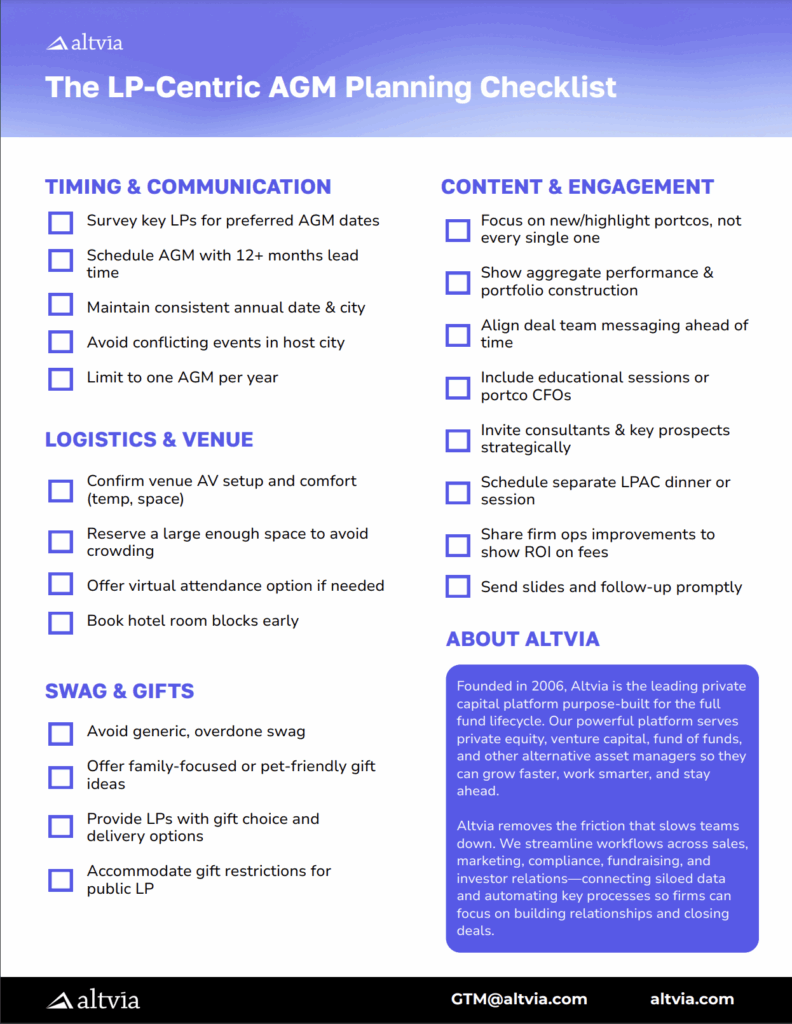
Downloadable: The LP-Centric AGM Planning Checklist

Click the checklist graphic below to download the full PDF. Plan your next AGM using this LP-approved checklist, covering:

  • Pre-event communications and scheduling
  • Logistics and venue essentials
  • Presentation content and team prep
  • LPAC and VIP experience design
  • Thoughtful follow-up and swag

Want to build an AGM that deepens trust and loyalty? Start by listening to your LPs—and designing with their needs in mind.

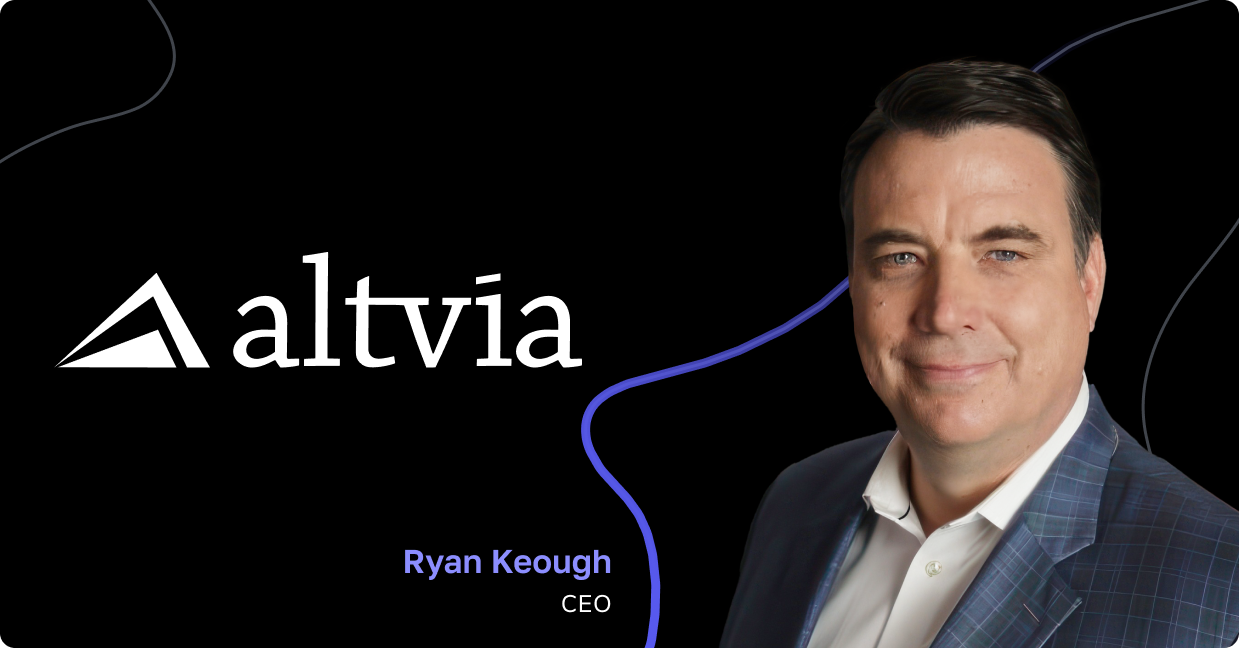
Altvia Taps Industry Veteran Ryan Keough as CEO

FOR IMMEDIATE RELEASE

Altvia Taps Industry Veteran Ryan Keough as CEO

BROOMFIELD, COLORADO–July 21, 2025 Altvia, a leading private capital platform purpose-built for the full fund lifecycle, today announced the appointment of Ryan Keough as Chief Executive Officer. A seasoned fintech executive with over 20 years of experience driving global SaaS growth and operational leadership, Ryan will guide Altvia into its next phase of expansion and product innovation.

Keough brings a rich history of delivering exceptional client value and driving product innovation in the alternative investment community. Prior to joining Altvia, he held senior leadership roles at Allvue Systems, Finastra, and Misys, where he was instrumental in accelerating growth, enhancing product delivery, and strengthening customer success across global markets.

“I’m honored to lead Altvia at such a transformative moment for the industry,” said Keough. “Private capital firms are demanding smarter, faster, and more connected ways of working. Altvia’s technology is well positioned to meet that need. I’m excited to partner with our clients to drive innovation, expand our reach, and deliver exceptional value.”

“We’re thrilled to welcome Ryan as Altvia’s CEO,” said Nathan Pingelton of Marlin Equity Partners. “Ryan’s extensive leadership history and industry expertise align perfectly with Altvia’s mission to be the leader in equipping alternative investment firms with cutting-edge products and insights.”

About Altvia

Altvia, a leading platform powering private capital from raise to results, unifies fundraising, deal, and investor workflows into one intelligent operating system. Built on enterprise-grade technology and proprietary AI, Altvia helps top-tier firms move faster, engage smarter, and scale without limits. Trusted by hundreds of private equity, venture capital, and other alternative investment firms, Altvia pairs relentless innovation with deep industry expertise to make operational excellence feel effortless. For more information on Altvia, visit altvia.com.

Media Contact
Annie Eissler
CMO
annie@altvia.com