
An LP who committed to Fund III calls three weeks before Fund V materials go out. They want to know what changed in the strategy, who has joined and left the team, and how the last two portfolio marks affect their exposure. The answer exists. It sits in a partner’s inbox, a quarterly report draft, a fund admin export, and the memory of an associate who moved firms last spring.
Assembling that answer takes most of a day. The LP expected it before the end of the call.
Closing that distance is what a private equity CRM is for. Not storing contacts, but holding the relationship context that fundraising, investor relations, finance, and the investment team all draw on. As firms plan technology investments heading into 2027, the evaluation process matters as much as the platform. A vendor feature list is not a substitute for testing a system against the workflows your firm actually runs.
Sebastian Holst, Chief Product Officer at Altvia, frames the standard this way in the 2026 Private Markets Survey:
“The evaluation criterion for technology needs to include how good it is for the whole team, not just for one person and one use case.”
Sebastian Holst, Chief Product Officer at Altvia
This guide applies that standard. You will learn how to pressure-test AI capabilities against investor relations and fundraising work, verify governance controls, score platforms with a weighted scorecard, and plan a migration your team will sustain.
Key Takeaways: Evaluating Private Equity CRM Software
- A CRM evaluation should start with the workflows your IR, capital formation, finance, and investment teams run today, not a vendor’s demo script.
- Investor relations and operations teams carry a measurably heavier manual burden than other functions, so adoption in those seats determines whether the system holds.
- High satisfaction with existing technology coexists with significant manual work, which means evaluation should test specific tasks rather than general impressions.
- AI capabilities matter when they produce traceable outputs your team can verify and override before anything reaches an LP.
- Governance controls must cover LP data and deal information together, with role-based access, information walls, and auditable trails.
- A weighted scorecard with pass/fail gates and an evidence column removes subjective bias and makes platform comparisons repeatable.
- Altvia’s GP Engagement Platform connects fundraising, investor relations, and deal sourcing in one operating layer, built on Salesforce.
What Should Private Equity CRM Software Support Across the Firm?
A private equity CRM needs to serve four operational areas: capital raising, investor relations, deal and relationship sourcing, and firm-wide reporting. When those run through disconnected tools, the cost shows up as duplicated effort, conflicting numbers, and slower responses to the people who fund the business.
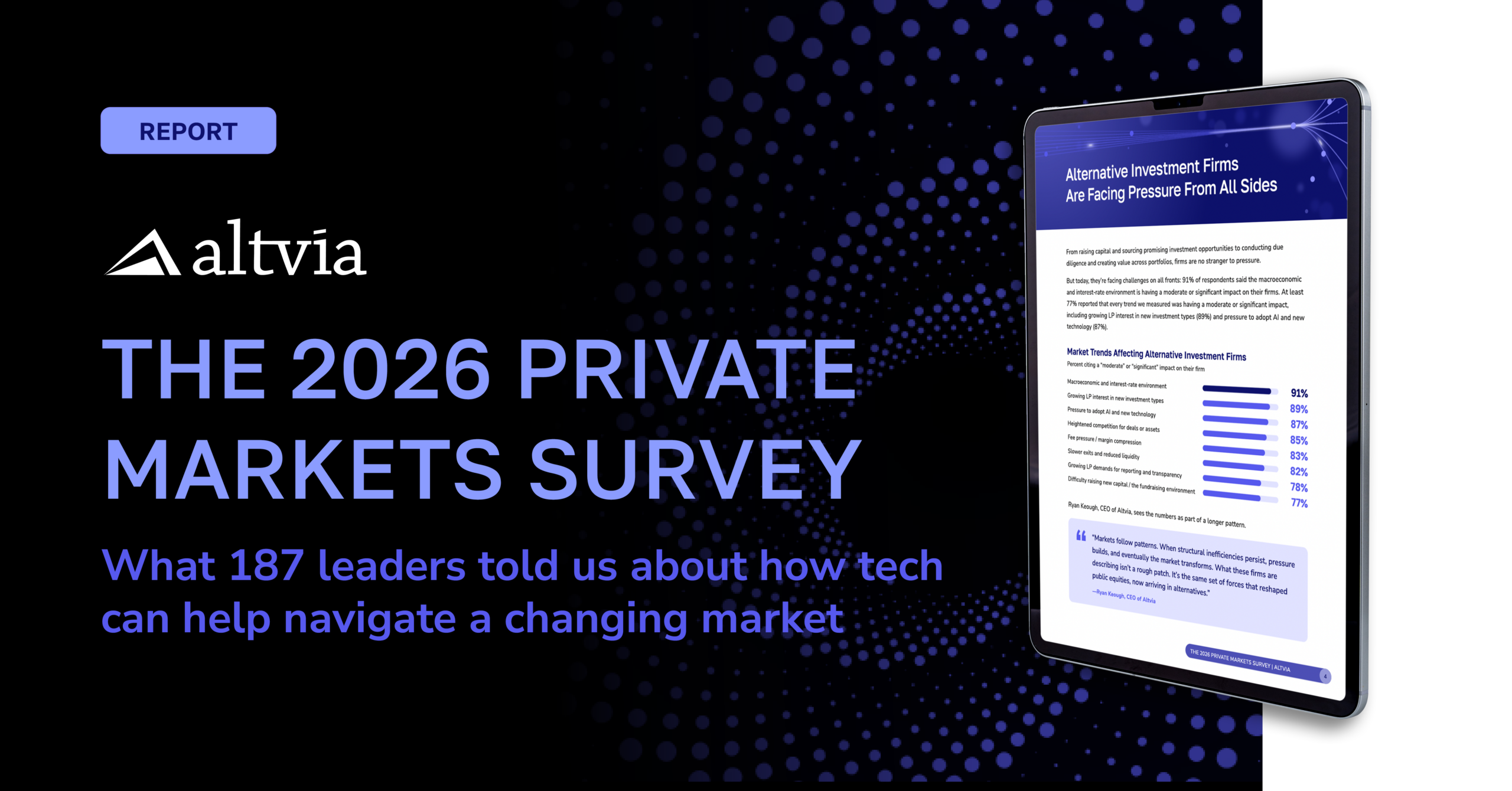
The 2026 Private Markets Survey, conducted by Altvia with independent research firm UserEvidence across 187 alternative investment professionals, found firms in a strong position to invest. Ninety-two percent said their firms have the resources and budget to meet current operational demands, and seven in ten expect headcount to grow over the next 12 months (Altvia and UserEvidence, 2026).
That resourcing picture is not even across the firm. Respondents in investor relations and operations were four times as likely as those in other roles to say their firms lack the resources to meet current demands, at 19% compared with 5%. Lisa Lewis, Industry Product Manager at Altvia, points to why headcount alone does not resolve it: “Budget can solve scarcity, but it doesn’t solve the operational issues causing the challenges.”
Capital Raising and Investor Targeting
Fundraising creates the densest layer of CRM data at most firms. Every LP meeting, conference conversation, placement agent introduction, and consultant touchpoint needs to reach a shared pipeline without requiring an associate to type it in afterward.
Prioritize platforms that capture email and calendar activity automatically. In the 2026 AI in Investor Relations Benchmark from Private Equity Marketeer, a survey of IR and capital formation professionals across private equity, venture capital, private credit, multi-strategy, and real assets, 30% named logging LP interactions in the CRM as a top operational pain point, and 42% named identifying relevant investors for fundraising (Private Equity Marketeer, April 2026). A system that depends on manual entry tends to lose the data that targeting depends on.
The quality of that record has become more consequential. In Coller Capital’s Summer 2026 Global Private Capital Barometer, a survey of 108 LPs collectively overseeing more than $2 trillion, 23% said they expect to reduce the number of GP relationships across their private markets portfolios over the next three years, up from 16% when Coller last asked in 2020 (Coller Capital, June 2026). Firms competing for a place on a shorter list benefit from knowing exactly where each relationship stands.
 Recommendation: Evaluate whether the platform layers third-party investor data onto your own records. Altvia’s capital raising workflow connects Preqin and PitchBook data to LP records so targeting draws on both market data and your firm’s own history with an investor.
Investor Relations and LP Servicing
Investor relations is where CRM data meets a deadline. Capital calls, distribution notices, quarterly reports, K-1s, DDQs, and bespoke LP information requests all run on the accuracy of what the system holds.
LP expectations have risen across every dimension the 2026 Private Markets Survey measured. Eighty-seven percent of respondents reported increased LP expectations for transparency into fund performance over the past 12 months, followed by speed of response at 86%, frequency of reporting and updates at 85%, self-service access to data at 84%, and level of detail in reporting at 82% (Altvia and UserEvidence, 2026).
Among respondents in LP-facing roles, reporting frequency was the hardest to meet, with 75% calling it moderately or very challenging, followed by transparency into fund performance at 69% and self-service data access at 66%.
LPs describe the same gap from their side. CSC’s Future Private Capital CFO 2025 study, conducted with Pure Profile across 300 GP and 200 LP senior fund professionals in Europe, the UK, North America, and Asia Pacific, found that 44% of LPs are not receiving the level of detailed performance reporting they need for informed decision-making, and 74% expect daily or on-demand access to portfolio performance data. Investor portal technology ranked as the single biggest frustration LPs have when working with GPs, cited by 35% (CSC, 2025).
Recommendation: Evaluate how a platform handles the servicing side specifically. Your team should be able to see the full relationship history for an LP without opening four systems, track which documents an LP has accessed, and tailor a distribution by fund, vehicle, or investor preference without rebuilding the list each quarter.
Deal and Relationship Sourcing
Deal sourcing and investor relationships draw on the same relationship graph. A board member at a portfolio company may share connections with a target management team. An LP in Fund III may have co-investment appetite that nobody has recorded. An intermediary who delivered a closed deal two funds ago may also be a route to a new allocator.
Recommendation: A CRM that separates investor records from deal records loses those connections. Evaluate whether the platform holds one relationship model across both, and whether a user in one seat can see the context a colleague in another seat created.
Firm-Wide Reporting and Leadership Visibility
Partners, the CFO, and the COO need a current picture without waiting for someone to assemble it. If a quarterly board review or an LPAC update requires manual pulls from three systems, the risk of conflicting numbers grows with each step.
Recommendation: Evaluate whether the platform generates standardized reporting directly from live records, and whether those views can be embedded where people already work rather than exported into a deck. Altvia’s analytics layer builds dashboards that can be embedded in both the CRM and the LP portal.
Why Technology Satisfaction Is a Poor Evaluation Signal
Before scoring any vendor, it helps to know that general satisfaction with a tech stack tends to overstate how well it works in practice. The 2026 Private Markets Survey found 74% of respondents saying their firm’s technology helps them keep pace with current demands, and 91% saying existing systems mostly or completely meet their needs for managing LP relationships and communication.
The same respondents then described substantial manual work. Fifty-four percent named preparing reports and updates among their most time-consuming or manual tasks, 50% named tracking deal or deliverable status, 47% named compiling data from multiple systems, and 42% named manual data entry or re-keying (Altvia and UserEvidence, 2026).
Ryan Keough, CEO of Altvia, describes the gap between the two answers:
“You can say, ‘I’ve got all the systems I need,’ but when someone actually needs to respond to an LP request or an inquiry from regulators, you realize how much work it takes. You have to pull information from a lot of different solutions; it’s a very manual process.”
Ryan Keough, CEO of Altvia
The burden falls unevenly. Among respondents in IR or operations, 53% identified manual entry or re-keying among their most time-consuming tasks, compared with 40% in other roles. They were also more likely to cite tracking deal or deliverable status, at 56% versus 48%, and maintaining records of LP interactions, at 31% versus 25%.
Recommendation: Two implications for your evaluation. First, ask current users of any platform about specific tasks rather than overall satisfaction, and ask the IR and operations teams separately. Second, when you check references, speak to someone in an LP-facing seat rather than only to the administrator who selected the system.
How Should Firms Evaluate CRM AI Capabilities?
AI features in private equity CRM platforms range from useful to decorative. Separating the two requires testing them against your own work rather than a vendor’s scripted scenario.
Adoption is already broad. The 2026 Private Markets Survey found 61% of firms using AI across multiple areas or embedded in daily operations, with 91% expecting to increase AI investment over the next 12 months. Top current use cases were data analysis and reporting at 59%, workflow automation at 56%, research and due diligence at 55%, and LP communications and content creation at 45% (Altvia and UserEvidence, 2026). Among IR professionals specifically, 98% reported using AI for IR work at least weekly (Private Equity Marketeer, April 2026).
Maturity is uneven by function. Fifty percent of respondents in IR or operations said AI was in production or embedded across their operations, compared with 63% in other functions. Sebastian Holst attributes part of that to the nature of IR work, where much of the value sits in personalized communication, institutional knowledge, and an understanding of investor preferences that lives with the individuals managing those relationships.
Lisa Lewis describes where AI has and has not taken hold:
“AI is winning where the work is high-volume, text-heavy, and reversible. It’s stalled where the work is high-stakes, and the answer needs a footnote.”
Lisa Lewis, Industry Product Manager at Altvia
Recommendation: That distinction is a useful filter for your requirements list. Define what you need AI to do before you evaluate it. Drafting a first pass at a quarterly report narrative is a different problem from flagging a cooling LP relationship ahead of a re-up conversation. Test each capability separately.
Test AI Against Your Own Anonymized Workflows
Request a scripted demo using anonymized or synthetic data modeled on your firm’s real patterns. Provide sanitized records from a closed fund, including anonymized LP contacts, commitment history, pipeline stages, and document types, so you can test the system without exposing confidential information.
Run the scenarios your teams face most often. The 2026 IR benchmark ranked the top forward-looking priorities for AI in IR as preparing DDQ and RFP responses and producing first-draft pitch or reporting materials, tied at 57%, followed by extracting portfolio data for LP reporting at 40% (Private Equity Marketeer, April 2026). Those make reasonable test cases.
 Watch for three things.
- Does the system assemble a complete LP history from the data you provided without manual prompting?
- Does a draft investor communication come back in a form your IR lead would edit rather than rewrite?
- Does it identify a relationship gap or an overdue follow-up that a person would have caught only by reviewing every record?
Verify Accuracy and Human Review Controls
Every AI output should trace back to its source data. When a system flags an LP as at risk, your team needs to see which reports, interactions, and commitments produced that flag.
Trust in outputs is one of the three leading barriers firms report. The 2026 Private Markets Survey ranked security or confidentiality concerns first at 49%, integration with existing systems second at 48%, and trust in AI outputs and accuracy third at 47% (Altvia and UserEvidence, 2026). Notably, the survey found data quality and trust move together: among respondents who cited data quality or readiness as a barrier, 57% also raised concerns about trusting AI outputs, compared with 47% of all respondents.
IR teams describe the same concern in practical terms. One Senior Investor Services Manager in the 2026 IR benchmark put it directly: “Ensuring AI doesn’t make anything up. Still not fully comfortable trusting everything that is AI generated” (Private Equity Marketeer, April 2026).
Ask the vendor three questions:
- Can a user override any AI-generated recommendation before it goes out?
- Does the system log when an output is accepted, modified, or rejected?
- Can you set thresholds below which an output is flagged for human review?
Altvia’s Investor Engagement Manager prepares the next step with its sources shown and records what was approved, with every action requiring a person to approve it before anything is sent. Whatever platform you evaluate, confirm that the review step is enforced by the system rather than by policy alone.
Your firm is accountable for every data point that reaches an LP, whether a person or a model produced it.
Expect the Barriers to Shift as You Mature
The constraint that blocks you during selection is not the one that will block you in year two. The 2026 Private Markets Survey tracked how the top barrier changes by AI maturity stage: firms exploring informally most often cited a lack of in-house skills at 57%, firms running structured pilots cited integration at 63%, and firms with AI in production or embedded day to day cited security and confidentiality, at 56% and 54% respectively (Altvia and UserEvidence, 2026).
Concerns about return on investment follow the same curve, climbing from 6% among firms exploring informally to 26% among those with AI embedded day to day. Evaluate a platform against the constraint you will have in 24 months, not only the one you have now, and ask vendors how their existing customers at a later stage handle security review and ROI measurement.
Skills remain a constraint on the deal and portfolio side as well. The FTI Consulting 2026 Private Equity AI Radar, a December 2025 survey of 200 private equity decision-makers, found talent to be the primary constraint on scaling AI adoption, cited by 35% of respondents (FTI Consulting, 2026). Factor vendor training and enablement into the evaluation rather than treating it as a post-signature detail.
Which Governance Controls Protect LP and Deal Data?
Private equity firms hold material nonpublic information, proprietary deal terms, LP capital commitments and side letter provisions, and confidential portfolio financials. A CRM storing that data has to enforce access controls matching your compliance obligations.
Security and confidentiality rank as the top barrier to AI adoption among firms furthest along the maturity curve (Altvia and UserEvidence, 2026), and data confidentiality was the top barrier in the IR benchmark at 55% (Private Equity Marketeer, April 2026). Test each control during evaluation rather than accepting vendor claims at face value.
Role-Based Access and Information Walls
Your CRM should support role-based permissions that work for both sides of the house. During evaluation, work with your compliance team to define a permission model that fits your structure: which roles see all unrestricted deals, which see only staffed deals, which can view LP commitment detail and side letter terms, and which require access to restricted records for compliance review.
Information walls matter for firms running multiple strategies, co-investment vehicles, or an evergreen product alongside drawdown funds. If a record is restricted, only authorized users should be able to view, search, or report on it. Test whether the restriction applies at the data layer rather than only in the interface.
Audit Trails and Data Residency
Evaluate whether the CRM logs record views, edits, exports, and deletions in a form your compliance team can query. When an LP or a regulator asks who accessed a specific document and when, your team should be able to answer without reconstructing it.
Ask about data residency:
- Where are records stored?
- Does the platform support region-specific hosting for firms with global LP bases?
- Can you enforce retention and destruction policies within the system?
AI-Specific Governance
If the platform includes AI, governance has to extend to the AI layer. Evaluate whether your proprietary data stays inside a governed environment while the AI processes it, whether outputs trace to source documents, and whether information barriers hold at the retrieval layer.
Firms are building the policy side. Sixty percent of respondents in the 2026 Private Markets Survey said their firms are establishing AI policies or governance to prepare for broader adoption (Altvia and UserEvidence, 2026), and 65% of firms in the IR benchmark had a formal AI policy approved by legal or compliance, while 15% operated on informal guidance and 10% had none (Private Equity Marketeer, April 2026).
A written policy is not the same as technical enforcement. Ask vendors for documentation of how their controls prevent confidential data from reaching unauthorized models, and confirm those controls hold for every user rather than only for administrators.
Which Integrations Matter Most?
A CRM operating in isolation recreates the silos it was meant to remove. Most firms are already running several systems in parallel. The 2026 Private Markets Survey found more than half of respondents using CRM or relationship management tools at 60%, fund administration and accounting tools at 52%, portfolio management and monitoring tools at 51%, and investor portals or LP reporting tools at 50% (Altvia and UserEvidence, 2026).
Few of those stacks are fully connected. Just 18% of respondents reported a single integrated platform or suite covering most functions, while 48% described a few connected core systems that share data and one-third reported fragmented or only partially connected setups. Fragmentation does not resolve with scale: 28% of firms managing less than $5 billion reported a fragmented setup, rising to 38% among firms managing $5 billion to $25 billion and 35% among those above $25 billion.
Firms are responding accordingly. Consolidating or integrating existing systems ranked as the second-highest technology priority for the next 12 months at 53%, behind improving data quality or accessibility at 56%.
Altvia’s CRM is built on Salesforce, which gives it access to a broad set of integrations. Altvia has direct connections to Passthrough for investor onboarding and Dakota for investor data.
Email, Calendar, and Activity Capture
Email and calendar sync determines whether the rest of the system has anything to work with. If the CRM cannot capture activity from Outlook or Gmail automatically, the relationship history will always be partial, and targeting, reporting, and any AI layer will inherit that gap.
Altvia’s CRM page states that the platform logs interactions and ingests emails directly from the inbox without manual workarounds.
Fund Administration and LP Onboarding
Your fund admin system and CRM should share data in both directions. Capital call notices, distribution records, and NAV figures need to reach the CRM so IR has the full picture of an LP relationship without requesting an export.
For onboarding, evaluate whether the CRM connects to subscription document automation. Altvia and Passthrough launched OnboardingBridge, which transfers subscription data between the CRM and the onboarding workflow.
Test Data Quality and Integration Reliability
Run a controlled test during evaluation. Push a known dataset through each integration and check what arrives. Did records sync accurately? Did fields drop or duplicate? How long did the sync take?
Ask about integration monitoring. When a sync fails the week a capital call goes out, how does the system alert your team, and what is the typical resolution time? Integrations that work in a demo and fail under production load are a common source of trouble, so test with realistic volumes and realistic timing.
How Can You Score Platforms Using Evidence?
Impressions from demo day are unreliable, and as the satisfaction data above shows, even firsthand experience with a system can overstate how well it performs on specific tasks. The partner who liked the interface, the IR lead who found a reporting gap, and the associate who tested the mobile view will reach different conclusions unless they score against the same criteria.
Build a Weighted Scorecard with Pass/Fail Gates
Set criteria and weights before you see any product. Have a partner, the COO, the head of IR, and at least one person from the investment team agree on the weights. The weights should sum to 100%. Below is a starting framework.
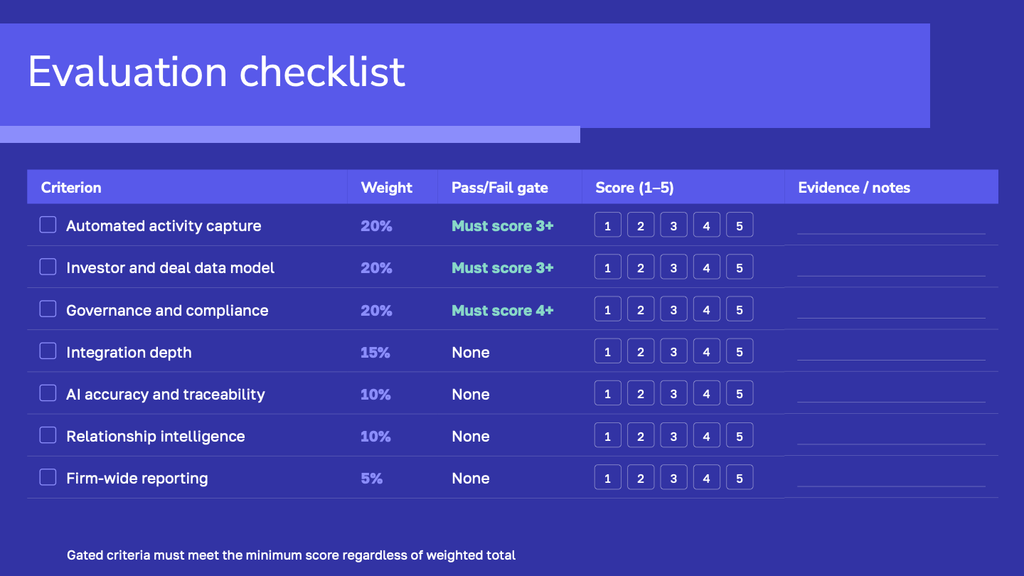
Score each criterion from 1 to 5. Multiply the score by the weight and sum the weighted totals. A vendor that fails a pass/fail gate is disqualified regardless of total score. Record specific evidence in the notes column so your team can revisit the reasoning months later.
Score each criterion from the perspective of every function that will use it, not an average across the firm. A platform that scores a 5 for the deal team and a 2 for IR is not a 3.5.
Run Scripted Demos with Consistent Scenarios
Give every vendor the same demo script built from your workflows, using anonymized data. Include a fundraising scenario, an LP servicing request, a quarterly reporting exercise, and a deal sourcing task. Cover every seat that will use the system.
Define pass/fail criteria for each scenario before the demo. For example: the platform must produce a complete LP relationship summary, including commitments, recent interactions, and open items, from the provided data in under five minutes. Document the outcome in the evidence column.
This approach prevents the polished-demo problem. A strong presentation means little if the platform cannot execute the work your firm does every week.
What Should You Ask About Pricing, TCO, and Data Exit?
Licensing is one component of total cost. Before signing, map the full cost structure so your firm can compare platforms on the same basis. Request written answers to each question below.
Licensing and Implementation Costs
Ask how licensing is structured: per user, per fund, or by AUM tier. Clarify whether implementation, data migration, and initial training are included or billed separately. Request an itemized implementation estimate so you can compare across vendors.
Per-user pricing deserves particular attention when the system will serve the whole firm. A platform priced for a six-person deal team becomes a different conversation at thirty seats across IR, finance, and investing. For firms building 2027 budgets, model the full first-year cost alongside the recurring annual cost. The two numbers often differ substantially.
Integration Maintenance and AI Usage Limits
Ask whether ongoing integration maintenance is included in the annual license or billed as professional services. If the platform includes AI, clarify whether usage carries per-query or per-record limits and what happens when you exceed them.
Request the vendor’s policy on API rate limits and third-party data costs. Some integrations require a separate subscription to the data source, which adds to annual spend.
Data Export and Ownership on Exit
Confirm in writing that your firm retains full ownership of all data in the CRM. Ask the vendor to describe the export process: which formats are available, how long an export takes, and whether fees apply at the end of the contract.
Confirm that you can export audit trail records alongside investor and deal data. If your firm is subject to regulatory retention requirements, verify that the export includes timestamps and access logs in a queryable format.
How Should You Plan Migration and Adoption?
CRM projects more often stall during migration and adoption than during vendor selection. Planning both before you sign is worth the upfront effort, particularly when the system spans teams with different daily rhythms. IR works to quarterly and capital call deadlines. The investment team works to deal timelines. A rollout built for one will struggle in the other.
Clean Your Data Before You Move It
Do not migrate dirty data into a new system. Deduplicate contacts, standardize investor and company records, reconcile commitment data against the fund admin system, and archive stale records before cutover. A CRM loaded with inaccurate legacy data loses the team’s trust on day one, and it is difficult to win back.
This work is also the highest-leverage investment you can make. The 2026 Private Markets Survey found that firms investing in data infrastructure and quality were further ahead on both counts that matter: 69% had AI in production or embedded, compared with 52% of firms not making that investment, and 82% said their technology helps them keep pace, compared with 66% (Altvia and UserEvidence, 2026).
Lisa Lewis notes why the work often gets deferred anyway:
“Without quality data, AI can’t do its job. Data infrastructure is the next big Achilles’ heel, but unlike launching a pilot or establishing a policy, it’s often a multi-year commitment that nobody gets credit for.”
Lisa Lewis, Industry Product Manager at Altvia
Map every field from your existing system to the new platform. Identify which fields transfer automatically, which require manual mapping, and which will be retired. Set a data accuracy target and validate against source records before go-live.
Define a Clear Cutover Plan
Unclear rollout timelines are where adoption stalls. Set a specific cutover date and communicate it to every team that will use the system. After that date, deal activity, fundraising pipeline updates, and LP communications run through the new CRM as the system of record.
Anchor Training in Workflows
Train people on workflows rather than features. Instead of showing where buttons are, walk each team through the tasks they perform every week: logging an LP meeting, updating fundraising pipeline status, preparing a quarterly distribution, pulling a relationship summary before a re-up conversation, adding a new deal.
Give the IR rollout its own attention. The 2026 Private Markets Survey found IR and operations trailing other functions on AI maturity, at 50% versus 63%, and carrying a heavier manual load at the same time. Sebastian Holst suggests one reason adoption can be slower in those seats: much of the value in IR work lives with the individuals who hold the relationships, and sharing that knowledge into a shared system can feel exposing. A rollout that treats institutional knowledge as something the firm gains rather than something an individual gives up will land better.
In addition to your main point of contact, consider also naming a champion in each function. The IR associate who lives in the system daily answers different questions than the VP on the investment team. Peer-driven adoption works well alongside a top-down rollout plan, and at firms where partners resist manual entry it often works better.
One participant in the 2026 IR benchmark named the underlying constraint plainly: “Don’t have time to evaluate tools and implement, that’s the real bottleneck” (Head of IR, Venture Capital, North America, in Private Equity Marketeer, April 2026). Build evaluation and implementation time into the plan rather than fitting them around a live raise.
Build Your Shortlist Around Verified Firm-Wide Workflows
Effective CRM selection means evaluating platforms against how your firm works today across every seat that will touch the system, not against a future state described in a vendor deck.
Start with your own requirements. Write one page naming the roles using the system daily, the fundraising and reporting cycles that define your calendar, and the integrations that are non-negotiable. Have a partner, the head of IR, and the COO sign it before any demo.
Score every finalist against the same weighted scorecard. Run the same scripted demo with anonymized data. Check references at firms with comparable fund sizes, strategies, and team structures, and speak with someone in an LP-facing role.
Timing is worth building into the plan. Preqin’s Q2 2026 quarterly update found that more than half of private equity funds now take between 19 and 30 months to close (Preqin, July 2026). A system selected and implemented before a raise opens has time to accumulate the relationship history that raise will draw on.
Ryan Keough, CEO, Altvia, frames what is at stake in the 2026 Private Markets Survey: “Operational capability is moving from a differentiator to a prerequisite. LPs will see which managers invested in the foundation and which didn’t, and that will influence where they allocate.”
Altvia connects CRM, investor engagement, LP portal, virtual data room, and analytics in one platform built on Salesforce. Request a demo to test how it handles your firm’s workflows.
FAQs About Private Equity CRM Software
What makes a purpose-built private equity CRM different from a general CRM?
A private equity CRM organizes data around funds, LP commitments, and deals rather than sales leads and marketing campaigns. Altvia structures its platform around the fund lifecycle, connecting capital raising, investor relations, deal sourcing, and reporting in one system.
Who at the firm should be involved in a CRM evaluation?
Include the head of IR or capital formation, the COO or CFO, a partner, and at least one person from the investment team. Research from Altvia and UserEvidence found IR and operations teams four times as likely as other roles to say their firms lack the resources to meet current demands, and carrying a heavier manual burden across data entry, deal tracking, and LP record-keeping (Altvia and UserEvidence, 2026). Excluding those seats from the evaluation tends to produce a system the heaviest users will not adopt.
How should you evaluate AI capabilities in a private equity CRM?
Test AI features with anonymized data modeled on your firm’s real workflows, including DDQ response, LP meeting preparation, and quarterly reporting drafts. Verify that every output traces to source records and that your team can override recommendations before anything is sent. The three leading barriers firms report are security and confidentiality at 49%, integration with existing systems at 48%, and trust in AI outputs at 47% (Altvia and UserEvidence, 2026), so build each into your evaluation criteria rather than treating them as implementation details.
What governance features should a private equity CRM include?
The platform should support information walls, role-based access covering both LP and deal records, auditable logs of record access and edits, and data residency options. Altvia’s CRM is built on the Salesforce security model and provides configurable permissions that compliance teams can tailor to the firm’s structure.
How do you measure CRM adoption success at a private equity firm?
Track daily active users by function, the share of LP interactions and deals managed exclusively in the CRM, and the time your team spends on manual reporting before and after implementation. Measure by function rather than firm-wide, since IR, finance, and deal teams adopt at different rates. Comparing these at 30, 60, and 90 days post-cutover shows whether the system is being used and by whom.
Can a private equity CRM replace spreadsheets for pipeline and investor tracking?
A well-configured platform centralizes investor and deal records, updates status automatically, and generates reports from live data. Altvia’s analytics include dynamic dashboards and customizable views that replace manual spreadsheet tracking for both fundraising pipelines and deal pipelines.
How much should data quality factor into a CRM decision?
Heavily. Improving data quality or accessibility was the top technology priority for the next 12 months among respondents to the 2026 Private Markets Survey at 56%, and firms investing in data infrastructure were more likely to say their technology helps them keep pace, at 82% versus 66% (Altvia and UserEvidence, 2026). Evaluate how a platform keeps records current without manual effort, not only what it can store.
Sources
Altvia and UserEvidence, The 2026 Private Markets Survey: How Tech Can Help Alternative Investment Firms Navigate a Changing Market, 2026. Survey of 187 professionals at alternative investment firms, averaging $22.1 billion in AUM and seven active funds; 59% at private equity firms. https://altvia.com/resources/2026-private-markets-survey/
Private Equity Marketeer, AI in Investor Relations 2026 Benchmark, April 2026. Survey of 40 IR and capital formation professionals across private equity, venture capital, private credit, multi-strategy, and real assets. https://www.privateequitymarketeer.com/ai-in-investor-relations-findings
Coller Capital, Global Private Capital Barometer, 44th Edition, Summer 2026, June 2026. Survey of 108 LPs collectively overseeing more than $2 trillion in assets. https://www.collercapital.com/global-private-capital-barometer-44-edn/
CSC, Future Private Capital CFO 2025: Transforming Challenges into Opportunities, April 2025. Conducted with Pure Profile across 300 GP and 200 LP senior fund professionals in Europe, the UK, North America, and Asia Pacific. https://www.businesswire.com/news/home/20250430162117/en
Preqin, Private Equity Q2 2026 Quarterly Update, July 31, 2026. https://www.preqin.com/insights/research/quarterly-updates/private-equity-q2-2026-preqin-quarterly-update
FTI Consulting, 2026 Private Equity AI Radar. Survey of 200 private equity decision-makers conducted December 2025. https://www.fticonsulting.com/insights/reports/2026-private-equity-ai-radar
Altvia, GP Engagement Platform. https://altvia.com/platform/
Altvia, Investor Engagement Manager. https://altvia.com/iem/