Private equity fundraising didn’t suddenly “change” in 2026. It tightened.
What’s different isn’t a brand-new set of rules. It’s the compounding effect of several forces that have been building for years: longer timelines, more competition for LP attention, and higher expectations for speed, clarity, and operational maturity.
In Altvia’s Fundraising in 2026: What High-Performing IR Teams Do Differently webinar, hosted by Ray Grant, Head of Strategic Initiatives at Altvia, and featuring Jeff Willems, COO of TritonLake, and Matt Curtolo, GP/LP Advisor at MC Advisory, LP and advisor perspectives converged on a single truth: performance is necessary, but it’s no longer sufficient.
Increasingly, LPs are selecting managers based on how the firm operates: how it communicates, how quickly it responds, how consistent its information is, and how well it manages relationships over time.
“It’s a progression. The environment remains challenging—and the bar is getting higher.”
— Jeff Willems, COO, TritonLake
The macro signal: fundraising is down, but expectations are up
The webinar opened with a sobering data point: global PE fundraising declined in 2025 (S&P Global). Even without debating the exact “why,” the downstream effect is clear. In a tighter fundraising market, LPs have more leverage and more options.
That shows up in two ways.
First, LPs are concentrating capital with managers they already know. If an allocator has done the work, built conviction, and had a solid experience, there’s less incentive to “trade out” into unfamiliar names when the environment feels uncertain.
Second, LPs are looking harder at risk, not just investment risk, but organizational risk: how reliably a firm can execute, communicate, and run a disciplined fundraising process.
“Capital is concentrating with the perceived less risky, larger brand-name firms.”
— Matt Curtolo, MC Advisory
For emerging and mid-market managers, this is where the game gets real. Differentiation isn’t just about strategy. It’s about building a machine that earns trust over time.
“Always be fundraising” is no longer a cliché—it’s a survival strategy
One of the clearest themes from the conversation: the fundraising process has evolved from a campaign into a continuous operating motion.
Five years ago, a manager could have a call, share materials, and move to a check within months. That environment—fast closes, compressed cycles—was an anomaly. Today, the cycle looks more like a relationship arc that can take years to mature.
Matt Curtolo put it succinctly:
“The best time to raise your next fund is the day after you close your last.”
This doesn’t mean spamming LPs indefinitely. It means you can’t disappear until you’re back in market.
LPs want to see lines, not dots: a clear progression of how a firm operates, performs, communicates, and follows through over time. That shows up in the fundamentals:
- A data room that’s always open
- Regular updates (quarterly reports, key firm developments)
- Touchpoints that demonstrate momentum and maturity—not noise
A practical tactic surfaced as well: invite prospective LPs into your ecosystem early. Annual meetings, updates, and thoughtful access points build familiarity before capital is on the table.
The diligence reality: LP attention spans are shorter, so relevance and responsiveness are everything
LPs are inundated.
“In my busiest year as an LP, I reviewed 500–600 opportunities. Last year, without even holding a formal LP seat, I still saw more than 600. That tells you everything: LPs are inundated. Attention spans are shorter. If you’re not building a long-term, compounding relationship, you’re just another cold outreach in a crowded inbox.”
— Matt Curtolo
In 2026, LP diligence is faster and more comparative. Many allocators are evaluating multiple opportunities in parallel. That means the friction of getting information from a GP becomes part of the decision.
As Matt noted:
“If an LP has to chase you for information or follow up just to get clarity on your track record—and you don’t make time to respond—it erodes trust. In a competitive process, their focus will move elsewhere.”
Responsiveness, in other words, isn’t just a courtesy. It’s a signal.
But responsiveness only works when it’s paired with relevance. A scattershot approach, like sending your fund to every LP with a pulse, doesn’t build pipeline. It burns credibility.
The teams that stood out were the ones that:
- Did the research upfront
- Targeted LPs whose preferences matched the strategy
- Articulated differentiation quickly and clearly
- Followed up consistently (without being overbearing)
This is where many IR teams struggle—not because they don’t understand the principle, but because executing it at scale requires infrastructure.
The operating system: data, workflows, and institutional memory
A recurring point from the panel: relationships are human, but relationship management requires systems.
At a certain scale, “good memory” breaks. Notes get trapped in inboxes. LP preferences sit in spreadsheets that no one updates. Context gets lost. Follow-ups slip. The firm becomes inconsistent in the moments when it needs to be crisp.
This is exactly where high-performing teams build leverage: they turn relationship strategy into operational reality through centralized data and workflows.
One example shared: advisory teams use dashboards and tasks to manage follow-up cadences—including sensitivity to LP preferences. Some LPs welcome proactive follow-up. Others explicitly ask, “Send the materials, then leave us alone unless we reach out.” The workflow adapts.
As Jeff explains:
“At TritonLake, we make sure teams know when it’s appropriate to contact an LP and when it’s not. You don’t want to forget about an LP who’s in an advanced stage and hasn’t been contacted in several days; that needs to be addressed. We rely heavily on data and technology as enablers for that. You can’t replace relationships, of course, that’s crucial. Relationships are the driver. But you can use data and systems to ensure timely responses, avoid dropping the ball, and make sure you’re not reaching out with irrelevant information or hassling someone unnecessarily. That balance matters.”
Doing this well isn’t about more touchpoints. It’s about better ones.
AI is speeding diligence—but it won’t save messy operations
The panel’s AI discussion was refreshingly grounded.
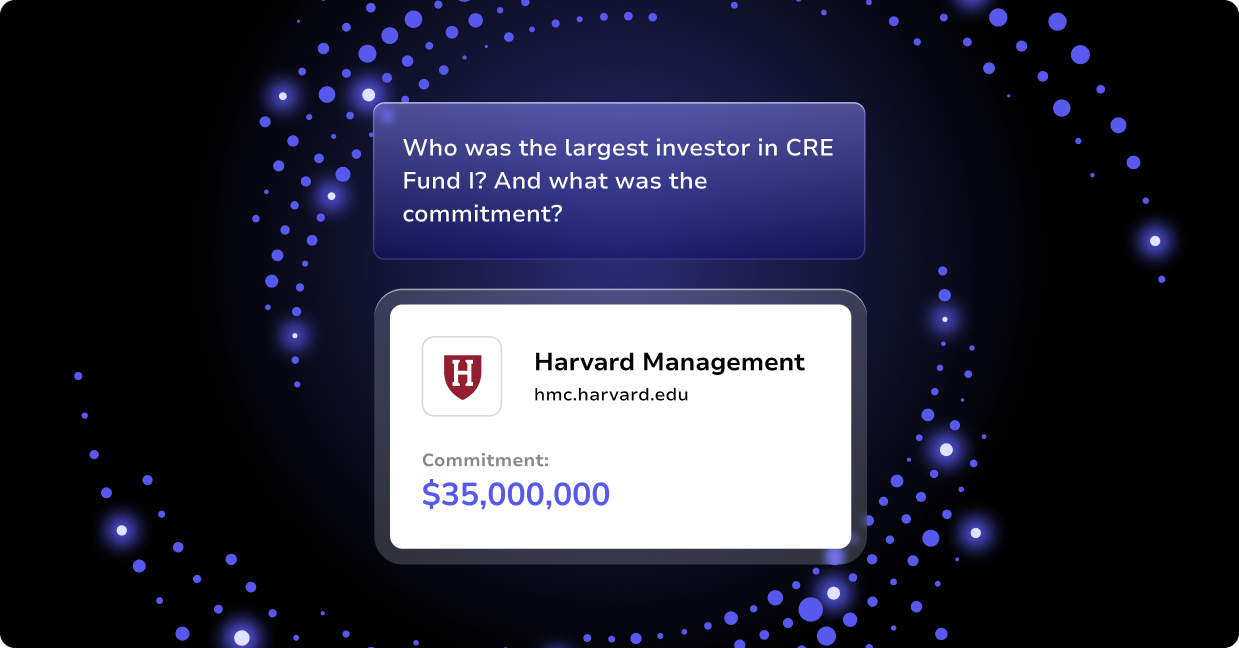
AI is becoming embedded in fundraising and diligence, especially on the LP side: chat-style interfaces layered on data rooms, faster extraction of details, quicker synthesis of materials. On the GP side, AI can help query CRM data (“Who should I meet in Chicago next week?”), identify relevant prospects at events, and draft responses.
But the warning was clear: AI without clean data is noise, and automation without human judgment undermines trust.
As Jeff put it:
“AI should be an enhancement, not a replacement for human interaction.”
There’s also a compliance reality. Regulators are paying attention, meaning the near future is “AI-assisted, human-approved,” not fully autonomous LP communication.
Jeff explained further:
“You need to make sure your agentic AI takes compliance into account—SEC marketing rules, FINRA communication rules, all of it. The language has to be compliant, and communications must follow the regulations. At this stage, AI should be drafting the email and placing it in the advisory team’s inbox, where a human reviews and validates it before it’s sent. We’re still a long way from having AI speak directly to LPs. It should always enable the relationship—not replace it. The human element is key.”
Where Altvia fits: institutionalizing trust at scale
Put all of this together and the throughline becomes obvious: fundraising in 2026 rewards firms that can behave like institutions—without losing relationship quality.
That is exactly the problem Altvia is built to solve.
Altvia helps IR and fundraising teams:
- Centralize relationship intelligence so LP preferences, touchpoints, and context don’t live in scattered notes or inboxes
- Operationalize follow-up workflows that reflect real LP engagement styles (proactive vs. hands-off)
- Improve responsiveness by making the right information easy to find, package, and deliver quickly
- Create visibility into what’s working by tying activity to stage progression and outcomes—not just volume
- Lay the foundation for responsible AI by ensuring data is structured, accurate, and usable
In a market where LPs can evaluate more opportunities faster, and where differentiation is increasingly operational, your IR operating system becomes part of your brand.
Fundraising isn’t just about what you say. It’s about whether your organization can consistently show up like the manager an LP can trust—today and two years from now.
If you want to win in 2026, don’t just refine your pitch.
Build the machine.