
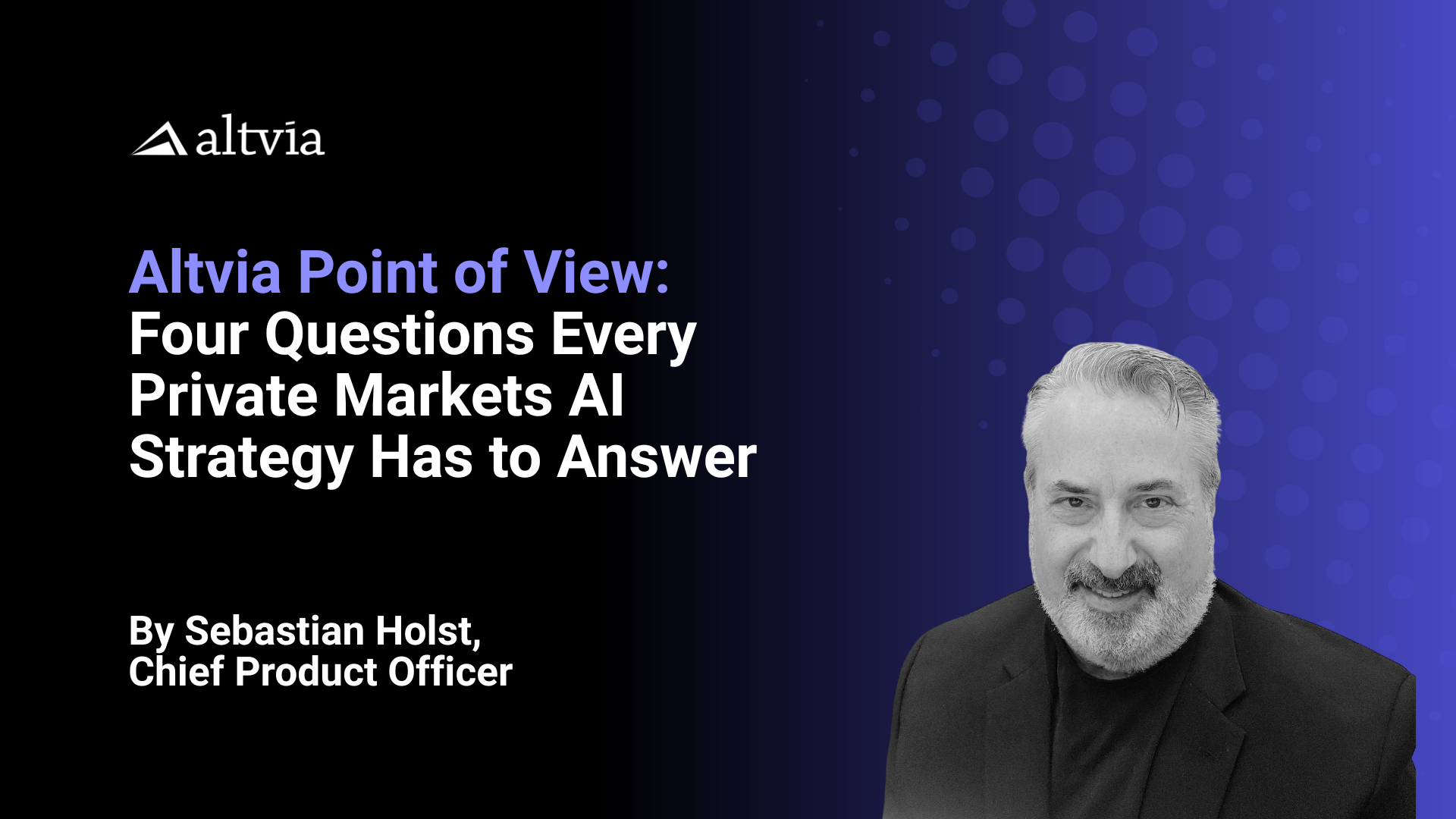
By Sebastian Holst, Chief Product Officer, Altvia
Part 1 of 4: AI Strategy in Private Markets
The short answer
An AI strategy in private markets has to answer four questions. What advantage does AI create in productivity, innovation, and quality? What risks come with it? What is the specific plan to integrate it? And in what sequence should that plan be executed, and how fast? For a general partner (GP), the answers turn on fundraising, investor relations, and deal sourcing, because that is where the firm’s longest relationships are and its highest compliance exposure.
The four questions an AI strategy has to answer
Every effective AI strategy answers four questions for its stakeholders:
- What advantages can AI offer in productivity, innovation, and quality?
- What risks and vulnerabilities come with integrating it, across the full range of use cases a firm might attempt?
Given honest answers to the first two:
- What is the specific plan to integrate AI?
- And in what sequence should that plan be executed, and how fast?
The four questions apply to any organization in any industry. The answers do not. Where private markets differ is in how the answers affect fundraising, investor relations, and deal sourcing.
Question 1: What are the advantages in productivity, innovation, and quality?
Sure, the generic answer centers around faster drafting, summarized records, and cleaner pipelines. Those are helpful, they’re tablestakes, and they improve the workflow without improving the decisions. The advantage that matters most to a GP is continuity of context across a fund cycle.
Bain’s 2026 Global Private Equity Report finds that 53% of limited partners (LPs) are constrained from making new commitments because capital they already pledged has not been called, up 15 points in a year, while the number of buyout funds reaching a close fell 23%. In a market that tight, an LP going quiet is expensive, and it is hard to see day to day.
It shows up as an LP that receded quietly during the quarters before launch — a commitment lost before the work began. Nobody decides to disengage; the engagement just thins. What changes the outcome is a system that reads the drift, explains what is driving it, and puts it in front of the person who covers the relationship while there is still time to do something about it.
Context retention is the difference between AI that works and AI that does not
MIT’s NANDA initiative found in its 2025 State of AI in Business report that 63% of executives want AI that retains context, and it named the ability to build on what happened before as the core barrier separating successful deployments from the rest.
Bring that into a GP’s world. A successful deployment retains the context of an LP relationship that spans years, vehicles, and people. It also learns from that relationship, and gets sharper with every interaction.
The measurable gain is less rework
In conversations I have had with Heads of IR, the advantage they actually measure is the reduction in rework and double-checking. An AI system that produces a figure a partner then has to go and verify has not improved the decision, and it has not saved anyone any time.
Question 2: What are the risks of AI in private markets?
Here too, the generic answer holds true: data leakage and fabricated output. And every AI vendor addresses those. But the risks specific to private markets are regulatory and reputational before they are technical. Data leakage and fabricated output apply to every industry, and every vendor addresses them. GPs must also assess three risks specific to their own firm:
- Regulatory (SEC Marketing Rule). A page that reaches an LP is an advertisement, and it carries the obligations that come with that.
- Compliance. An LP email, a quarterly letter, or a data-room summary sent without a person reviewing it is a compliance event.
- Reputation. Every figure that reaches an LP carries the firm’s reputation, and a number with no visible source is a number nobody can defend in the meeting.
Partners repeatedly ask what the AI model can access and where the data goes. In our 2026 Private Markets Survey, security becomes the top barrier once firms reach production, displacing the skills and integration concerns that dominate earlier stages. In private markets, that barrier has a compliance officer’s name on it.
The structural risk: the function that owns the LP relationship is the least equipped to evaluate AI
There is a structural risk at play as well. In Altvia’s forthcoming 2026 Private Markets Survey, investor relations and fundraising professionals trust AI accuracy less than any other function: 29% against 47% overall. They name a lack of in-house skills as their top barrier. A strategy that hands this function a general-purpose tool and a training session has misjudged the risk.
Why general-purpose AI answers are not sufficient for private markets
Horizontal CRM, document, and marketing platforms answer the first two questions generically for every industry at once. A GP’s answers rely on things those platforms do not account for: commitments that attach to a subsidiary’s vehicle and roll up to a parent, side letters whose obligations come due on their own calendar, feeders and look-through investors, the reporting cycle, and the person who covers the relationship. The benefit of a system, and its risk, lives in those specifics.
This is where fundraising, IR, and deal sourcing have room to move ahead. The best answers to the first two questions will come from people who understand the LP relationship, working with tools built around it, on the platforms the firm already runs.
Question 3: What is the specific plan to integrate AI?
A plan is not a list of tools. It settles three things: who builds it, where it runs, and what it has to guarantee regardless of the first two. The first two are execution decisions. The third is a property of the system itself, and it is the one most plans leave out. Once the first two questions have honest answers, each of the three has a fairly obvious one.
Four questions a GP has to answer for themselves
1. Who can build and continue to develop the right solution? The NANDA study found that purchased solutions from specialized vendors, paired with partnerships, succeeded about 67% of the time, while internal builds succeeded about one-third as often. The sharpest gap was in financial services. For a firm whose IR function already names in-house skills as its top barrier, building in house compounds the very problem the project is meant to solve.
2. Where’s the data coming from? AI-ready data does not mean a new warehouse. It means one current representation of the LP relationship spanning the CRM, the investor portal, the data room, and fund reporting all captured with less manual effort each quarter and read by the AI where it already lives. Gartner projects that through 2026, organizations will abandon 60% of AI projects that lack AI-ready data. Most of those projects will not fail at the model. They will fail at the data underneath it.
3. Who’s accountable? It’s a trick question, you are! That’s why it’s so important that every output shows provenance and its paper trail. The system proposes; a person approves. This is not a feature to negotiate at procurement. It is the condition that lets a compliance officer, a partner, and an IR associate say yes to the same system.
4. Build or Buy? The build case fails on economics. The cost that sinks it sits underneath the model. Provenance on every output, entitlements that match the firm’s sharing rules, an audit trail a compliance officer will accept, and change control on models and prompts maintained every quarter thereafter. None of that differentiates one GP from another, and all of it has to be right before a single output reaches an LP. A specialist carries that cost across many firms and improves it with every deployment. A single firm carries it alone, for as long as the system runs.
Building is the right call when three conditions hold together: the workflow is genuinely proprietary, the governance stack already exists and is actively maintained, and the team is staffed to keep it current as models change. Few firms clear all three. When two hold and the third does not, the third is what fails, and it fails after the system is already producing work that reaches LPs.
Question 4: In what sequence should the plan be executed, and how fast?
Sequence first because most firms have it backward, and because the sequence is what sets the pace.
Our survey shows the top barrier shifting as firms mature: skills at the informal stage, integration during pilots, security in production, and return on investment only once AI is already embedded. ROI arrives last. Which means most firms are years into the work before they can say what the work was worth.
Reverse the order.
- Start with the return. Choose one use case with an outcome you can measure, and define the measure before the pilot begins rather than after it. If you cannot say what success would look like as a number, you do not have a pilot. You have an experiment.
- Require the vendor to demonstrate approval rules, audit trail, and data boundaries. Settle approval rules, the audit trail, and data boundaries while the stakes are still small, so security shows up as a solved problem rather than a blocker at the worst possible moment.
- Select a system that already sits where the work happens, so integration is not a project you run. Run inside the systems the team uses now — CRM, investor portal, data room — rather than beside them. Integration stops being a project.
- Let the skills barrier resolve itself. The skills gap that stalls informal-stage firms is largely an artifact of building rather than partnering. Answer Question 3 correctly and this one mostly disappears.
That sequence also answers the velocity question. Move quickly through the pilot and deliberately into production. A pilot’s only job is to produce a number, and that should take weeks, not quarters. Production is where the compliance exposure becomes real, and that deserves time. Firms that invert this, like a cautious year-long pilot followed by a fast rollout, take the longest to learn anything and carry the most risk when they finally do.
Pilot-stage firms are already choosing their anchor. In our same survey, 82% of firms at the pilot stage rank LP relationship visibility among their top three objectives, ahead of deal flow, compared with 56% of all other firms.
That is where the industry is placing its first serious AI bet. And because the pilot becomes the system a firm scales, the pilot stage is where that bet is effectively decided.
What is next in this series
Over the next several weeks we will take these questions in turn: the problem the LP relationship poses and the standard AI has to meet, the plan in practice, and what our survey says about sequence. The framework stays the same throughout. The answers are ours, and they are specific to private markets.
Frequently asked questions
What should a private markets AI strategy answer first? It should answer what advantage AI creates in productivity, innovation, and quality, and what risks come with it. Only after those two are answered honestly does a plan, and a sequence for executing that plan, become possible. For a GP, both answers are specific to fundraising, investor relations, and deal sourcing.
What are the biggest AI risks for a private equity firm? Beyond data leakage and fabricated output, three risks are specific to private markets: SEC Marketing Rule exposure, because a page that reaches an LP is an advertisement; compliance exposure from a draft sent without human review; and reputational exposure from any figure that reaches an LP without a visible source.
Should a GP build AI in house or buy from a specialist? MIT’s NANDA research found that organizations that purchased solutions from specialized vendors , paired with partnerships, succeeded about 67% of the time , while internal builds succeeded about one-third as often, with the widest gap in financial services.
What does AI-ready data mean in private markets? AI-ready means one current representation of the LP relationship — across the CRM, the investor portal, the data room, and fund reporting — captured with less manual effort each quarter and read by the AI where it already lives. Gartner projects that through 2026, organizations will abandon 60% of AI projects that lack AI-ready data.
In what order should a GP roll out AI, and where should it start? Start with one use case whose outcome you can measure, and define the measure before the pilot begins. Govern before production, run the pilot inside the systems the team already uses rather than beside them, and partner rather than build so the skills gap does not become the gate. In Altvia’s 2026 Private Markets Survey, 82% of pilot-stage firms rank LP relationship visibility among their top three objectives.
About the author
Sebastian Holst is Chief Product Officer at Altvia, where he leads product strategy for the platform private markets firms use to run fundraising, investor relations, and deal sourcing. This is part one of a four-part series on AI strategy in private markets.
Methodology: Altvia 2026 Private Markets Survey, 187 respondents. Pilot-stage figures rest on 38 respondents and investor relations and fundraising figures on 21. Treat both as directional. All percentages are shares of respondents.