

A year of AI conversations in private capital, and the question that is still unsettled.
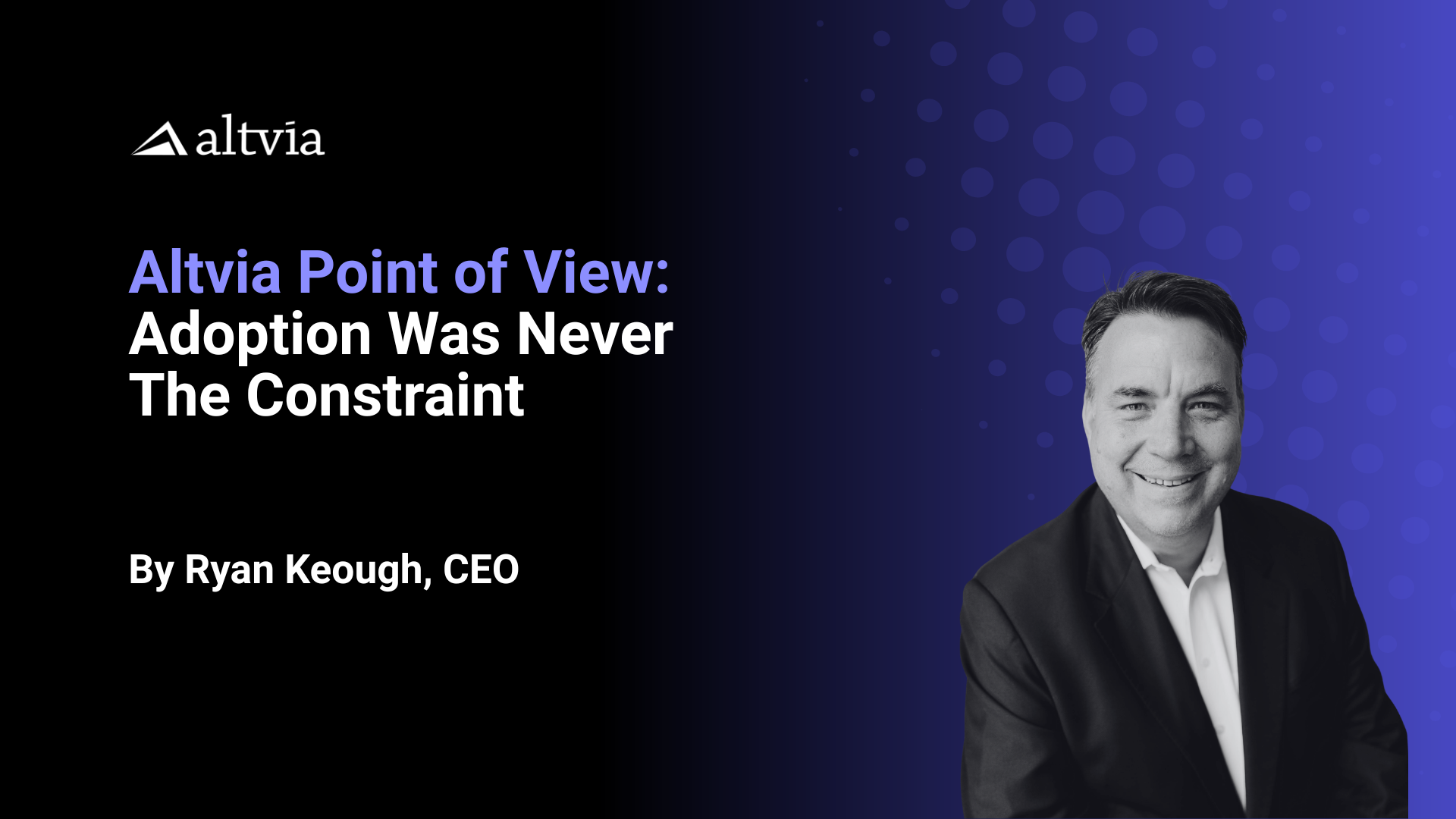
By Ryan Keough, Altvia
I have spent the past year in a lot of rooms. Customer calls, user sessions, conferences, panels, and more industry reports than I would like to admit reading end to end. AI came up in every single one. What I have not heard, in any of them, is a definitive answer to the bottom line question: where does AI earn its keep?
First, let’s kill the framing that keeps showing up in survey data: adoption is not the constraint. Nearly every firm I talk to is doing something with AI, and most are increasing what they spend on it next year. The interesting variance is not between the firms that have started and the firms that have not. It’s between firms that have deployed very different things under the same word.
Broadly, I see three approaches.
1) Tooling that improves an existing workflow. Summarize the call notes. Draft the first pass of the update. Clean the list. These are real gains, and I do not want to be dismissive of them, a lot of time gets recovered here. But the ceiling is what it is. You are doing the same job, in the same sequence, slightly faster.
2) Connected models / MCP. This is where most work is happening, and where results vary the most. Connecting a model to your systems is the easy part. What determines the answer is everything underneath: whether the model knows what your fields actually mean, whether it is allowed to see what it is reading, and whether anyone can trace the number back to the record it came from.
Most of what I have seen is built without those three things. A model with open access to a CRM guesses at field names, ignores who is permitted to see what, and returns a figure with no provenance. The output is directionally correct and unverified. Useful for exploration. Not something you take into an LP conversation.
Most of the market is somewhere in one of the first two scenarios. A third approach is:
3) Reimagining the work itself
This is a different approach entirely. Not a faster version of what you do now. This is the hardest to build, and the only one that changes what an IR team’s week looks like.
When thinking about the third approach to AI, creating a different process entirely, you have to start with what the current default costs you. Reporting tells you where you were; it never tells you where you are. A dashboard answers the exact question you thought to ask, not the gist or the inference, and certainly not a follow-up. A chat box is still a blank prompt that is your problem to solve. Each of these waits for someone to go looking, which means coverage ends up being a function of bandwidth, and you end up working the relationships that surfaced this week, not the ones that changed.
Your LP relationships don’t change quarterly. Your visibility shouldn’t either. The re-up conversation shouldn’t be the first time you learn where you stand. When reimagining the best approach, the process needs to be action oriented. It’s always watching, across every relationship rather than the ones on this week’s list, and it notices change when it happens rather than when someone reports it.
Noticing is not enough on its own. Awareness without a recommendation is just another alert, and nobody needs more of those. The bar is a change, an explanation, and a suggested next step, delivered together and in time to matter. Not only what moved, but what the system thinks you should do about it.
From there, the question is whether it can carry that step through. There is a real difference between a system that hands you a recommendation and one that can prepare the outreach, update the record, and move the work forward when you say go. In other words, advice adds to your list, action takes something off of it.
The second major component that is critical to change the work process is…say it with me…data! Listen, the data exists, we know that. It’s a matter of where it exists and with whom. Today, no one person has the whole relationship, it’s spread across your organization and with your CRM, the inbox, the data room, a spreadsheet someone maintains, and a colleague’s memory. The firm as a whole should have it even when no individual does. Institutional memory, without anyone having to remember. That’s what makes the analysis worth acting on, and it is also why this is hard: the data foundation underneath is the real work, and most of the market would rather talk about the model.
When the process changes and the data foundation underneath is working correctly, what changes is both mundane and significant at the same time. Monday morning used to be prep; now it is follow-up. You stop deciding who to call based on who emailed you last. Your team stops being the integration layer between five systems. New hires inherit the relationship instead of starting over.
How it delivers ROI
Different AI approaches will garner different returns, and it’s up to the firm to decide what they’re looking to accomplish.
1) Tooling: automate the work, same result. The output is what it always was; it took fewer hours. Real savings, capped savings.
2) Connected models / MCP: Insight without precision. A view you did not have, directionally right, unverified. It informs a decision. It does not make one .
3) Change how the work happens. Always watching, proactive about what it surfaces, and able to take direct action rather than handing the work back as a task.
This approach shows up as work getting done that wasn’t getting done before. Coverage stops depending on how many relationships your team has bandwidth to actively work.
This approach enables you to be always watching, proactive about what it surfaces, and able to take direct action rather than handing the work back as a task.
The first two save you time. The third gives you coverage you did not have and that is where the return is found, because it shows up in the situations the old way never surfaced at all.
An LP whose engagement has been quiet for two quarters and on nobody’s list because nothing happened. An opportunity is noticed such as a co-invest appetite visible in the pattern of what someone has been reading, while there is still time to act on it. None of these announce themselves. They are only found by looking, and no team has the hours to look everywhere.
The return is a relationship strengthened before it needed repairing, or an opportunity worked while it was still open.
This approach is also the only approach that has to earn the right to operate that way. The more a system moves first, the more it has to show its work, every figure tied out to the record it came from, every action proposed before it is taken, every step a person can check.
Human-led by default. Enterprise ready, secure, traceable, and auditable. Those are not the brakes on a proactive system. They are the reason a firm can let one move quickly on its behalf at all.
In the end, Investor Relations can focus on the relationship and opportunities.
Where we are
In June, our CMO wrote that no end-to-end, AI-native IR product exists yet.
That was a fair read at the time, and I did not argue with it.
But we’ve been building. More very soon.