How Investor Engagement Manager Enables Firmwide Investor Relationships
Summary: Most AI in investor relations delivers value only to the people with the expertise to operate it. Turning that into a strategic advantage the whole firm holds, and one that accelerates, takes three things in place at once. The automobile needed the same three, and took thirty years to assemble them.
By Ryan Keough
For AI to actually move an organizational objective such as investor relations, fundraising, or the strength of every LP relationship a firm holds, three elements have to be in place at the same time.
There is a version of AI success that firms are quietly settling for, and the awkward thing about it is that it works. It produces genuinely useful output, but only for the people who know the data, know how to ask, and can tell a good answer from a plausible one.
That is a real skill. It is also unevenly distributed, and today’s AI is almost entirely dependent on it. The value a firm gets is capped by how many people it has who hold that expertise, and the colleague at the next desk gets something worse without being able to say why.
The three elements
That is a set of capable individuals, not a capable firm. It does not compound, because the value lives in the operators rather than in the organization. And it is not fixed by training, because the dependency is structural: a system that only works in expert hands will only ever reach as far as your experts do.
One. It has to be accessible to the entire team. Usable by everyone who touches the relationship, not dependent on an expert user who knows how to work it.
Two. The guardrails have to be in place. Safe, reliable and governed, which is what allows a team to move fast rather than what slows it down.
Three. It has to have the essential inputs. Clean, connected, current data, arriving continuously, without anyone hand-crafting it.
Any two without the third leaves you with a pilot. All three together is a different thing entirely.
The automobile is the proof
The car is the clearest example of all three arriving, and of how little the machine alone was worth until they did.
Accessible. Early automobiles were for mechanics and enthusiasts: difficult to start, harder to maintain, and priced for the wealthy. The Model T mattered because an ordinary person could afford it and operate it1. Mass value required mass accessibility, not a better engine.
Guarded. Then the roads. Early roads had no lane markings, no stop signs, no signals, no right-of-way conventions and no requirement that the driver knew how to drive. The control layer was invented piece by piece over two decades. Center lines appeared in several states between 1911 and 1917, the first stop signs and signals around 1914 and 1915, and national uniformity only with the first Manual on Uniform Traffic Control Devices in 1935.2 Until then, driving at volume was dangerous rather than useful.
Fueled. And the fuel. Crude oil does not run an engine; gasoline came out of a refining process, as a byproduct of making lamp kerosene, and was so plentiful that refiners burned it off.3 It was never scarce. It simply was not where the driver was. Before filling stations you bought it in cans from a pharmacy or a blacksmith, and planned long trips by telephoning ahead.4 Quality varied with whatever crude it came from, and the property that actually mattered, knock resistance, had no agreed measure until the octane scale arrived in 1930.5
A car nobody could drive, on roads nobody could survive, running on fuel nobody could find, is a hobby. All three together built an industry.
And what the three delivered together was not a better car. It was access. Ordinary people could travel routinely and arrive safely, which changed where they could live, where they could work, and how far a business could reach. Freight moved by road. Rural isolation eased. A machine that had been an enthusiast’s curiosity became infrastructure an entire society ran on, and the people who had it could do things the people who did not simply could not do.
The elements were the enabler. The advancement was the point.
The same three, in our clients’ own numbers
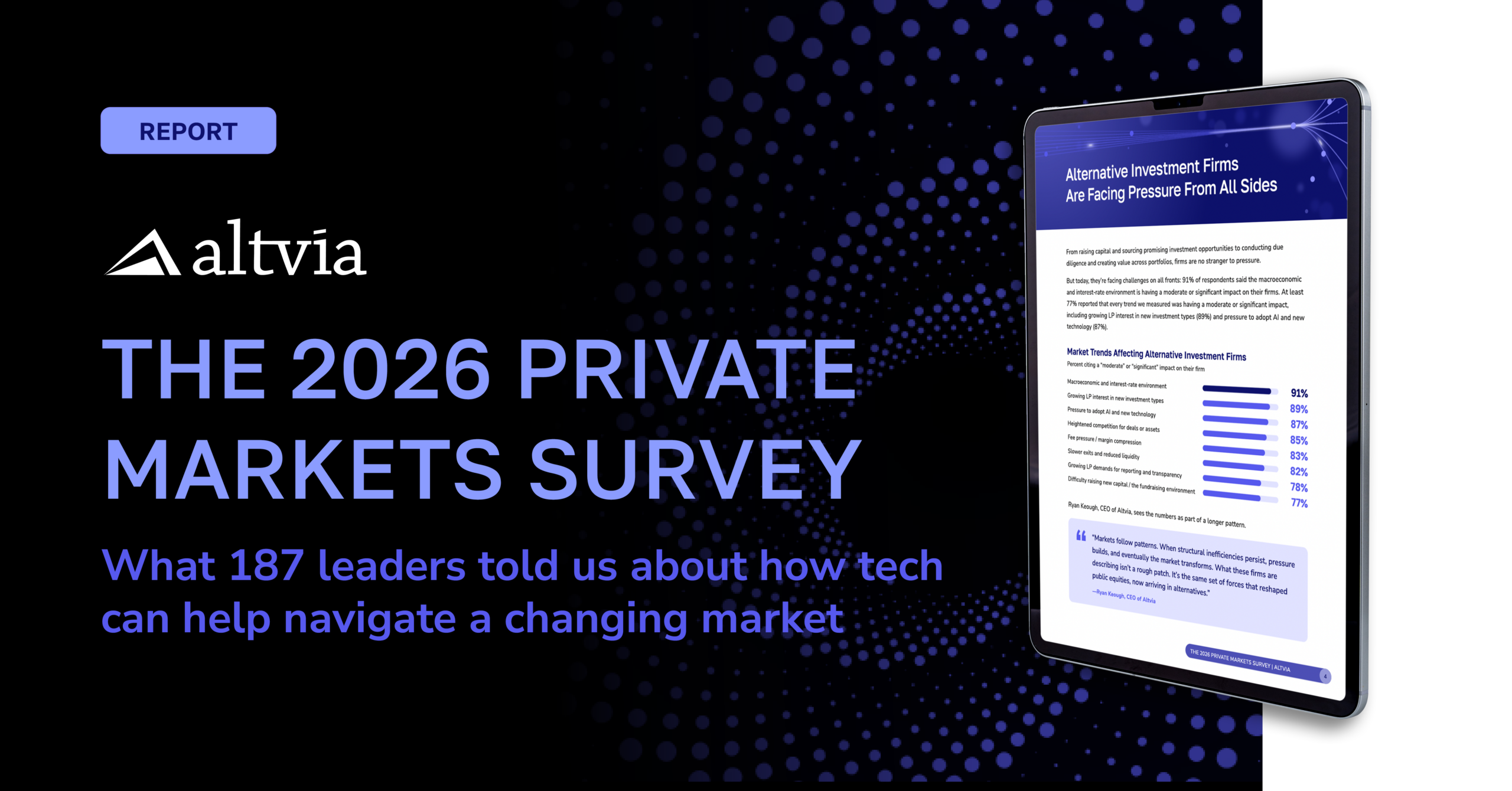
We asked 187 private markets professionals in September what is blocking them.6 The answers map onto those three elements almost exactly.
| THE ELEMENT | IN THE CAR ERA | IN AN AI SOLUTION | BARRIER IN OUR SURVEY |
| Accessible to everyone | A car an ordinaryperson could afford,start and drive, not amachine for mechanicsand enthusiasts. | Value available to the whole team without an expert operator in the middle. | In-house skills: 40% |
| Guardrails in place | Signs, painted lines, barriers, and rules of the road, so speed was survivable. | Permissions, traceability, auditability, and human approval, so the firm can move fast. | Security 49%, trust 47% |
| The essential inputs | Refined fuel, available where you needed it, at consistent quality. | Clean, connected, continuously replenished data, delivered without manual effort. | Integration 48%, data readiness 37% |
Security 49%, integration 48%, trust in outputs 47%, in-house skills 40%, data readiness 37%. Not one of the top five is a model problem. Every one is one of the three elements being absent.
It shows where firms are stuck: 19% informal or exploring, 20% running structured pilots, 42% in production, and only 19% with AI embedded in day-to-day work. Four in ten have not reached production at all. The middle of that curve is crowded with firms that have proven something works for somebody and cannot get it to work for everybody.
Investor Engagement Manager was built around these three elements rather than around a model. Each one is a deliberate design decision, and the combination is what turns AI from a capability into an advantage a firm actually holds.
How IEM puts the three together
ONE · ACCESSIBLE TO THE ENTIRE TEAM
IEM changes how the work gets done, and it does it for everyone.
The expertise the current generation depends on is not something IEM asks the user to supply. The intelligence is surfaced by the system and embedded in it, rather than drawn out of it by someone who knows how. There is no prompt to compose, no need to know where the data lives, no judgment call about whether an answer can be trusted, and nothing a person has to understand about how AI works in order to benefit from it. IEM surfaces what changed across every LP relationship, explains what is driving it, and puts a recommended next step in front of the person who covers it.
That design choice does something a better model cannot. Because the experience is the same for everyone, the quality of preparation is the same for everyone. The associate, the IR lead and the partner all start from the same place. Value stops being a function of who is good at the tool, which means it scales with the size of the team rather than with the number of experts on it.
TWO · GUARDRAILS THAT LET THE TEAM MOVE FAST
A system that moves first has to meet a higher standard, and IEM is built around four commitments.
Secure. IEM reads inside the firm’s existing permissions rather than building a second access model beside them. What it surfaces to any individual stays bounded by what that person could already see.
Traceable. Every alert, assessment and draft ties back to the record it came from. Nobody is asked to accept a number on faith.
Auditable. What was surfaced, what was recommended, who saw it, who approved it and what was done, all reconstructable afterward.
Human-led. Nothing consequential reaches an investor or changes a record until a person approves it.
The instinct is to read that list as friction. The roads say otherwise. Lane markings and signals did not restrain traffic; they are the reason traffic could move at volume and at speed without constant collision. Guardrails are what make speed possible, and they are the difference between a firm piloting AI in one corner and a firm running it everywhere.
THREE · THE INPUTS THAT MAKE IT WORK
No firm in private capital is short of data. It accumulates as a byproduct of the work, whether email, documents, fund reporting or notes, and like crude in the ground, none of it runs anything in the state it arrives in. It has to be refined: resolved, connected, deduplicated, put in context. Most of it never is. It sits where it landed.
Firms tend to judge their data by whether the CRM looks populated, which is the equivalent of grading fuel by specific gravity: easy to measure, and not the property that determines whether the engine runs.
Altvia’s underlying data management and data model is what turns that raw material into an enabler rather than a constraint, and the governing principle is that refining cannot depend on the user. That is the lesson of every CRM adoption program ever run: if the value requires people to faithfully enter data first, the value does not arrive. So we handle it three ways.
1. We refine the data you already have. Existing records cleaned, connected and put right, so the firm’s history is usable from day one rather than after a migration project. Nobody starts with an empty tank.
2. We embed data consumption, so nobody hand-crafts the fuel. Integrations and imports keep other systems feeding in automatically. The picture stays current without anyone copying between tools or maintaining a second record by hand.
3. We consume unstructured email automatically. Email is the richest and least governed record of an LP relationship. It is captured, cleaned, organized and recorded into the CRM without user involvement, and made available to IEM without anyone filing anything.
The common thread is that none of the three require a person to be diligent for the system to work. That matters more than it sounds. A system reading only what people remembered to type is reading a fraction of the relationship, and the fraction is biased toward whoever is most dutiful about paperwork, which is rarely the person closest to the investor.
This is how siloed data becomes organizational intelligence: refined, pumped into the tank, and available to everyone entitled to see it.
No one person holds the whole LP relationship. With the inputs handled this way, the firm holds it, even when the individual who built it has moved on.
From changing the work to changing what the firm can do
Each element on its own is worth something and capped. Accessibility without guardrails is a fast car on an unmarked road. Guardrails without accessible value is governance over a pilot nobody uses. And either of those without clean, continuous inputs is an engine with nothing in the tank.
Together they change the work itself. Coverage stops depending on how many relationships a team has the bandwidth to work. Preparation arrives assembled rather than assembled by someone. The quiet relationship that was drifting gets surfaced while there is still time, and the re-up picture arrives months before a launch rather than during the raise.
But the change to the work is the smaller half of it.
Mass access to the automobile did not simply make individual journeys easier. It changed what was possible for the people and the businesses that had it, and it did so at the level of the whole enterprise rather than the single trip. The same thing happens here. A firm where every person works from the same quality of preparation, where coverage no longer tracks bandwidth, and where institutional memory survives the departure of the person who built the relationship, is not performing the old job more efficiently. It is operating at a level its competitors cannot reach by working harder, because working harder is precisely what the constraint always was.
That is a strategic advantage, not an operational improvement. And unlike an operational improvement, it accelerates.
Every interaction connected makes the next connection sharper. Every proactive pass improves the one after it. The firm’s accumulated history becomes an asset a competitor starting today cannot simply buy, because the only way to acquire it is to have been compounding it already. The gap does not stay the same size; it widens in favor of whoever assembled the three elements first.
That is the difference between deploying AI and gaining ground because of it.
Launching with all three
Investor Engagement Manager is available today, with the data refined and continuously replenished, the guardrails built in rather than promised, and the value accessible to every person on the team without an expert in the middle.
The automobile needed thirty years to assemble those three elements, and the assembling is what cost the time. The findings are published now. There is no reason for a firm in private capital to repeat the experiment.
Investor Engagement Manager is available today
Proactive by default. Human-led by design.
Sources
1. The Henry Ford, Model T collections.
2. Federal Highway Administration; Manual on Uniform Traffic Control Devices publication history.
3. Smithsonian National Museum of American History, America on the Move.
4. Smithsonian National Museum of American History, America on the Move, “Fill ‘er Up!”
5. Environmental and Energy Study Institute, “A Brief History of Octane in Gasoline.”
6. Altvia 2026 Private Markets Survey, September 2026, 187 respondents.